
Reading Bones: How to Tell If an Old Lafayette House Is Worth Saving
Buying an old house in Lafayette is never just about square footage or finishes. It is about spreadsheets, imagination, patience, and knowing when the charm is telling the truth versus when it is distracting you from the cost. The best old houses are not perfect. They are layered, imperfect, sometimes intimidating, and often full of the kind of original character you cannot casually recreate anymore.
This post breaks down how to tell when an older Lafayette home is worth saving, from foundation concerns and inspection report language to neighborhood strength, renovation value, and the math that has to hold the whole dream together. It also shares the story of one Lafayette family who leaned into the process instead of panicking, asked the uncomfortable questions, and found the rare place where lifestyle, investment, and a real forever-home vision could meet.
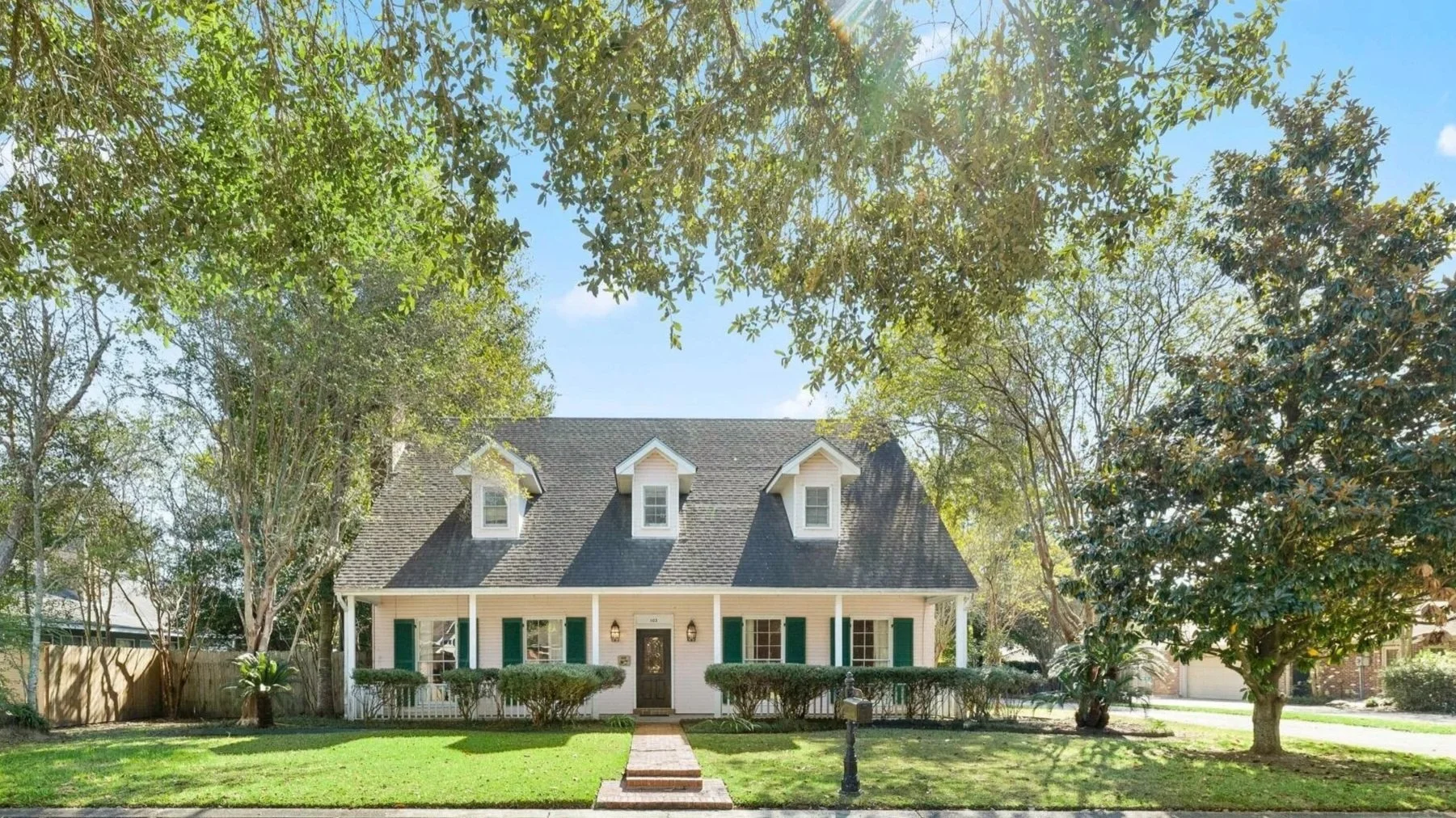
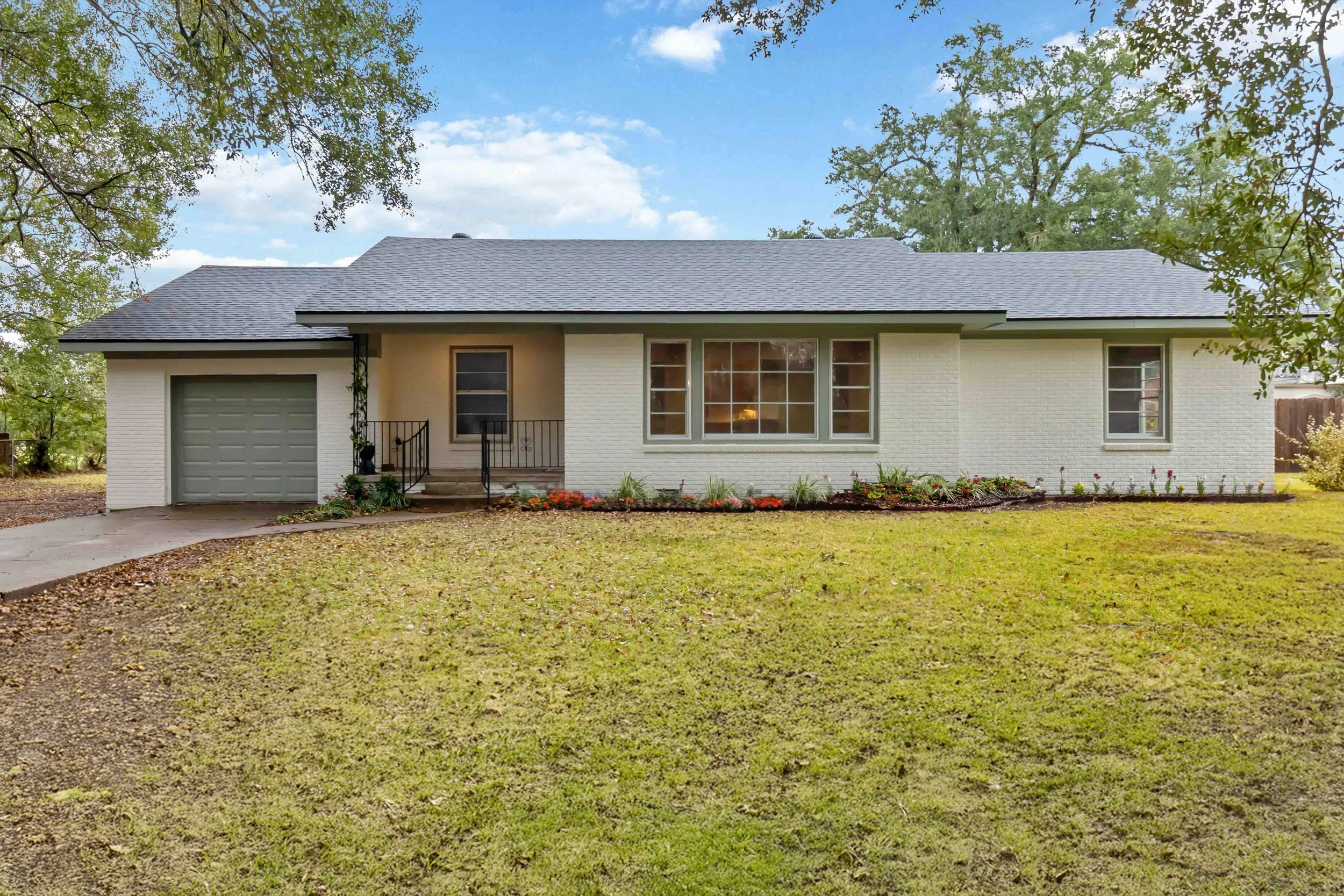
103 Clipper Cove; Photo courtesy of Debbie Green and Compass Real Estate via MLS, used with permission.
Every old house tells you the truth eventually, the question is whether you know how to listen before you sign the closing papers.
“Is this house worth saving, or am I about to set my money on fire?”
I get some version of this question all the time, usually from a buyer standing in the doorway of an older Lafayette home, staring at a crack in the plaster, a sloped floor, or an inspection report that suddenly made the house feel like it belongs in hospice.
The answer nobody wants, but every buyer needs, is this: It depends on what is actually wrong, what only looks wrong, and whether the location is strong enough to support the money you are about to put into it.
That last part matters more than people think.
Good bones are not just about framing, floors, and foundation. Good bones are also location. Neighborhood. Lot. Street. Surrounding values. Long-term upside. A house can have gorgeous original materials and still be a bad buy if the neighborhood cannot carry the renovation. On the other hand, a tired house in the right pocket can be one of the smartest buys in the market, as long as the structure and the math both hold.
And most buyers, understandably, cannot tell the difference yet.
So let’s fix that.
Let’s talk about how to read the bones of an old Lafayette house before you fall in love with the porch, the old floors, or the idea of who you will become once you own a home with old-growth cypress doors and trim.
Which, to be fair, is a very compelling personality shift.
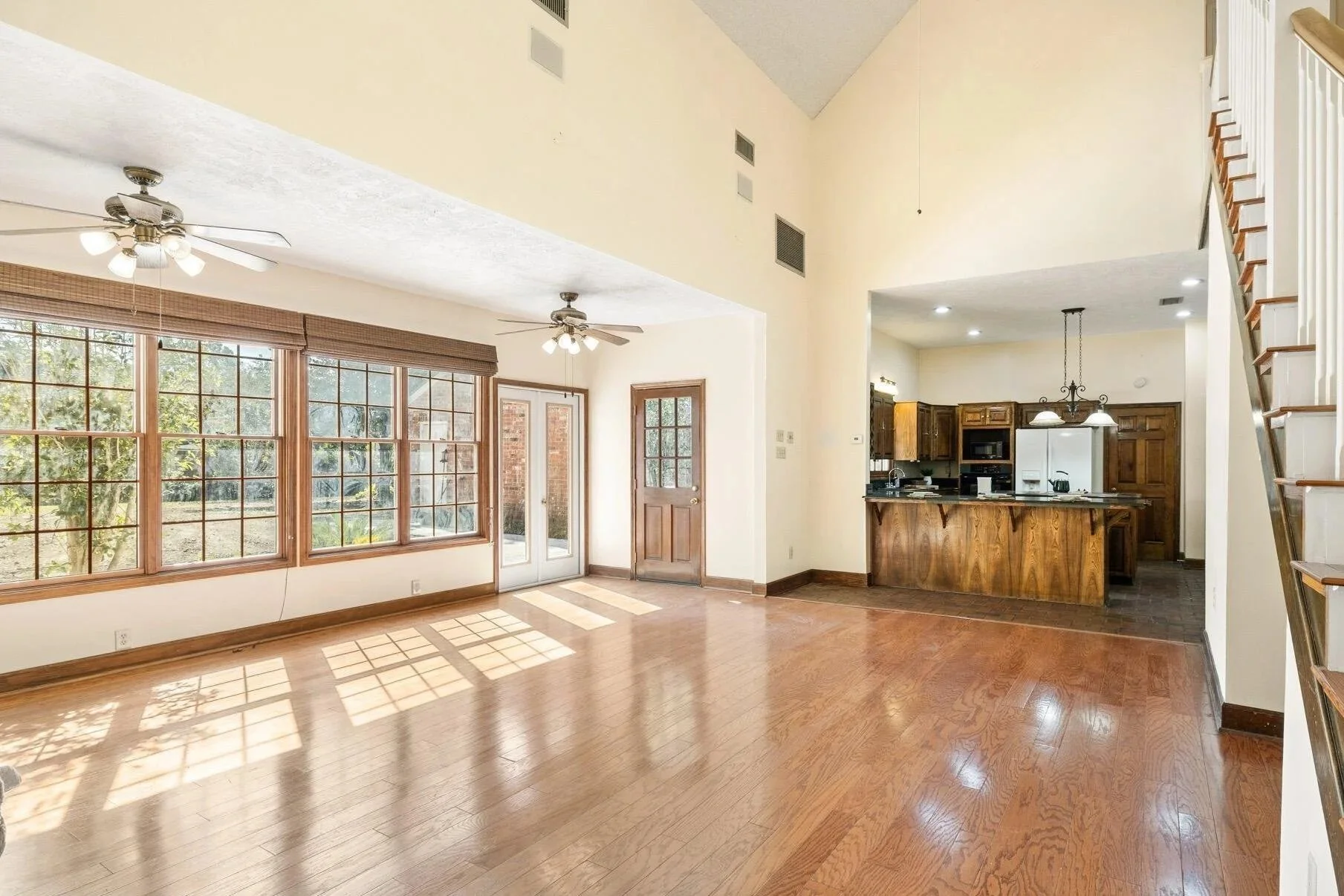
Photo courtesy of Debbie Green and Compass Real Estate via MLS, used with permission.
What “Good Bones” Actually Means
“Good bones” gets thrown around constantly in real estate, but it is not just a cute phrase for a house with pretty windows and old doorknobs.
A house with good bones has underlying value.
That value usually comes from five things:
The structure is fundamentally sound.
The layout, scale, or footprint gives you something worth improving.
The original materials are better than what you could easily buy today.
The location supports the renovation.
The purchase price leaves room for the work.
That is the real test.
A house with good bones does not mean “only needs cosmetic work.” It may need foundation work, a roof, HVAC, insulation, electrical work, full bathroom redos, tree removal, and a full emotional support team. But the important question is whether those repairs are building on something that will be worth more than you spent when the work is done.
A house without good bones is different. That is when the issues are structural, systemic, overpriced, poorly located, or hidden behind fresh listing-photo paint.
In Lafayette, especially in older neighborhoods and established 70508 pockets, you will see both.
You will see homes with real architecture, mature trees, large lots, generous rooms, old-growth materials, and proportions builders do not (and many times cannot) recreate anymore.
You will also see homes that have been patched, neglected, flipped badly, cosmetically dressed up, or in a location that will never support your renovation cost per square foot.
The skill is knowing which one you are standing in.
The House Is Only Half the Bones
This is where buyers get it wrong.
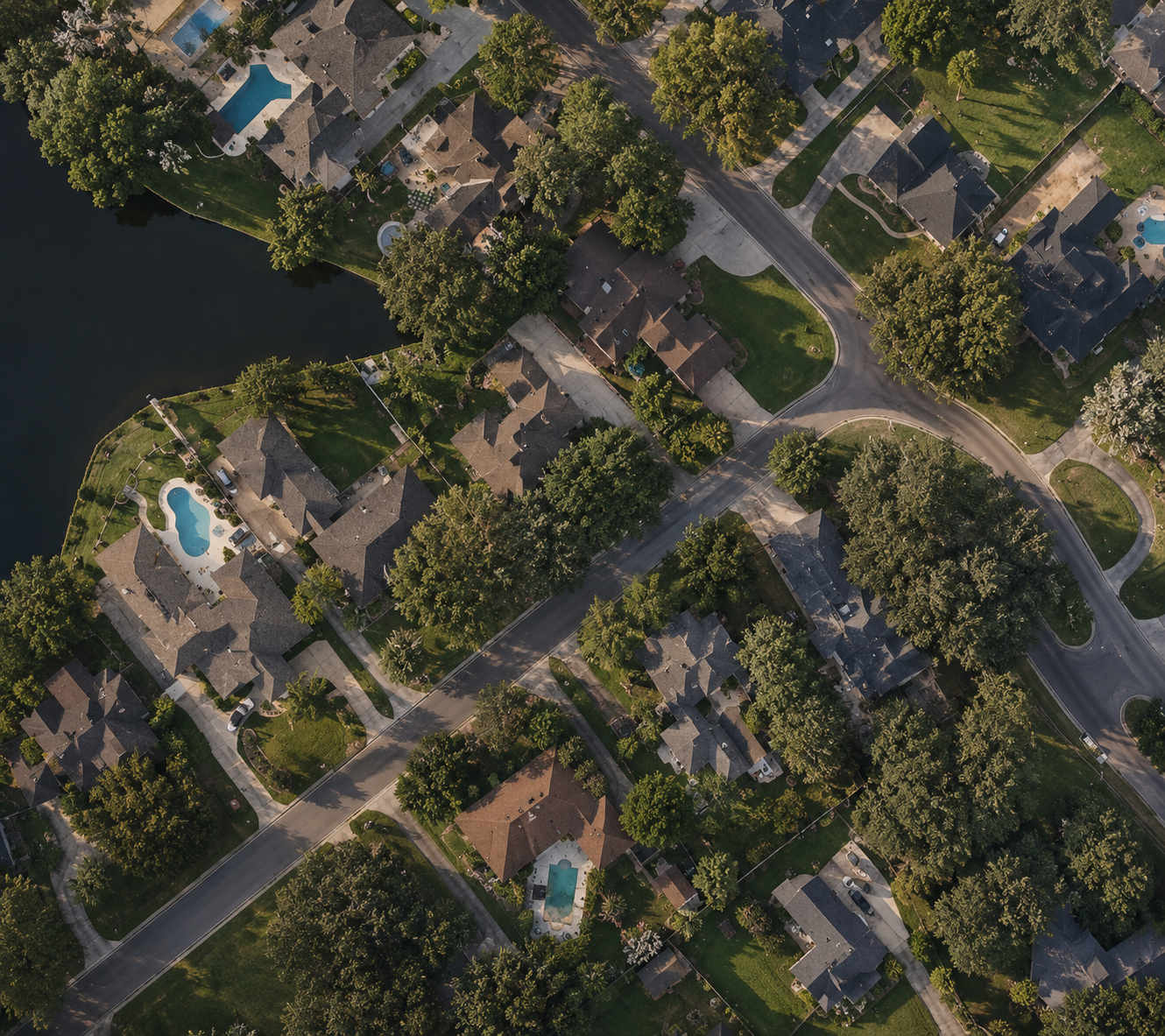
A house can be charming, original, and full of character, but if the neighborhood ceiling is too low, you can easily over-improve it. That does not mean you cannot renovate it. It means you need to be honest about whether the money is lifestyle money or investment money.
There is a difference.
Lifestyle money is what you spend because you want to live beautifully. You fell in love with an old home on a big lot in a low property value neighborhood, but the view of your chickens in the Louisiana sunset can’t be beat and you don’t ever want to move again.
Investment money is what the market is likely to give back to you.
The best old house opportunities are where those two things overlap.
That is why location is not a side note in the “good bones” conversation. It’s the spine.
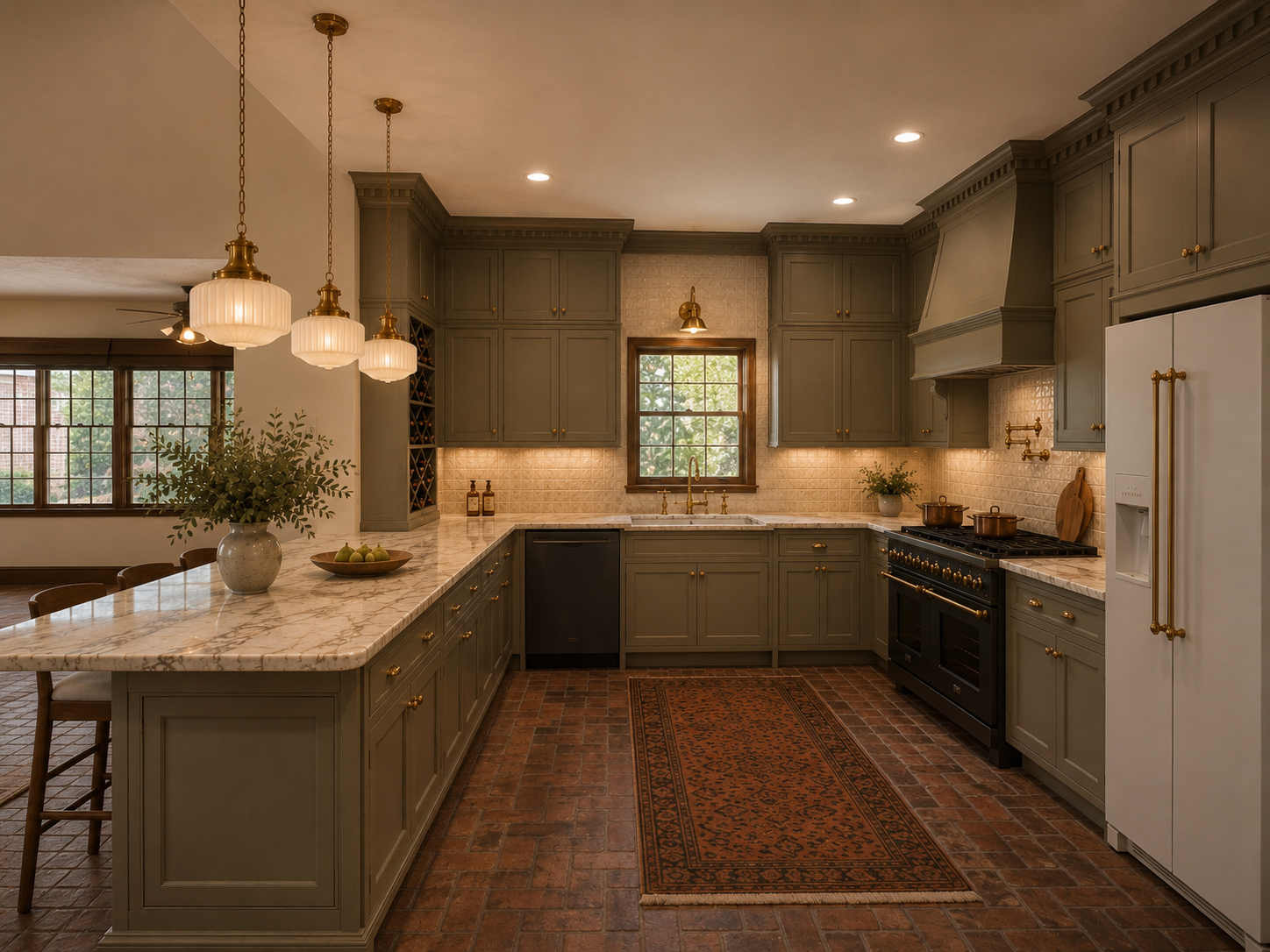
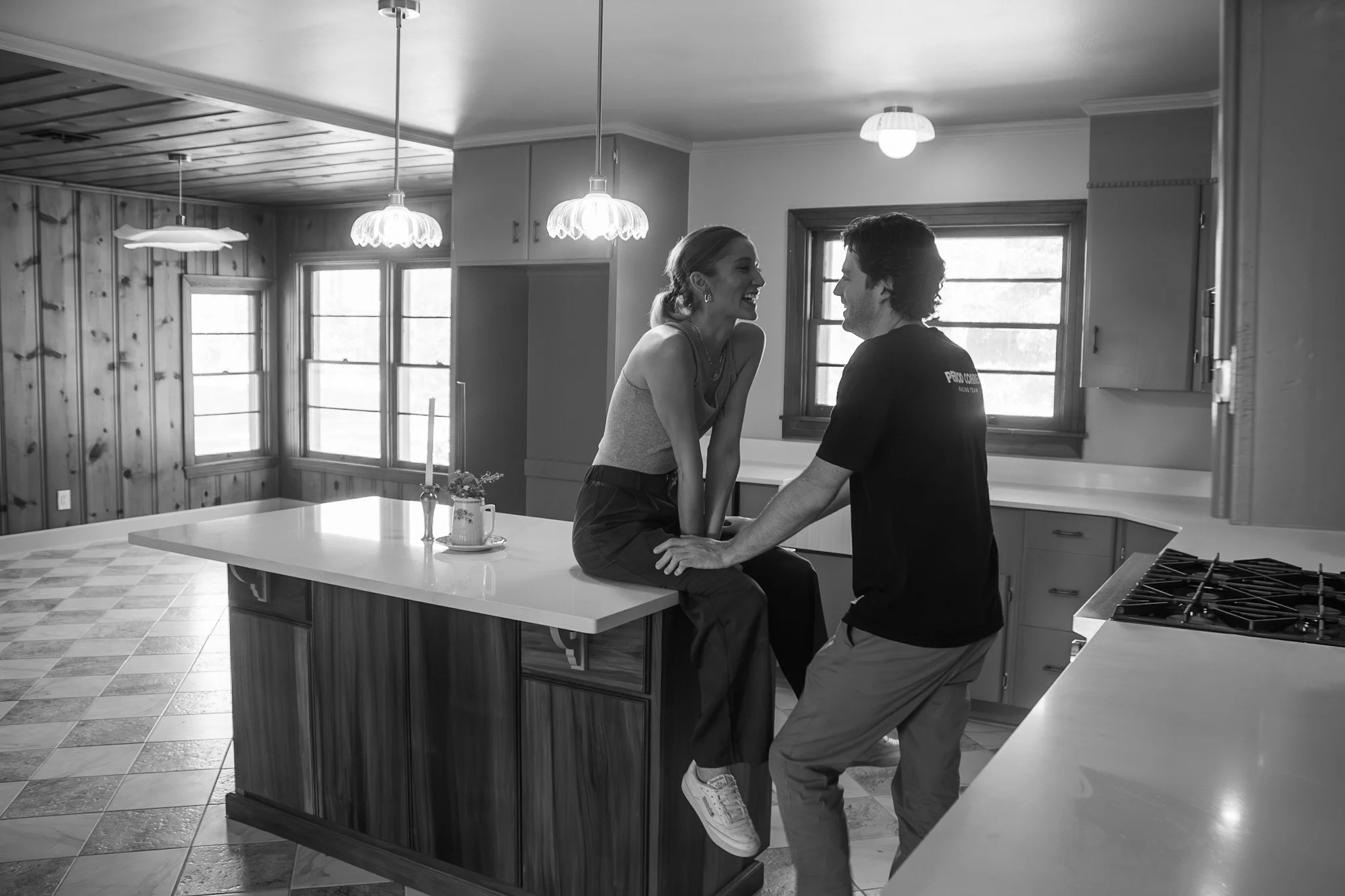
Early reimagination of the kitchen at 103 Clipper Cove c/o Youtsas Real Estate & Design
Where Investment Money and Lifestyle Money Intersect
This is exactly why I look at a house like 103 Clipper Cove differently than I would look at a quick flip.
The point is not to buy it, slap a trendy renovation on it, take listing photos, and sprint back to market. That is not the assignment. The point is to renovate it for life. To make the kind of decisions that hold up, not just the kind that photograph well for thirty seconds online. That changes the math, and honestly, it changes the whole lens.
The value model matters because it keeps the romance honest. In the Clipper model, the purchase price is $330,000, with a $15,000 seller credit bringing the net purchase exposure to about $315,000. The modeled renovation budget is significant, with about $124,410 in structural work and $127,380 in cosmetic work, for a total renovation budget of about $251,790. Once closing costs and carry costs are included, the all-in basis is around $588,540.
That is not a casual number. It is not “paint the cabinets and call it equity.” It is a real renovation budget attached to a real house in a location that can justify doing the work correctly.
The projected renovated value today is around $600k which creates only a modest immediate equity cushion. That is important. The model is not pretending this is some cartoonish quick-flip spread where every dollar magically comes back by Tuesday. The real strength shows up in the longer-term value model, where the projected 5-year value is around $705k using a 3% annual growth assumption. In 10 years? Roughly $820k.
That tells a much more honest story. Clipper is where the lifestyle decision and the investment decision intersect. The renovation makes sense because the location is strong, the neighborhood can support a higher finished value, and the plan is long-term ownership, not a fast resale. The money is not just going into finishes. It is going into structure, function, comfort, design, and durability inside a neighborhood where those improvements have a better chance of being protected over time.
That is the part buyers miss. A renovation for life does not need to behave like a flip. It still needs discipline, but the return is not only measured by what you could sell it for the second the dust settles. It is measured by how the house lives, how well the work holds, how much future maintenance you solved upfront, and whether the neighborhood continues to support the value of what you created.
You can put a $250,000 renovation into almost any house. The market does not have to care. The smartest renovation is the one where the house, the location, and the long-term plan are all saying the same thing.
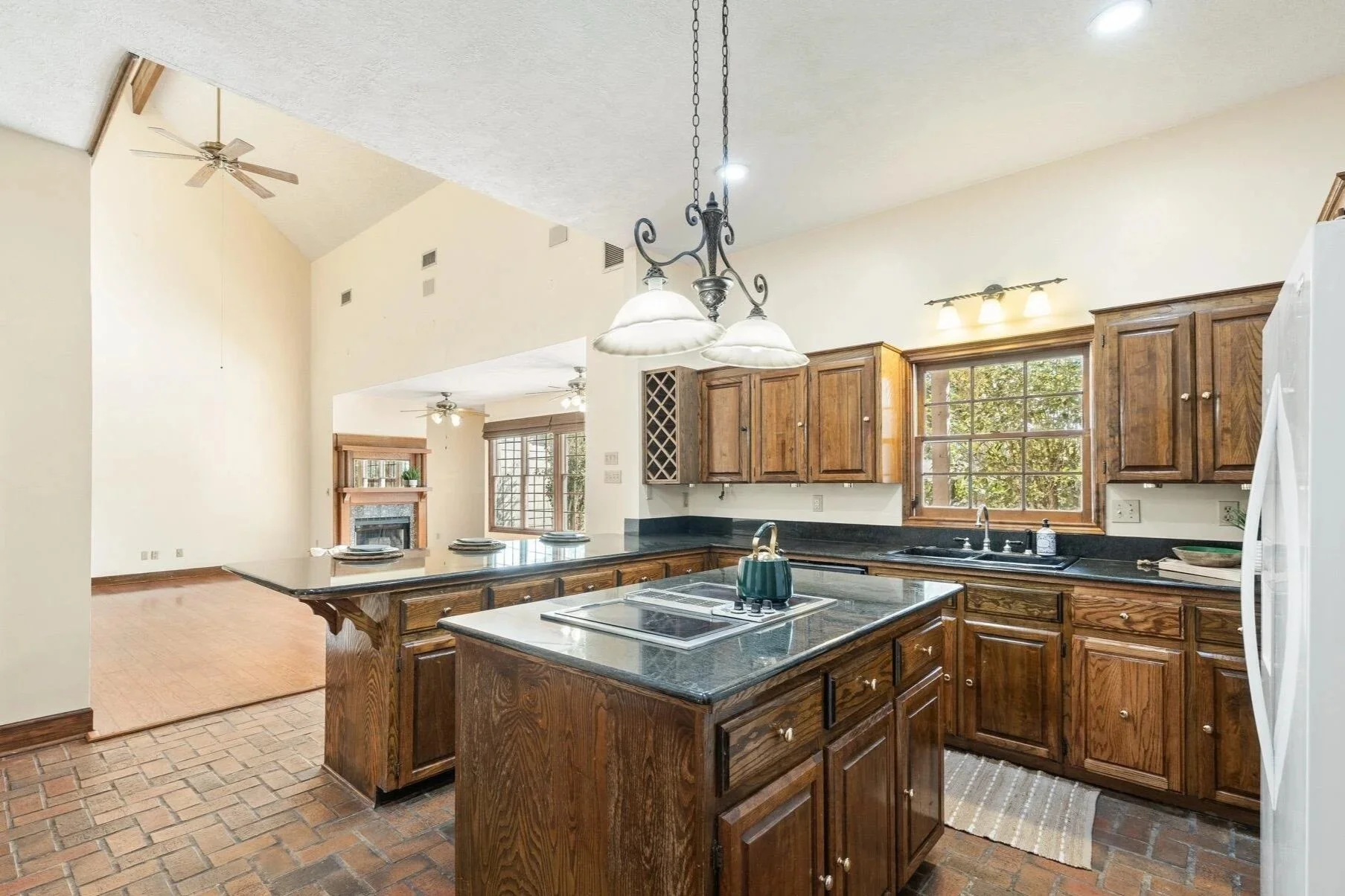
Photo courtesy of Debbie Green and Compass Real Estate via MLS, used with permission.
Cosmetic Damage Lies. Structural Damage Doesn’t.
Peeling paint does not scare me. Dated wallpaper does not scare me. Ugly carpet over hardwood does not scare me. A kitchen stuck in 1994, with fluorescent lighting and cabinets the color of peanut butter, does not scare me.
That is lipstick. Lipstick comes off.
What I care about is everything underneath the lipstick. I care about the foundation, the roofline, the original materials, the systems, the drainage, the quality of past repairs, and whether the house has been neglected in ways that are expensive to undo.
A dated house can be a gift if the expensive parts are understandable and the location is strong. A freshly updated house can be a trap if the pretty parts are covering up problems nobody wanted to price correctly.
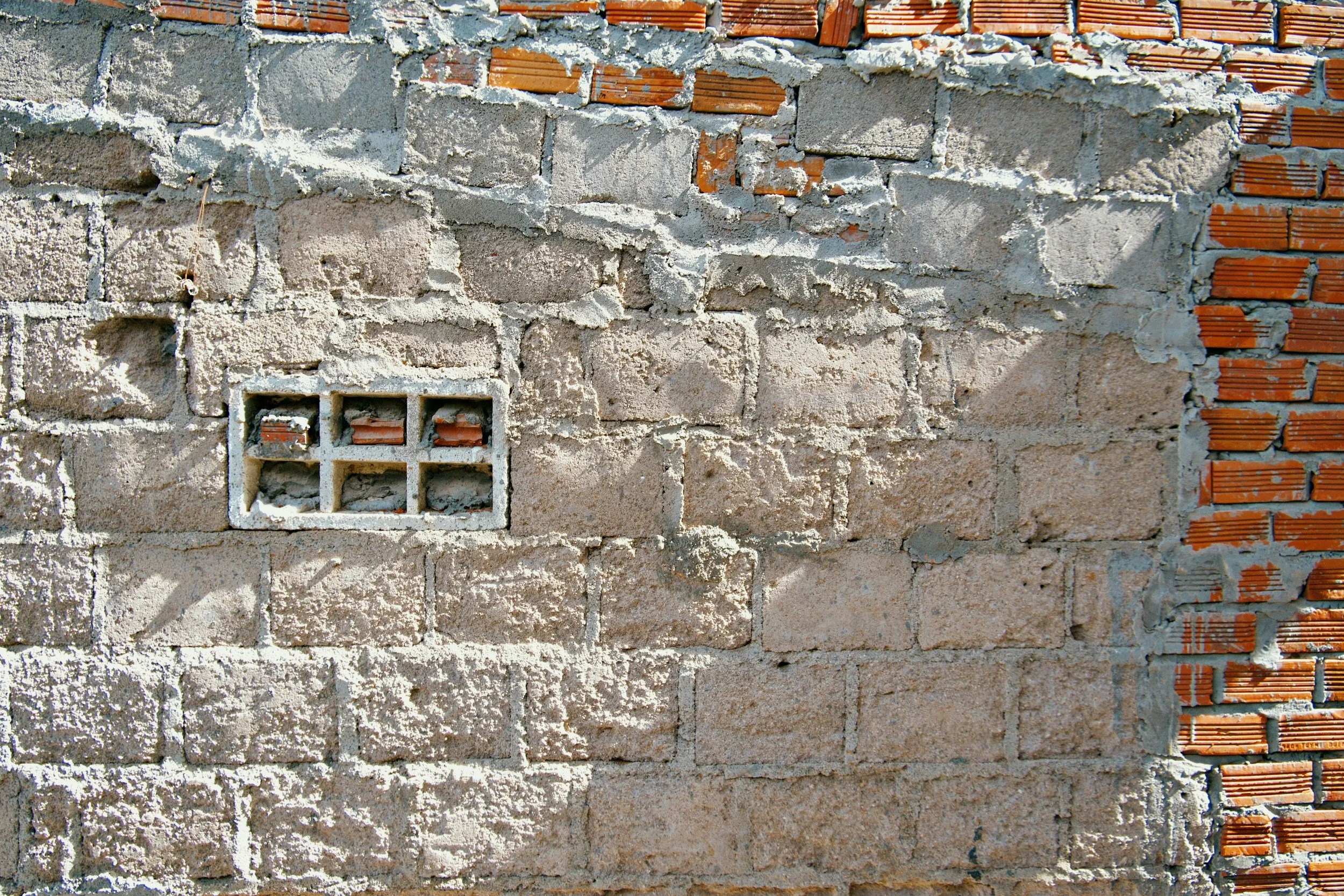
The Foundation
The foundation is one of the first things I pay attention to, but I do not automatically panic the second the word comes up.
That is important.
After the very first showing at Clipper, before anyone got too emotionally attached, I called a foundation specialist who had already been familiar with the house. Not because I was trying to talk myself out of it, but because I wanted to understand the why behind what we were seeing.
That is the part buyers miss.
A foundation issue is not automatically a yes or no. It is a why question.
Why is this happening? Is it old movement or active movement? Is it caused by drainage, trees, soil conditions, poor construction, plumbing, or something structural? Has it changed over time? Is it correctable? Is it being controlled? What would it cost to monitor, repair, or prevent it from getting worse?
Those answers matter more than the existence of the issue itself.
In this case, the concern was not some mysterious, catastrophic failure. The conversation pointed more toward differential settlement connected to trees, soil moisture, and the way the house had moved over time. That is a very different conversation than “the house is falling apart.” It still matters. It still needs evaluation. It still needs to be priced. But it is not the same as running blindly from the word “foundation” because it sounds expensive.
A little settling is normal in an older house. Lafayette soil, age, drainage, humidity, tree roots, and decades of movement all matter. What I want to know is whether the movement has a clear pattern, whether the cause makes sense, whether the right corrective steps have been taken, and whether a specialist can give us a realistic path forward.
That is why I look at doors, windows, floor slope, interior cracks, exterior cracks, drainage, and the relationship between the house and the trees around it. Are the doors and windows hanging square in their frames, or are they fighting gravity? Do interior doors swing open or closed on their own? Are there diagonal cracks above doorways? Does one side of the room visibly slope? Are there trees pulling moisture from the soil near one side of the house? Has anything been done to correct the condition?
A visible slope across an entire room is not something I ignore. But I also do not treat every uneven floor like a death sentence.
Foundation issues are not always dealbreakers. They are always math, context, and cause.
You need to know what is happening, why it is happening, what has already been done, what still needs to happen, and whether the purchase price still makes sense after that number is added back in.
That is the difference between being scared and being informed.

The Roof
A roof tells on a house. I look at the ridgeline, the overhangs, the fascia, the ceilings, the attic if accessible, and any stains that suggest water has been getting in.
Water damage is one of the biggest things buyers underestimate because it often starts quietly. A ceiling stain, a soft spot near a window, a musty smell, bubbling paint, or old patchwork in the attic can all point to deferred maintenance. A roof near the end of its life is not automatically a reason to run, but it is a line item, and should be treated as such.
The problem is not that an old house needs a roof. The problem is pretending it doesn’t.
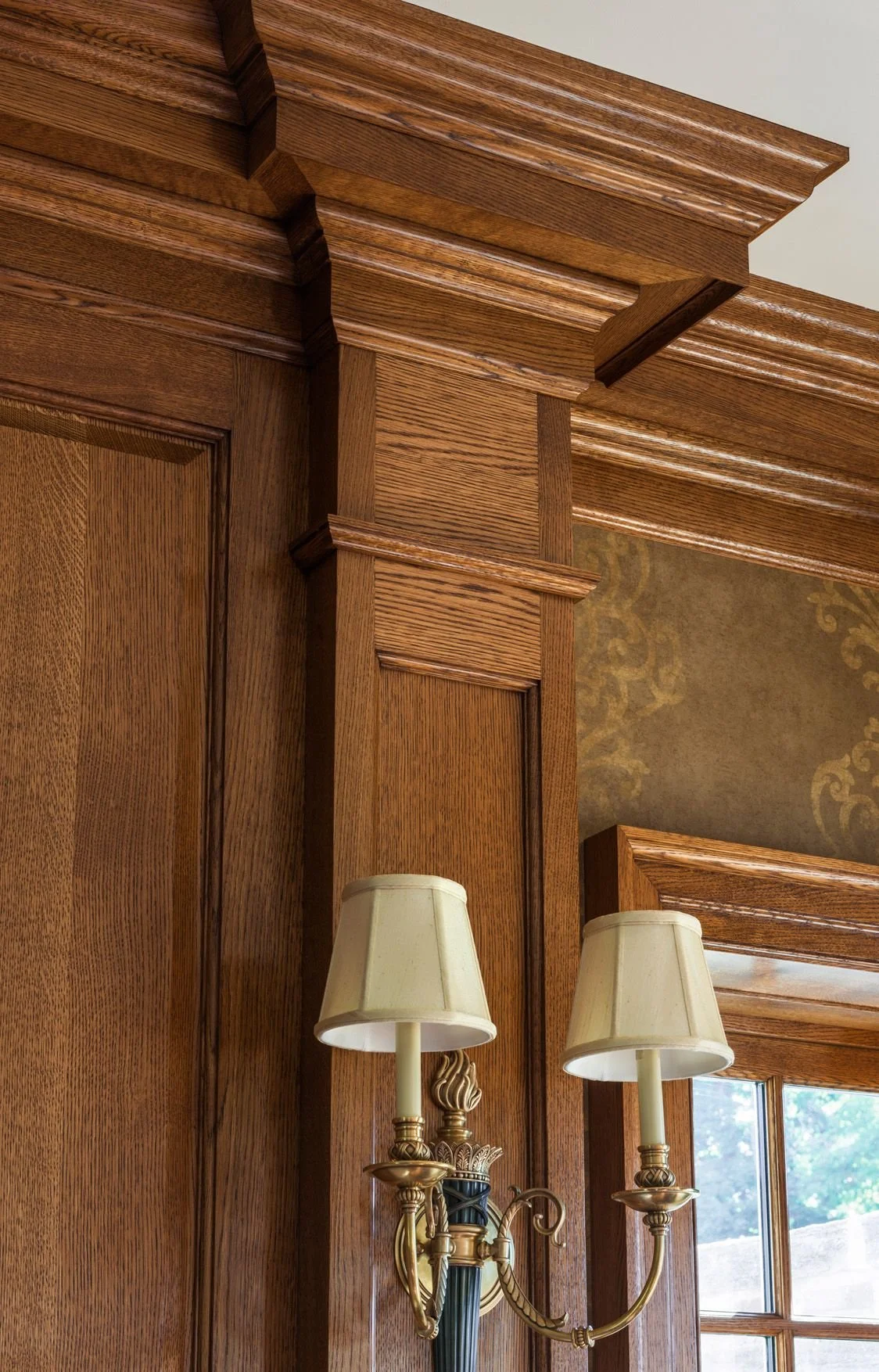
The Original Materials
This is where old homes can be magic. Heart pine floors. Cypress framing. Plaster walls. Solid wood doors. Original trim. Brick fireplaces. Real wood siding. Rooms that feel like they were designed by someone with a soul and not just a subdivision spreadsheet.
This is the good stuff.
Old-growth wood is often denser, straighter, and more rot-resistant than many materials used today. You’ll often find a home constructed of 6×8s instead of 2×4s, which to put in perspective, means you have more than 4 inches of wood rot in every direction before your home is less structurally sound than a new build. When those materials are still solid, you are not fighting the house. You are restoring it. That distinction matters.
A tired house with quality original materials can often be brought back beautifully. A house that has had every original detail ripped out and replaced with cheap updates might photograph “clean,” but it may have lost the thing that made it valuable in the first place.
As a designer, I would rather start with honest original character than a bad flip almost every time.
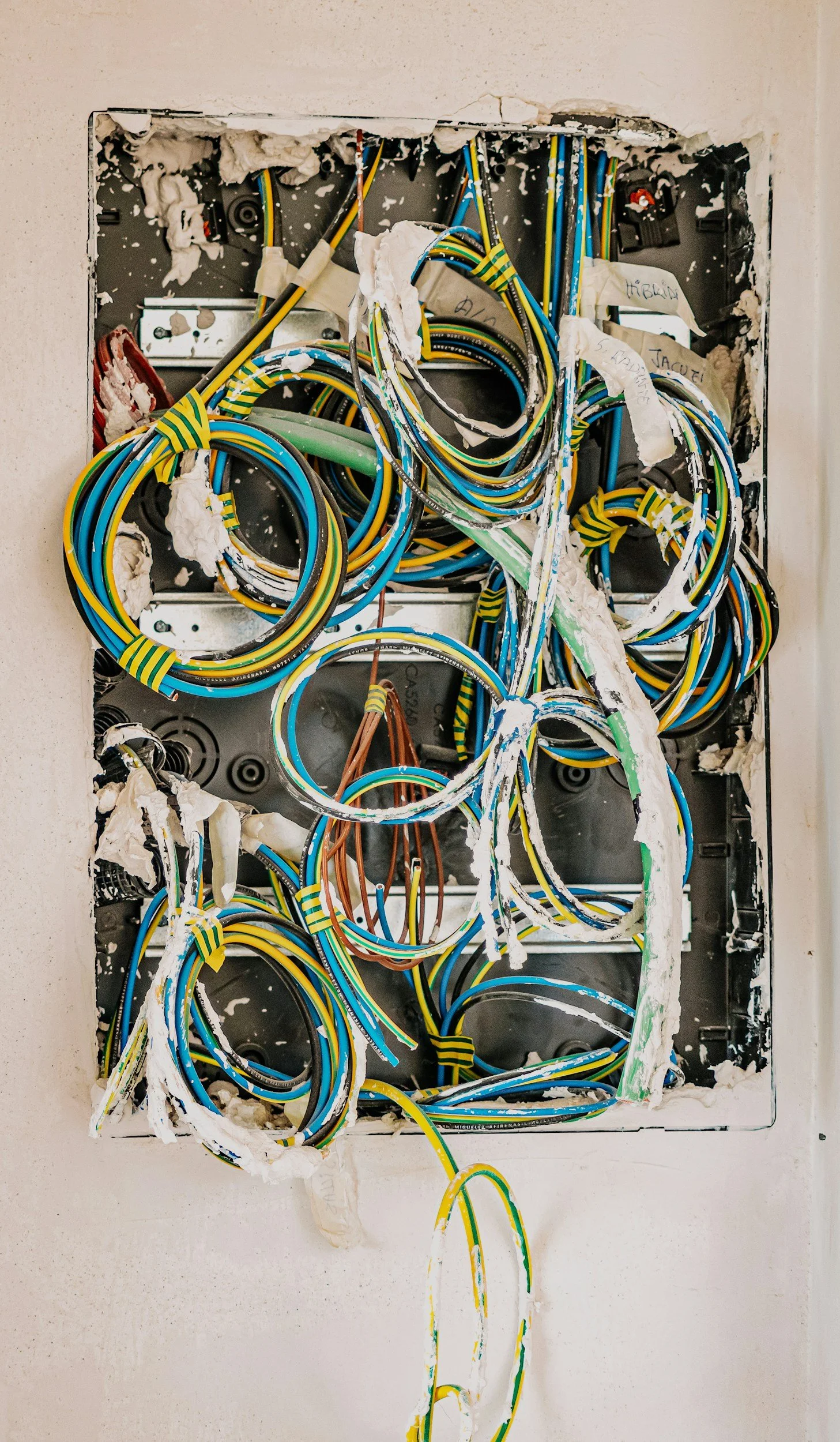
The Systems
Plumbing, electrical, HVAC, drainage, and roof condition are not sexy, which is exactly why they matter. Outdated wiring, old cast iron, aging HVAC, roof leaks, poor drainage, and questionable DIY work are not always dealbreakers, but they are automatically line items.
This is where buyers need to be especially careful. A charming house with outdated systems may still be a great buy if the price supports the work, but you need real numbers before you fall in love with the crown molding.
Systems are also where “renovating for life” becomes different from renovating for resale. A quick flip might prioritize visible finishes because visible finishes sell. A life renovation has to care about what is behind the walls, above the ceiling, under the floor, and outside the foundation. It is less glamorous, but it is also the difference between a house that simply looks done and a house that actually lives well.
Home Triage: Is the House Broken, or Is It Just Tired?
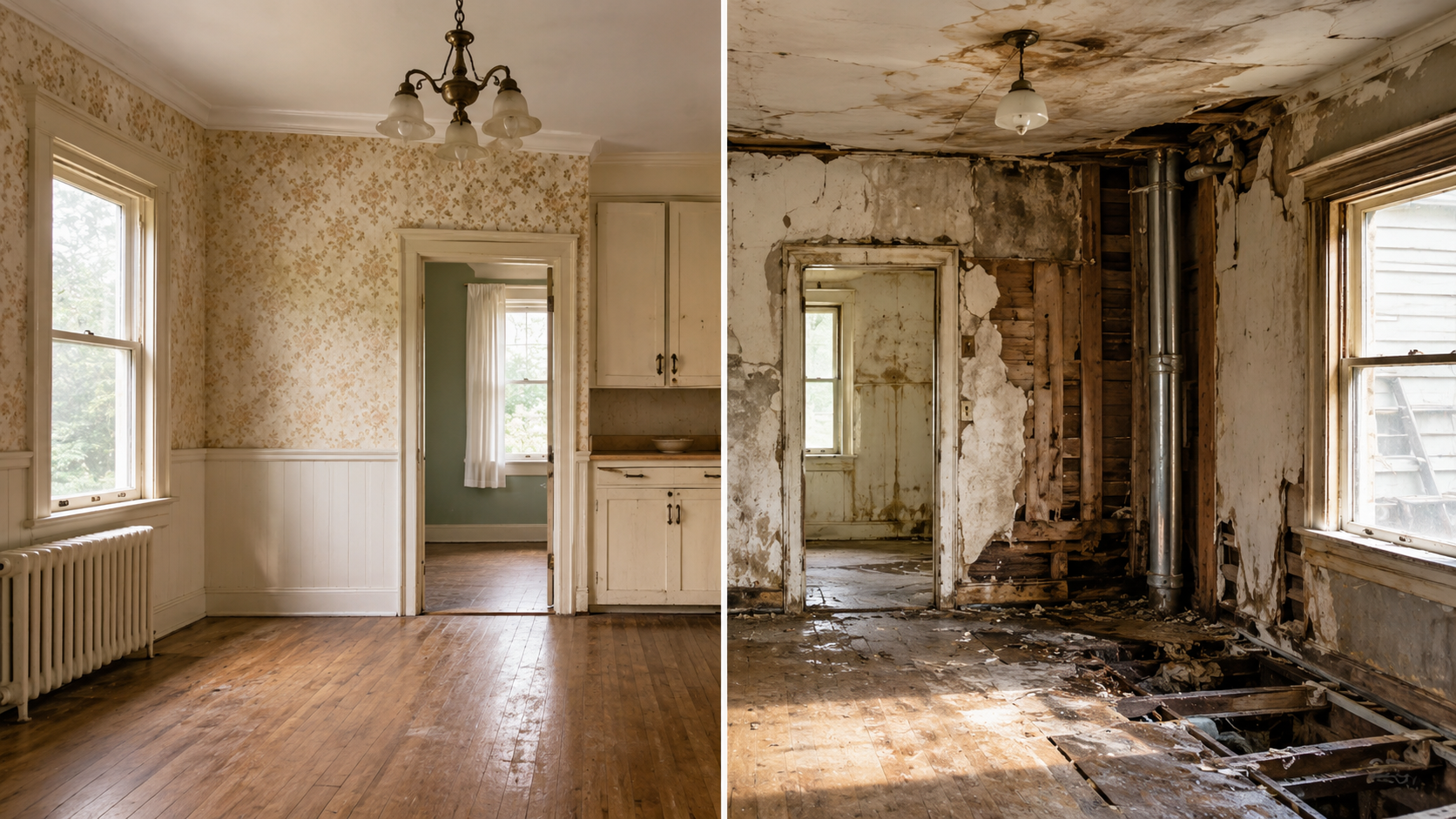
I use a simple filter with clients: is this house broken, or is it just tired?
A tired house needs attention, money, patience, and a plan. A broken house needs an engineer, a specialist, and a much harder conversation about whether the deal still makes sense.
A tired house may have old paint, bad lighting, worn floors, dated fixtures, neglected landscaping, an awkward kitchen, and bathrooms that look like they were designed during a beige shortage. A broken house has active water intrusion, major structural movement, unsafe electrical, failing plumbing, termite damage, roof failure, severe drainage issues, or years of neglect hidden behind cosmetic updates.
A tired house in a strong neighborhood can be an opportunity. A broken house in a strong neighborhood might still be an opportunity, but only if the price is deeply honest. A tired house in a weak location is usually just expensive wishful thinking.
That is why the neighborhood has to be part of the home triage.
Reading the Report
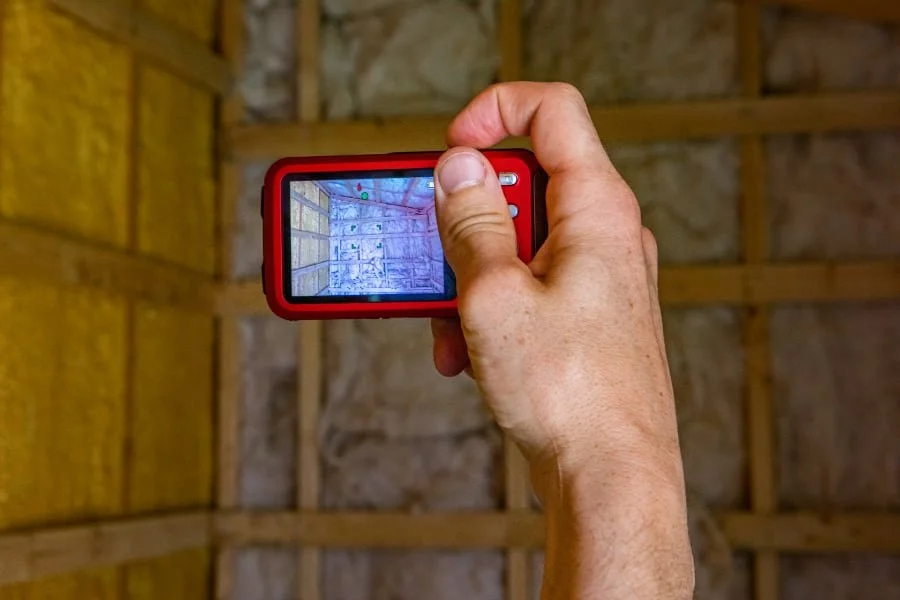
Inspection reports are important. They are also deeply unromantic.
An inspection report is not written to make you feel calm. It is written to document defects, reduce liability, and tell you everything the inspector observed, from “possible structural movement” to “missing outlet cover in bedroom.” Useful? Yes. Emotionally soothing? Absolutely not.
This is where buyers spiral. They see words like moisture, settlement, fungal growth, deficient, corrosion, end of useful life, structural movement, organic growth, improper slope, and further evaluation recommended, then suddenly the house feels like it needs to be taken behind the barn.
But inspection language needs translation. A scary word does not always mean a catastrophic problem. Most of the time, it means, “Pay attention here.” That is different.
“Settlement” sounds terrifying because nobody wants to hear that a house has moved. But some settlement is normal, especially in older homes. The question is whether it is minor, historic, active, or severe. Minor old movement may be manageable. Active movement needs specialist evaluation. Major movement needs pricing before you proceed.
“Moisture intrusion” means water is getting somewhere it should not be. That could come from a roof leak, flashing issue, plumbing leak, poor grading, window leak, drainage issue, or condensation. The word itself is not the full story. The source is the story.
“Organic growth” is inspector language for visible growth that may be mold or mildew, but the inspector is usually not making a laboratory diagnosis. It means moisture is or was present. You need to know why, how long it has been happening, and whether affected materials need cleaning, removal, or repair.
“Deferred maintenance” is the polite way of saying the house has been asking for help and everyone has been pretending not to hear it. Deferred maintenance can be minor or expensive. Old caulk, worn paint, clogged gutters, aging systems, and neglected exterior wood can all fall into this category.
“End of useful life” does not always mean something is dead today. It means the system or component is old enough that you should budget for replacement soon. This is common with roofs, HVAC systems, water heaters, appliances, and exterior materials.
“Further evaluation recommended” usually means the inspector saw enough to flag the issue, but you need a specialist to price or diagnose it. Foundation specialist. Roofer. Electrician. Plumber. HVAC contractor. Structural engineer. Pest professional. The general inspector found smoke. Now you need the right person to tell you whether there is fire.
“Structural movement” is one of the bigger phrases. It can mean anything from old settling to serious active movement. The pattern matters. The severity matters. The cost matters. This is not where you guess. You price it.
“Improper drainage” or “negative grading” means water may be moving toward the house instead of away from it. In South Louisiana, this matters a lot. Drainage is not landscaping. Drainage is house protection.
“Evidence of previous repairs” can be good or bad. A previous repair may mean someone addressed an issue properly. It can also mean someone patched over a recurring problem. Ask who did it, when it was done, whether it solved the issue, and whether there is documentation.
“Termite damage” or “wood-destroying insect evidence” is serious, but not automatically a dealbreaker in Louisiana. What matters is whether activity is active or old, whether the damage is cosmetic or structural, and whether the home has treatment history or a current termite contract.
The inspection report is not there to make the decision for you. It is there to tell you what questions to ask next.
Do not read it like a lab result. Read it like a budget outline.
The goal is not to find a perfect house devoid of defects. The goal is to sort what you are seeing into categories: safety, big-ticket systems, maintenance, and cosmetic.
Safety items are the things that matter immediately: electrical hazards, structural concerns, major plumbing leaks, gas issues, missing railings, unsafe stairs, serious roof leaks, and active water intrusion.
Big-ticket systems are the things that affect budget and negotiation: roof, foundation, HVAC, plumbing, electrical, drainage, windows, and insulation.
Maintenance items are the normal homeowner realities that still cost money: caulking, minor wood rot, gutter issues, small leaks, worn components, aging appliances, exterior paint, and small repairs.
Cosmetic issues are usually the least scary, even though they are often the first things buyers notice: paint, wallpaper, dated tile, old fixtures, worn finishes, ugly cabinets, and flooring preferences.
Once you organize the report this way, it becomes much less emotional. You stop seeing a haunted document full of doom words and start seeing a list of decisions.
That matters even more in Lafayette, because our houses live a hard life. Humidity, rain, drainage, termites, heat, soil movement, aging HVAC systems, roof wear, and additions that may or may not have been done with the kind of care one would hope for all matter here. Greenbriar, Bendel Gardens, Girard Park Circle, Fernewood, The Settlement, Ivanhoe, and the E Bayou/W Bayou areas are full of houses with real potential, but they need sharper evaluation because South Louisiana does not exactly go easy on a structure.
None of that means old houses are bad investments. It means the inspection period matters. It means the scary words need context. It means you bring in the right specialists, price the real issues, and separate what is ugly from what is expensive.
An old house is not the risk. An old house you did not evaluate correctly is the risk.
Questions Worth Asking Before You Get Attached
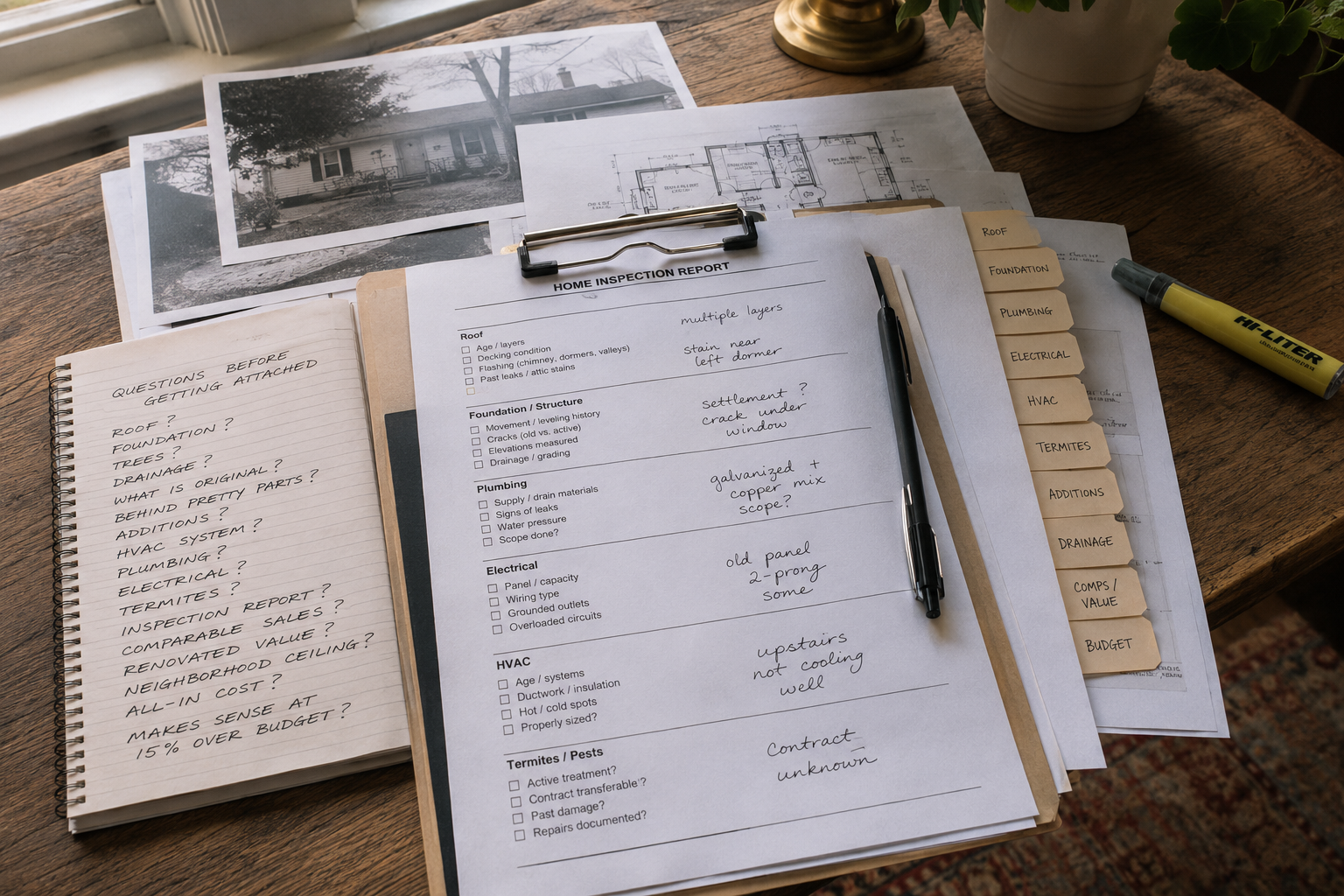
Before you start picking paint colors in your head, and I say this with love because I do it too, ask better questions.
Not just the obvious ones. Not just “how old is the roof?” and “has the AC been updated?” Those matter, but they are only the first layer. With an older house, especially one in Lafayette, the better questions are usually more specific, more annoying, and much more useful.
Ask how the roof is aging, not just when it was replaced. Are there multiple layers of shingles? Is the decking solid? Are there old leak stains in the attic that line up with current roof penetrations? Was flashing replaced properly around chimneys, dormers, valleys, and additions, or did someone just reshingle over old problems and call it a day?
Ask what kind of foundation movement exists and why. Has the house been leveled before? If so, by whom, when, and what exactly was done? Is the movement consistent with soil, trees, drainage, age, or something more concerning? Are cracks old and stable, or are they showing signs of active movement? Has anyone measured the elevations, or are we all just standing in the dining room saying “it feels a little sloped” like that is a structural report?
Ask what the trees are doing to the house, because in South Louisiana, mature trees are both the romance and the villain. Are roots affecting the foundation? Are large trees pulling moisture from one side of the house? Are limbs overhanging the roof? Is the shade helping with heat load but hurting roof life? Were trees removed recently, and if so, has the soil had enough rainy seasons to respond?
Ask whether the drainage is actually working. Does water move away from the structure, or does it sit near the slab, piers, or crawlspace? Are gutters present, clean, and directed somewhere useful? Does the lot slope toward the house? Are there low points near additions? Has anyone looked at the property after a hard rain, or are we judging drainage from a sunny showing at 2 p.m. like amateurs?
Ask what is original, what is worth saving, and what has already been ruined. Are the floors true old hardwood, and is there enough wear layer left to refinish them? Is the trim original or replacement? Are the doors solid wood? Are the windows repairable, or are they failing beyond reason? Is the old material an asset, or is it so damaged that restoration becomes more fantasy than plan?
Ask what is behind the pretty parts. If a kitchen or bathroom was updated, was plumbing moved? Was electrical brought up with it? Were walls opened? Were permits pulled? Was the work done by licensed trades, or does it just look fine because someone used decent tile and good lighting?
Ask how the additions were tied into the original house. This is a big one that average buyers almost never think about. Was the roofline properly integrated? Does the addition have the same foundation type? Does it heat and cool correctly? Are there weird floor transitions, ceiling height changes, drainage problems, or cracks where old meets new? Bad additions are where houses quietly collect expensive little sins.
Ask how the HVAC is actually serving the house, not just how old the units are. Are the systems sized correctly? Is the ductwork intact, insulated, and routed well? Are there hot rooms, cold rooms, dead zones, or additions that never got proper airflow? Is the equipment old, or is the whole design bad? There is a difference between replacing a unit and correcting a system that was never really working.
Ask what kind of plumbing you are inheriting. Is it cast iron, galvanized, copper, PEX, PVC, or a thrilling little buffet of every era? Are drain lines original? Has a camera scope been done if there are concerns? Are there signs of slow drains, patched slab leaks, old water stains, or moisture near bathrooms and kitchens? Plumbing is not the place to be charmed by vintage.
Ask the same of electrical. Has the panel been updated? Are outlets grounded? Is there old cloth wiring, aluminum wiring, knob-and-tube remnants, double-tapped breakers, overloaded circuits, or mystery switches that control the emotional state of the house but nothing else? Does the electrical support modern living, or are you about to ask a 70-year-old system to handle two refrigerators, a hair dryer, and your delusions?
Ask about termites like someone who understands where we live. Is there active treatment? Is there a termite contract? Is it transferable? Has there been prior damage? Was the damage cosmetic, structural, or unknown? Were repairs made, and can anyone show you what was replaced? In Louisiana, “termite history” is not automatically a dealbreaker. Unclear termite history is the problem.
Ask what the inspection report is pointing toward, not just what it says. If it says “further evaluation recommended,” who is the right specialist? If it says “moisture intrusion,” where is the water coming from? If it says “settlement,” what is causing it? If it says “end of useful life,” is that a negotiation item, an immediate replacement, or a future budget line?
Then ask the money questions, because like it or not, a renovation is nothing more than a complex math problem.
What are the strongest nearby comparable sales, and are they actually comparable? Same neighborhood? Same school zone? Same size range? Same lot size and quality? Same level of renovation? Same architectural appeal? A renovated house across town is not your comp just because it also has quartz and a cute powder bath.
What is the realistic renovated value, not the emotional one? What will the market support if the house is renovated well, but not overbuilt? Is there a ceiling in this neighborhood? Are buyers in this pocket paying for design, lot, square footage, updates, location, or all of the above?
Does the neighborhood support the renovation budget, or are you about to create the most expensive house on the wrong street? Is the location strong enough to protect the money you are putting in? Are surrounding homes maintained enough to help your value, or will your renovation be doing all the heavy lifting alone?
What is the true all-in cost after purchase price, closing costs, repairs, cosmetic renovation, structural work, inspections, carry costs, contingency, and the little things nobody wants to count because they are inconvenient?
And finally, the question nobody enjoys: would the finished house still make sense if the renovation runs 15% over budget?
That question is rude. Ask it anyway.

The Renovation Math Has to Match the Story
A house can be beautiful and still not make financial sense. A house can be ugly and still be a great buy. That is why the math matters.
For a house like Clipper Cove, the model does not work because the house is flawless. It works because the house is in a strong enough location to justify serious improvement, and because the long-term plan supports an ARV high enough to justify doing the work properly instead of cheaply.
That distinction matters. If this were a quick flip, the margin would need to be larger upfront. The renovation choices would need to be tighter, faster, and more resale-neutral. Every dollar would be judged by how quickly it could come back at sale.
But when the plan is to renovate for life, the value model works differently. The house still needs financial discipline, but the return is not only resale margin. It is also livability, durability, comfort, avoided future maintenance, neighborhood protection, and the ability to make design decisions with a longer shelf life. It also puts the buyers’ happiness, preferences, and comfort as an unofficial line item on the budget.
That does not mean “spend whatever, it is for us.” That is how people accidentally become emotionally attached to financial chaos. It means the budget should be intentional. Spend where the house, the neighborhood, and the long-term ownership plan justify it. Be careful where they do not.
The strongest renovation decisions sit right in the middle: beautiful enough to feel personal, disciplined enough to protect the investment (and your bank account).
When an Old House Is Worth Saving
Are you still with me?? It’s finally time to discuss what you actually came here to find out.
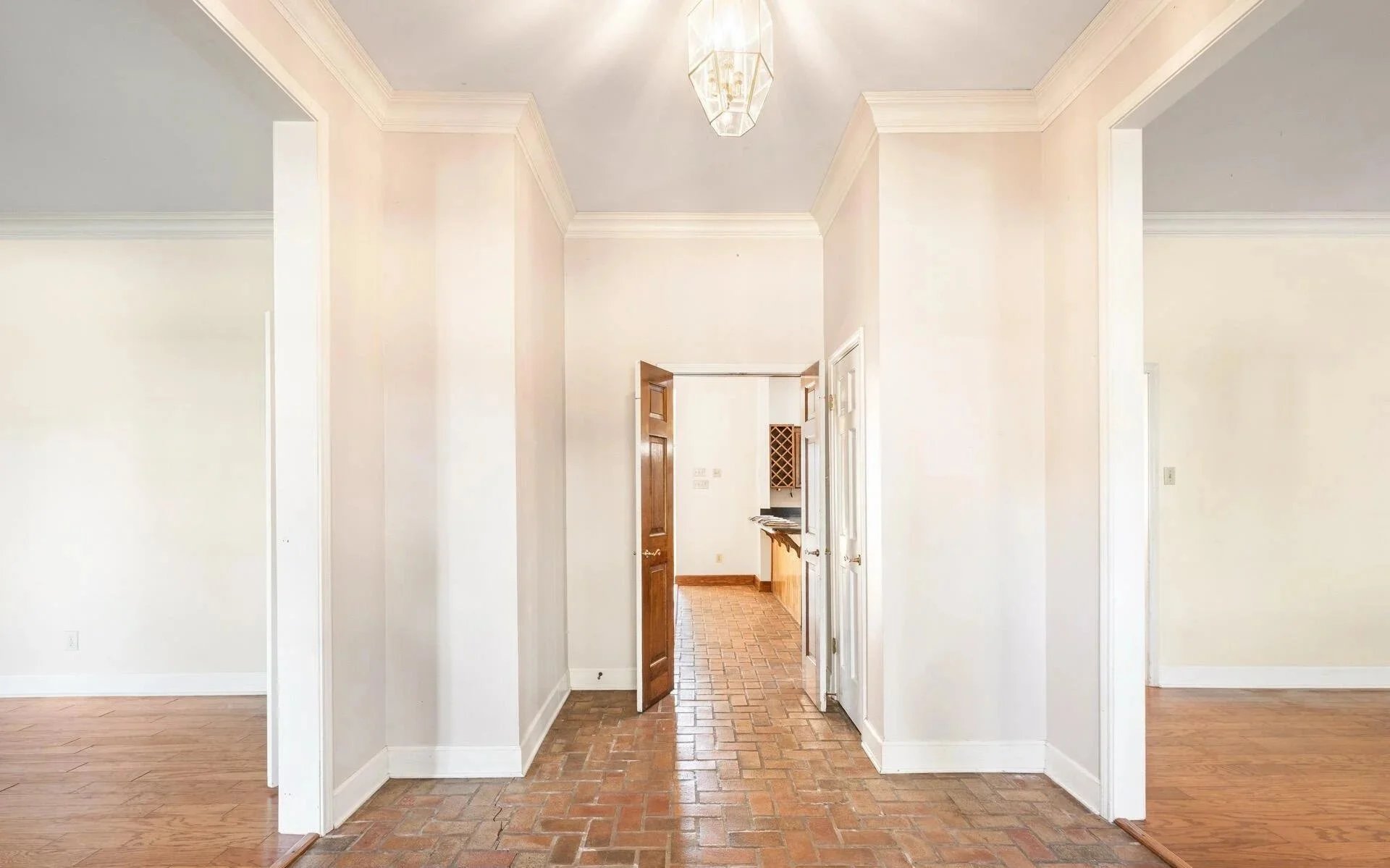
An old Lafayette house is usually worth serious consideration when the structure is fundamentally sound or fixable, the roof and water issues are identifiable, the original materials are worth preserving, the floor plan has real potential, the neighborhood supports the after-renovation value, and the purchase price leaves room for repairs.
The finished home should be able to compete with surrounding sales without becoming the most over-improved house on the street. The inspection issues should be priceable. The renovation should make sense for the way you actually plan to live, not just for the version of you who has never had to source a backordered faucet during drywall week.
That is the kind of old house that can reward you. Not because it is perfect, but because it is worth the work. There’s likely one of you working purely from a spreadsheet and one of you working purely from a gut feeling. The truth is this: you’re both right. For a renovation like this one, it’s best to work from where the numbers and feelings intersect.
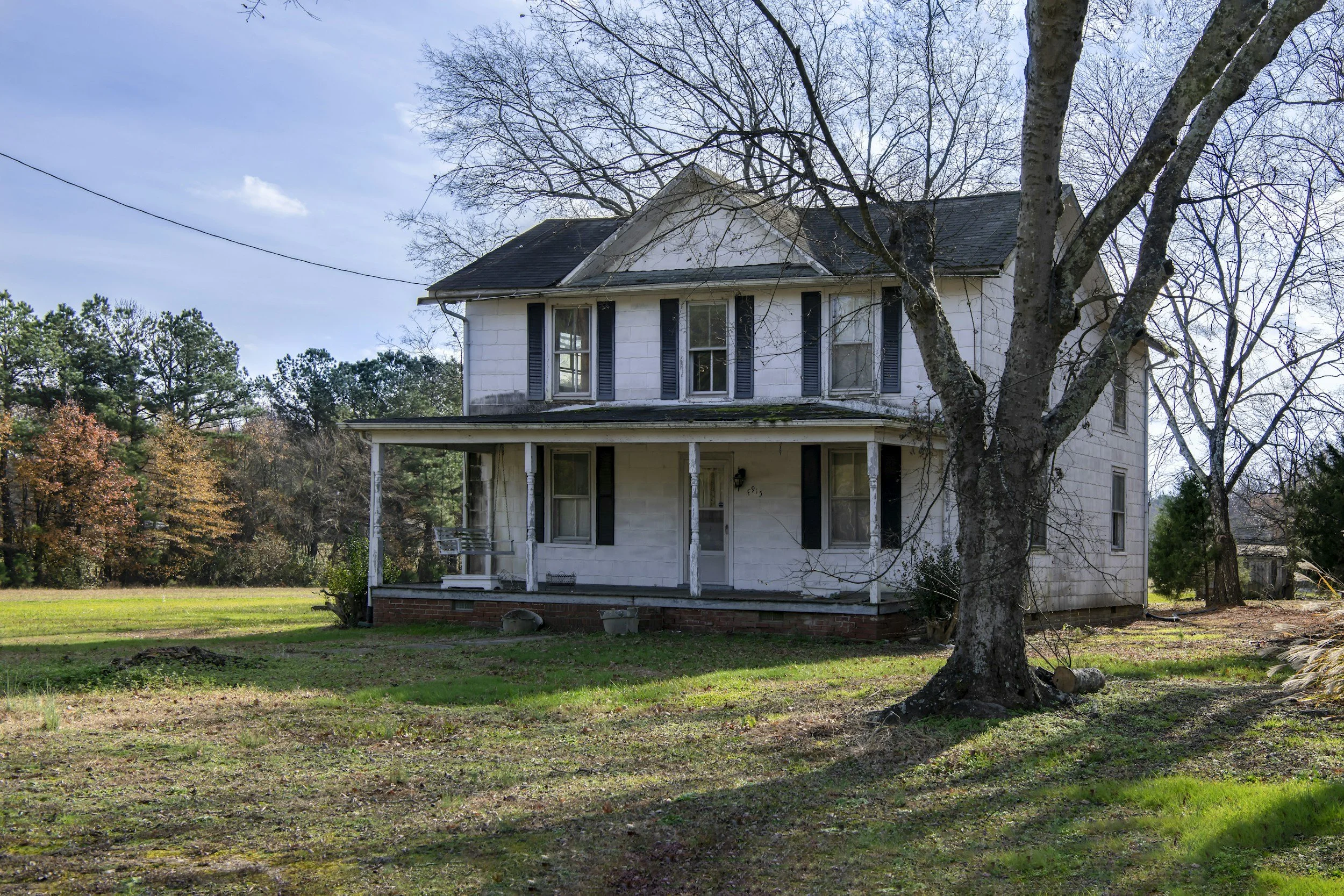
When You Should Walk Away
Sometimes the best renovation decision is not to renovate.
Or at the very least, not yet.
This is the part people love to skip because it is emotionally exhausting, but walking away is sometimes the thing that keeps a good house from becoming a bad decision. If the cost to make a house safe, dry, level, functional, and beautiful destroys the financial logic of the purchase, the answer is not to squint harder at the potential. The answer is to stop.
And we did…
…Twice.
There were points in this process where the house still had the bones, the location still made sense, and the long-term vision was still there, but the numbers did not support the risk. So we walked. Not because the house was not worth saving, not because we wanted to “play hardball,” but because it was not worth saving at the price.
That distinction matters.
A house can have character, mature trees, a strong neighborhood, good proportions, and real upside, and still be the wrong deal if the seller is not acknowledging the work. Foundation questions, roof life, HVAC, drainage, plumbing, electrical, termites, cosmetic renovation, closing costs, carry costs, and contingency all have to live somewhere in the math. They do not disappear because the house has good light.
Getting to a number that made sense took hard work, uncomfortable conversations, tough negotiation, and actual evidence. Not vibes. Not “we just feel like it needs work.” Evidence. Inspection findings. Specialist opinions. Repair estimates. Comparable sales. Renovation modeling. Four separate excel workbooks with supporting quotes, multi scenario valuations, and comps going back 10 years to support trend estimates. A clear argument for what the house could be, but also what it would realistically cost to get it there.
That is what changed the conversation.
The goal was never to “win” at someone else’s expense. The goal was to get to a place where the risk, the repairs, the price, and the long-term value made sense for everyone. Eventually, after walking away when we needed to and coming back with a stronger, better-supported position, we got there.
That is the real lesson.
Character is valuable, but character does not cancel math. Potential is powerful, but only if the price respects the work. Sometimes the smartest thing you can do for a house you love is be willing to leave it on the table until the numbers tell the truth.

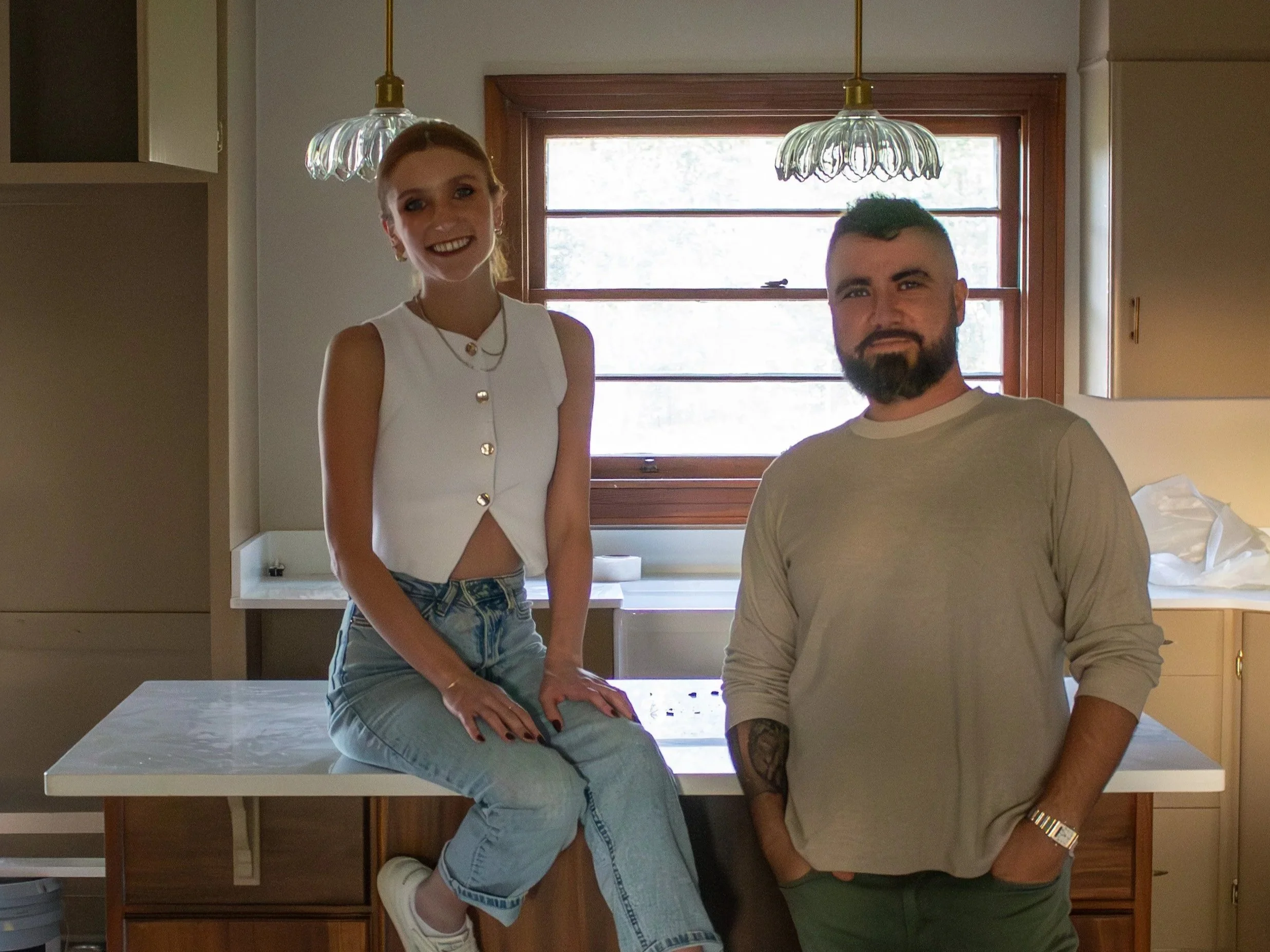
Kristen and Alex Chauvin with their 2 beautiful boys, Preston and John Douglas
Final Thought: Learn to Listen (and Question!) Before You Fall in Love
Old houses have a way of making smart people act irrationally. I get it. The porch is good. The light is good. The trees are good. The original floors are peeking out from under some tragic carpet. You can already picture the kitchen, the unlacquered brass, the weird little powder room wallpaper, and the dinner party version of yourself who apparently owns letterpress stationary and embroidered linens.
But before you fall in love, listen to the house. Then listen to the neighborhood. Look at the roofline. Open the doors. Check the floors. Read the inspection report without panicking. Bring in the specialists. Price the work. Study the comps. Ask whether the location can carry the renovation.
Then decide whether the house is tired, broken, overpriced, or quietly brilliant underneath all the neglect.
Because good bones are not just what is holding the house up. They are what is holding the investment up too.
Occasionally I get to work with dream clients who are not only game for a project, they are ride or die dream partners who trust my strategy, expertise, vision, and advice while still educating themselves to the point of putting a sewer scope up on their living room tv and watching every dirty second, then doing the same with every page of a 200+ page inspection report and somehow not pulling the plug out of panic. The Chauvins blew everyone out of the water on this one, and I’m forever grateful to call them friends as well as clients. Thank you Alex for getting quotes to back up my quotes and tolerating me and Kristen’s nonsense in our group chat, thank you Kristen for encouraging every wild design musing I throw your way and keeping me laughing when I would otherwise absolutely be crying, thank you Preston for being cute enough for me to be fully unbothered by you throwing up on me at a showing, and thank you JD for being a sweet baby sunshine boy every time we needed it. I’m forever invested in your lives, like it or not. The Settlement doesn’t know what absolute gems they just got for neighbors, but I can’t wait for them to find out.
If you are house-hunting in Lafayette and you find an older home that feels like it might have good bones under some rough edges, reach out. I can usually tell pretty quickly whether you are looking at a project worth falling in love with, or one worth walking away from with your deposit intact.
FAQs
-
Lafayette homes have to be evaluated through a South Louisiana lens. Humidity, drainage, termites, soil movement, tree roots, heat, and roof wear all matter here more than they might in a drier climate. A home that looks “fine” cosmetically can still have expensive moisture or foundation issues if water has not been managed properly. That does not mean old Lafayette houses are bad investments. It means buyers need sharper due diligence before they decide the house has good bones.
-
You may be over-improving if your all-in cost, including purchase price, repairs, renovation, closing costs, carry costs, and contingency, pushes the home above what nearby buyers are realistically paying. The best way to check is to ask your agent. They will compare your finished plan to the strongest nearby renovated sales, not just the prettiest homes you found online. If the neighborhood does not support the finished value, the renovation may still be worth doing for lifestyle reasons, but you should not pretend it is all investment money.
-
Lifestyle money is what you spend because it improves the way you live. Investment money is what the market is likely to return to you. A custom plaster hood, antique marble, unlacquered brass, or a reworked floor plan may be absolutely worth it if you plan to live in the home long-term. But not every beautiful choice produces equal resale value. The smartest old house renovations understand the difference and look for places where lifestyle and investment overlap.
-
Not always, but they should be evaluated before they are removed. Original hardwood floors, cypress trim, solid wood doors, plaster walls, built-ins, brick, and old hardware can carry real value, especially when they are difficult or expensive to recreate today. But original does not automatically mean salvageable. Water damage, termite damage, previous bad repairs, and excessive wear can change the equation. The right question is not “is it old?” The right question is “is it good enough to restore?”
-
An honestly dated house can be easier to evaluate than a cheaply updated one. When a home still has old paint, dated cabinets, worn floors, and tired finishes, you can usually see what you are dealing with. A quick cosmetic update can hide water stains, soft floors, bad repairs, cheap materials, or systems that were never addressed. Pretty is not the same thing as sound. In addition to that, everyone’s tastes are different, and it’s rare that someone renovated a home with the exact finishes you’d choose. Remember that “unflipping” a house costs more than renovating from the ground up, plus you’re paying a premium for an “updated” home no matter how ugly the previous owner’s tile choices are, and that absolutely should be treated as its own line item. Sometimes the ugly house is the more honest house.
-
Say it with me: “LISTEN! TO! YOUR! AGENT!!!!”
We read, troubleshoot, and navigate these reports every single day. No matter how many houses your dad bought in his life, I guarantee we are more equipped to navigate inspections than he is. Do not read the inspection report emotionally. Sort it into four categories: safety, big-ticket systems, maintenance, and cosmetic. Safety and major system issues need immediate attention and pricing. Maintenance items are normal but still affect your budget. Cosmetic items are usually the least scary, even though buyers often notice them first. Inspection reports are written to document defects, not to reassure you. The goal is not to find a perfect house. The goal is to understand the real cost and risk. -
Renegotiate when the inspection reveals real issues that were not already reflected in the price, especially roof, foundation, electrical, plumbing, HVAC, drainage, termite, or structural concerns. The strongest renegotiations are based on evidence: inspection findings, specialist evaluations, contractor estimates, comparable sales, and renovation math. “We feel like it needs work” is weak. “Here is what it needs, what it costs, and how that affects the value” is much harder to dismiss.
-
Personally, I’d argue buyers’ biggest mistakes with old homes is trashing gorgeous antique fixtures and slapping LVP down that doesn’t fit the home’s aesthetic, but that’s just me. The REAL biggest mistake is falling in love before doing the math. Old houses are emotional by nature. They have better stories, better materials, better trees, and usually better weird little rooms than newer homes. But charm can make buyers ignore expensive problems or overpay for potential that the market will not fully support. The best old house buyers stay romantic about the vision but practical about the numbers. That is where the good deals live.
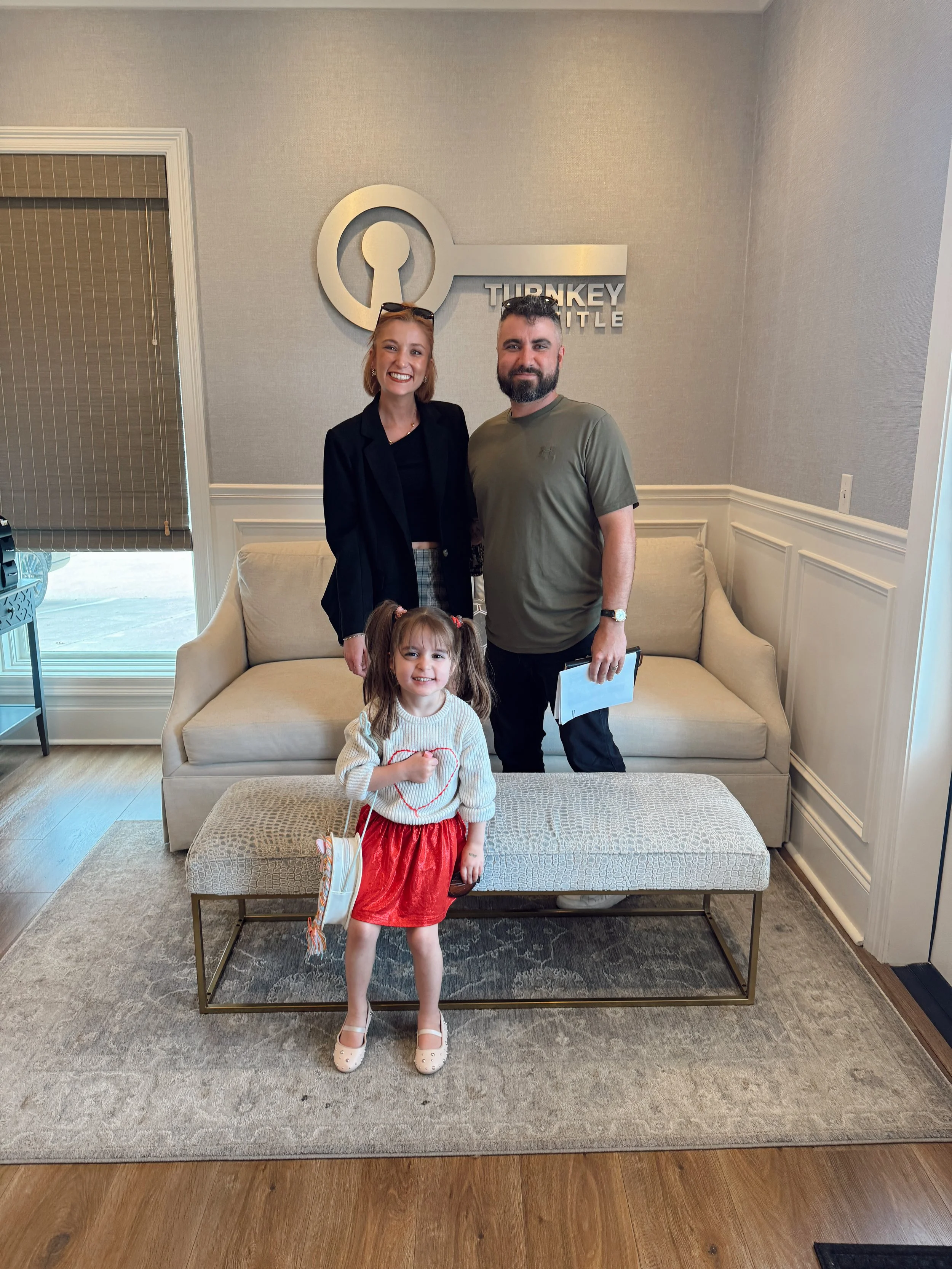
Closing Day (Or, The Part Where We Let Her Go)
105 Teche is officially sold. From late-night touch-ups and intentional staging to going under contract in January and closing at full price in February, this post shares the strategy, emotion, and business behind a design-forward Lafayette home restoration — plus a closing-day cameo from a five-year-old with “serious business” to handle.
There’s something surreal about closing day.
After months of dust, design decisions, late-night paint touch-ups, grout sealing at unreasonable hours, hardware swaps, staging marathons, and more “one last thing” moments than I can count — it all condenses into a stack of paper and a pen.
No sawdust.
No drills.
Just signatures.
And somehow, that feels louder than all of it.
The Nights Before the Numbers
The week leading up to closing wasn’t glamorous. It was final walk-through energy. It was tightening hinges. Adjusting strike plates. One last caulk line.
It was making sure Teche was ready for the new family that fell in love with her.
Staging had been the most indulgent part of this project — the rugs, the vintage glass, the brass glowing under the correct temperature bulbs (always the correct temperature bulbs). But closing week is about restraint. About making sure everything you promised is exactly what the buyers receive.
No half-painted hardware.
No dusty baseboards.
No tape hiding in corners.
Just a house, fully ready.

The Business of Doing It Right
Because I know some of you are wondering how it all shook out.
We purchased 105 Teche at a price that respected her bones — solid structure, a strong lot, original cypress worth restoring, not replacing. The renovation plan was measured from the start. We allocated capital toward what actually creates long-term value: improving layout flow, upgrading electrical and plumbing systems, insulating properly, restoring historic materials, and choosing finishes designed to age beautifully.
No trend chasing.
No artificial inflation.
No shortcuts disguised as savings.
We went under contract in January — traditionally one of the slower months in our market — and closed in February at full price, supported by appraisal. That detail matters. Not because it’s dramatic, but because it validates the work. Thoughtful restoration holds its ground, even when the market cools.
Yes, there was profit. There should be. Risk, time, and expertise deserve return. But the margin wasn’t extracted — it was earned through months of labor, deliberate decision-making, and a refusal to rush quality for speed.
The buyers didn’t overpay. They stepped into a home where the systems were addressed, the details were resolved, and the hard work was already done.
In a market that often rewards shortcuts, we chose steadiness.
That’s the kind of business I’m proud to run.

Closing Day, According to a Five-Year-Old
Evie came with me.
She insisted (plus school was closed for Mardi Gras break).
She wore something sparkly and announced to the receptionist, with full authority, that she “has serious business to take care of.” Which, honestly, she did.
She sat at the closing table doing her makeup with intense focus while I signed what felt like a small forest’s worth of paperwork. At one point she leaned over and whispered, “Mommy, why is there so much legal jargon?”
Valid question.
There’s something poetic about watching your child witness a full cycle — from demolition days to handing over keys. She’s run through those rooms mid-construction. She’s danced on the floors. She told me once the house was “almost done.”
And now she watched it officially become someone else’s.
It felt… right.


After the Signatures
When it was done, I gathered the documents and drove them straight to “Mista Patrick’s office.”
We reflected on this flip like adults. Talked strategy. Talked next moves.
And then we did what any serious real estate professional and her family would do:
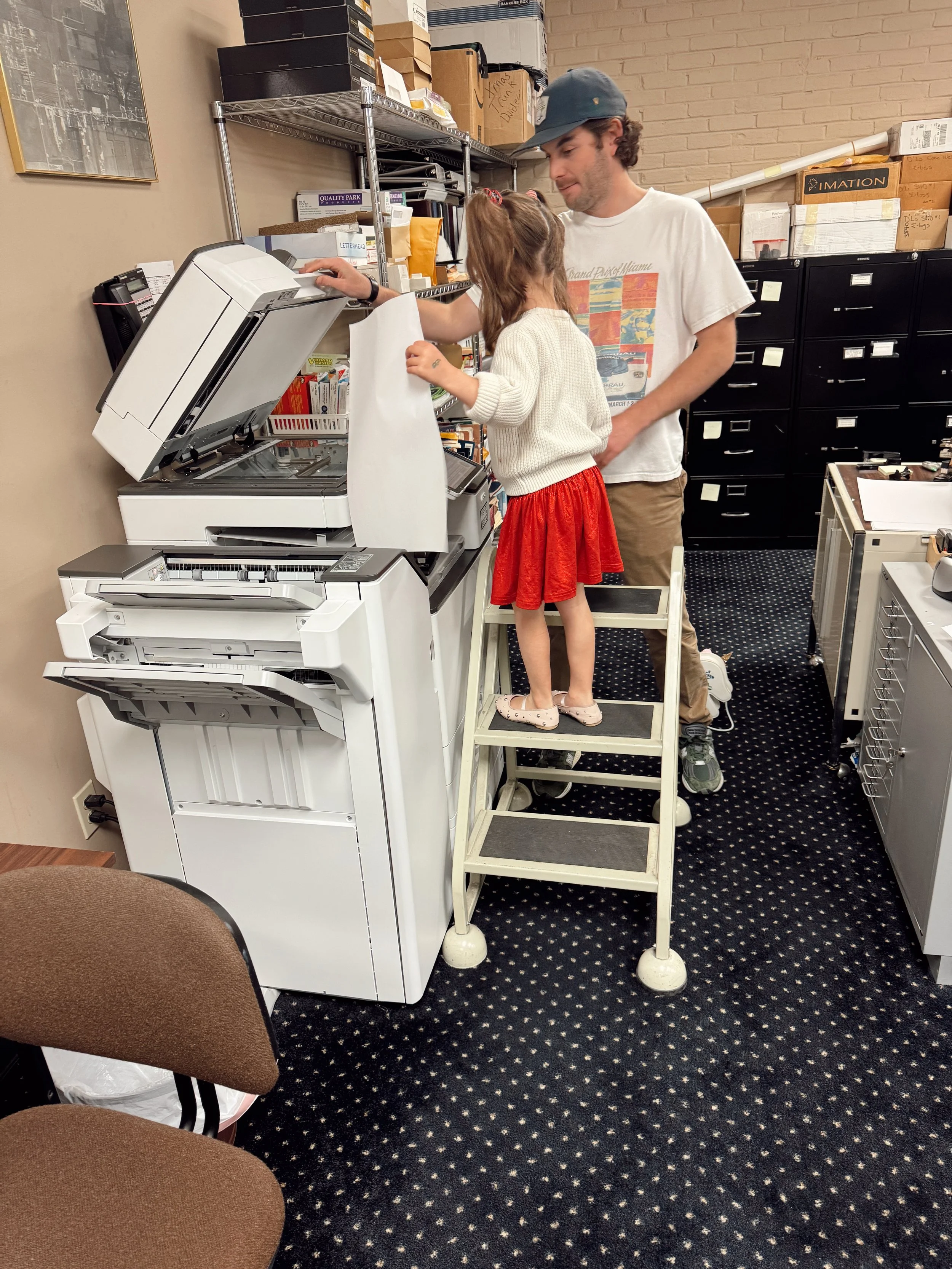
We made heart shapes with our hands on the office copier and ran copies.
Proof of serious business.
What Closing Really Means
Closing isn’t an ending. It’s a transfer of stewardship.
We restored 105 Teche. We listened to her. We made her whole again. But she was never ours to keep.
Now she belongs to someone else’s slow mornings. Someone else’s late dinners. Someone else’s wildflower garden maintenance schedule.
And that’s the point.
We didn’t build a flip.
We built something ready.
And the best part?
We get to do it again.
Now if you need me I’ll be enjoying my long-standing closing day ritual: Steak for one, too much red wine, and a whole box of lucky charms.
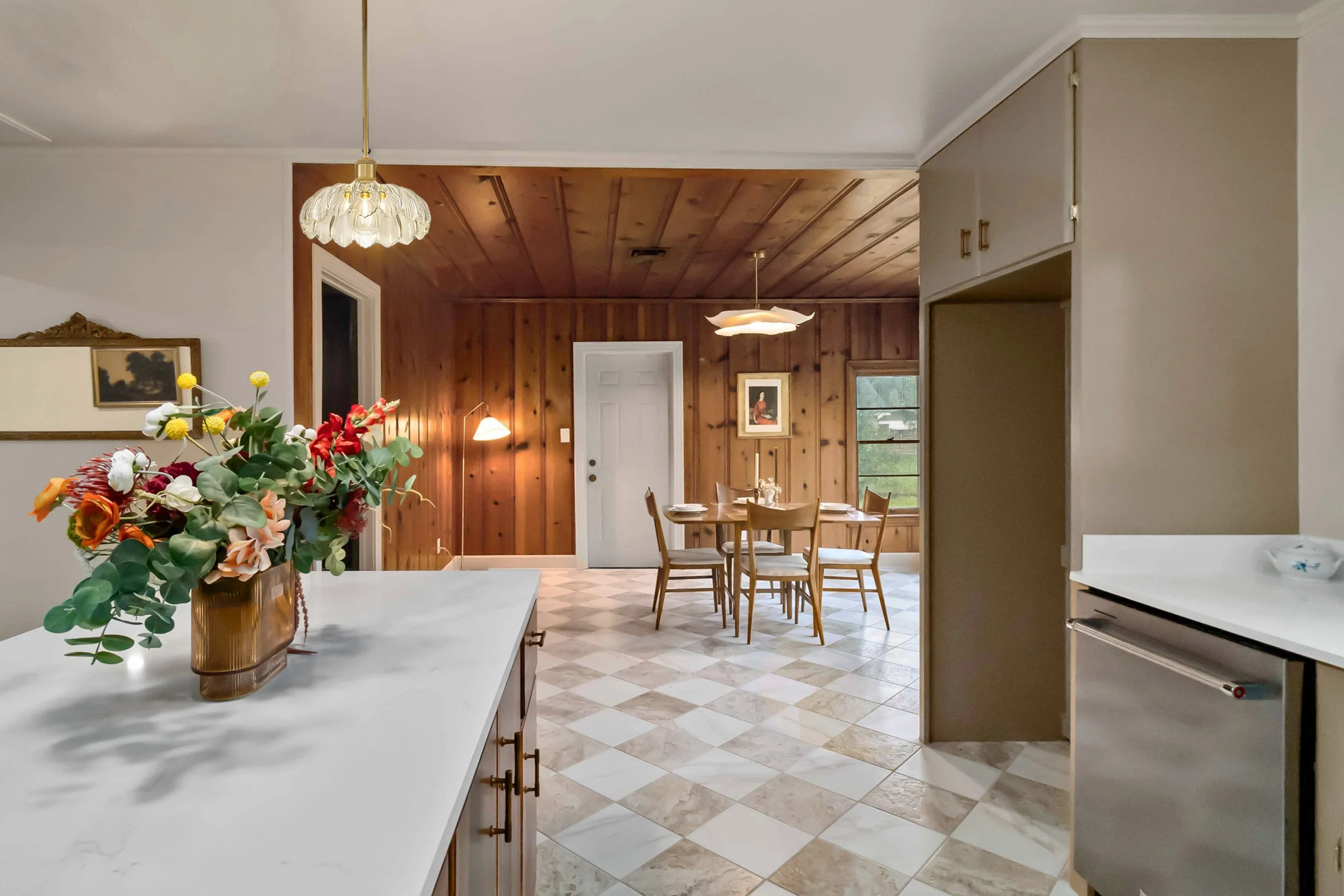
From Renovation to Real Life: The Journey Continues
What started as a flip became a home. 105 Teche wasn’t just renovated—it was restored with care, depth, and layers of real life. This post walks you through the final moments, the emotional turns, and the design decisions that transformed a project into something personal.
You know a house is done when you stop stepping over sawdust and start stepping into quiet.
Teche didn’t get finished on a schedule — she got finished on a feeling. There were 31‑hour runs (yes, literally) where I barely slept, a Sunday with Patrick and Evie where the air smelled like paint and ambition, and a moment that suddenly made all the chaos worth it: when Evie, mid‑sprint across what had finally become a clean floor, skidded to a stop and turned to me, wide-eyed: “Mommy? I fink dis house is almost done.”
In that second, the walls stopped being walls. The rooms stopped being rooms.
That was it. The shift.
Suddenly, this wasn’t a flip full of deadlines and dust. It was a house with lungs.
The second the house became present. Intentional. Ready to be lived in.
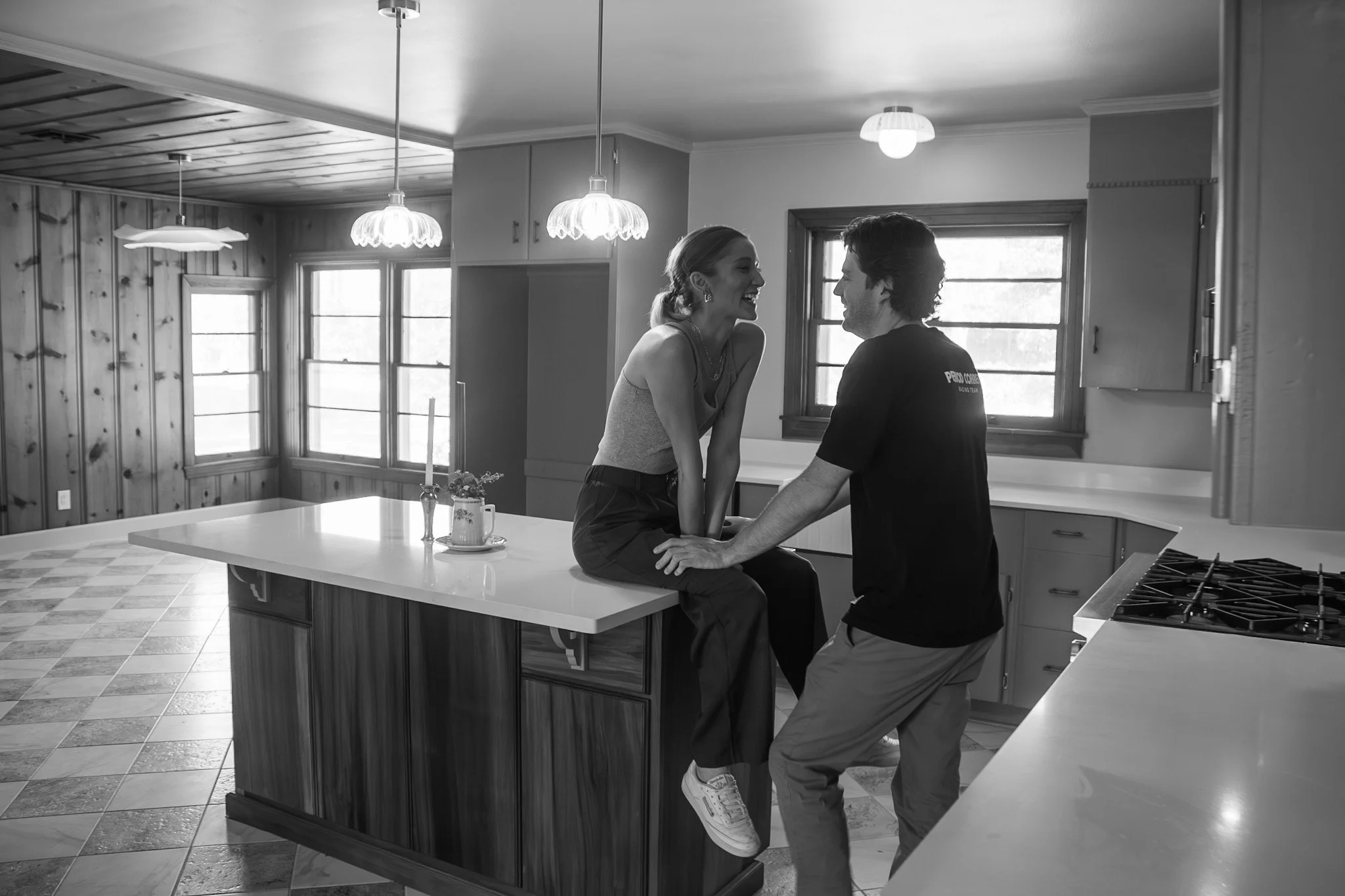
From Chaos to Calm Underfoot
I’ve walked through enough flips to know what “listing‑day ready” often ends up meaning: floors still suffused with drywall dust, painter’s tape dangling from casings, baseboards coated in debris, hardware that doesn’t match. That’s never been my standard — and Teche made sure of it. By the time the final photoshoot rolled around, I had crawled on my hands and knees through eight hours of vacuuming, mopping, and hand‑polishing the original cypress tongue‑and‑groove walls and ceilings in the dining room.
Each pass wasn’t just about cleanliness — it was about respect. Respect for wood that had weathered decades, respect for a home that will carry decades more, and respect for whoever walks in next. This wood deserved reverence. It wasn’t just clean. It was cared for. Sure, I’m certain there is a paint touch up or 2, maybe a light fixture that needs adjusting, but nothing about this finished project feels rushed or careless.
This wasn’t fluff or finishing touches. The house didn’t just get wiped clean — it got given a second breath. Because if you’re going to ask someone to call a place home, the least you can do is make it feel sacred.
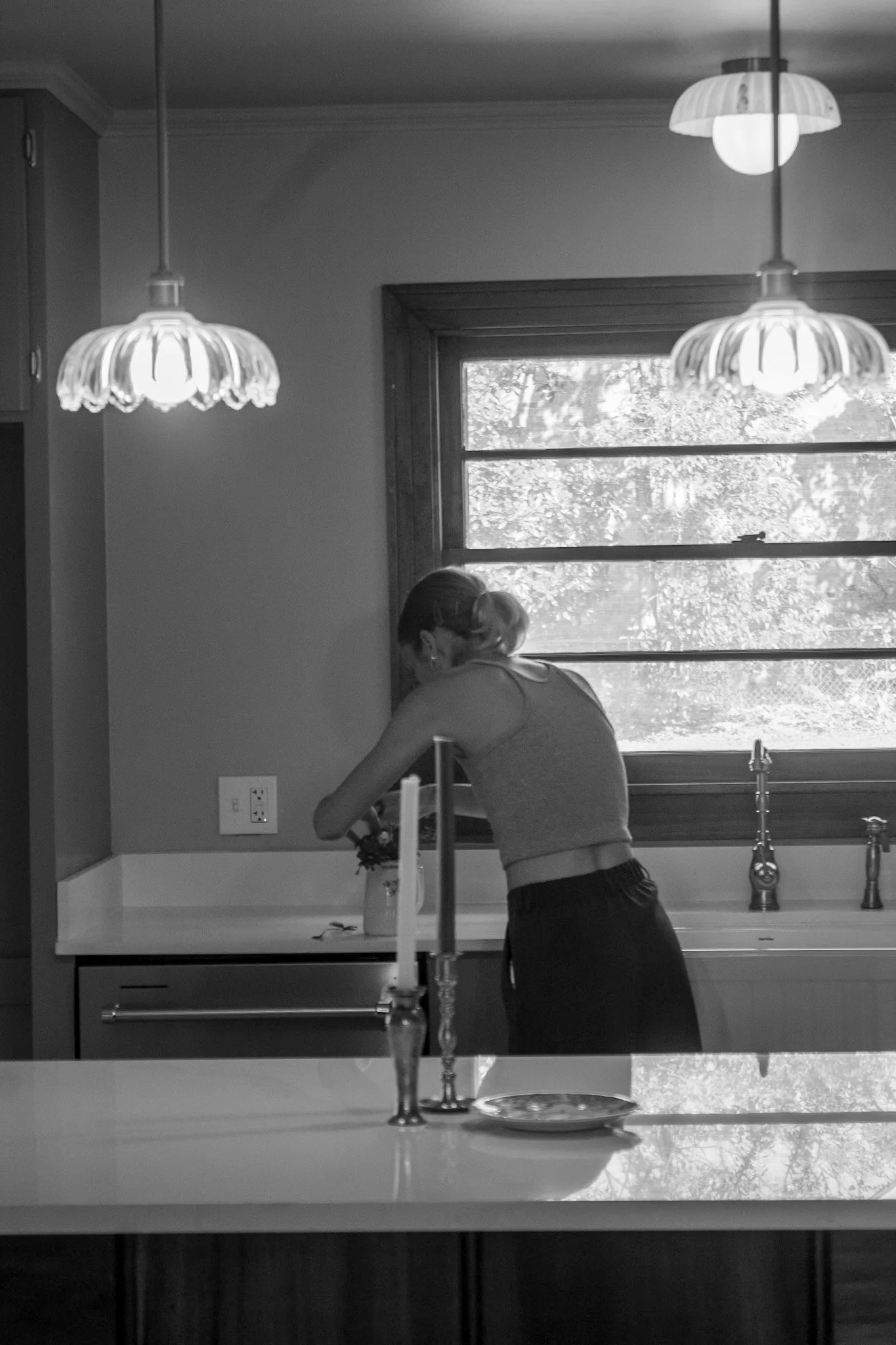
The Last-Minute Details That Made the Difference
Spare No Detail — Especially the Late‑Night Ones
Finishing a home isn’t glamorous. It’s in the tiny decisions that add up, the ones nobody notices, but can feel it when they’re missing.
The truth about finishing a home is that the smallest decisions take the longest.
The right hardware.
The correct temperature bulbs (because lighting matters).
Brass that actually patinas.
Paint touch-ups performed at hours when normal people sleep.
We swapped out every piece of tired, half-painted hardware. We aligned switch plates, patched corner joints, adjusted trim, polished surfaces until even the reflection felt deliberate. No band‑aids. No “good enough.” Not one corner was overlooked. It wasn’t about checking boxes — it was about asking the space to be ready, really ready.
And then came the staging — which was, admittedly, too fun for my own good. I styled until the rooms felt lived-in, not decorated; until every seat looked like someone had just stood up; until leaving the house felt genuinely difficult. Every surface looked like it had just been touched.
When you care — really care — you feel it. In the bones of the walls. In the grain of the wood. In the quiet hum of a space that finally, finally works.
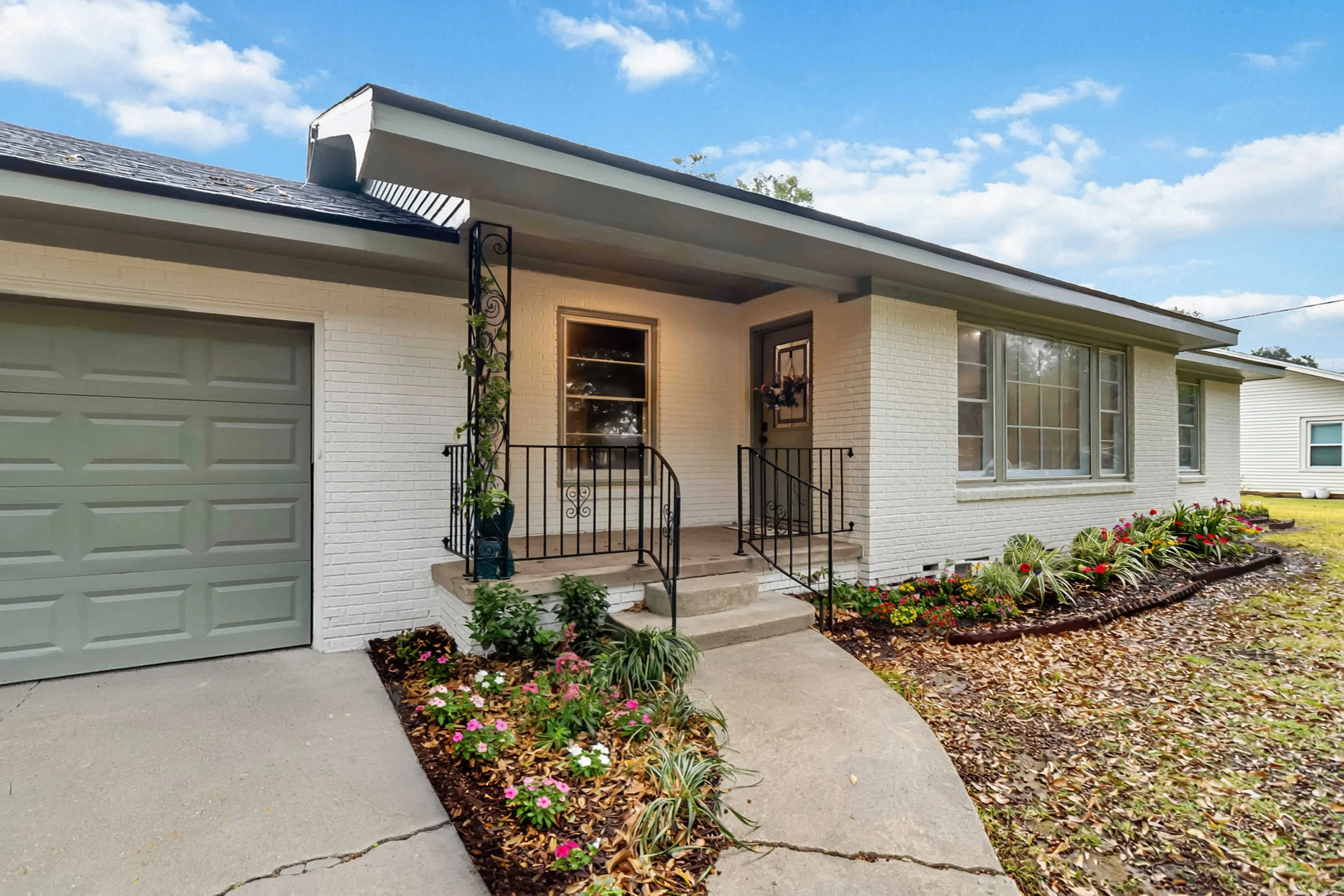
Because Charm Shouldn’t Be a Victim of Renovation
Out front, I planted the cottagecore wildflower-inspired garden I’d dreamt up while drawing floor plans at midnight. Snapdragons. Jasmin. Creeping fig vine. Swaths of soft green stems and bursts of Red, yellow, and purple dancing in the Louisiana wind. It’s not for the MLS — and that’s fine. It’s for Sunday mornings, bare feet, and half‑drunk mugs of coffee in the quiet peeks of sunrise before the world stirs.
No spreadsheet calculates charm like that.
Because charm doesn’t just show up on paper — it settles in the bones of a place. And those are the details that stick with people, even when the finishes fade. But buyers feel it.
They always do.
This Isn’t a Flip. It’s a Rebirth
Call it heresy, but I almost hate the word flip for this project. The word feels too quick. Too transactional. Too empty. Flips are often all sheen and no substance — designed to photograph well and age poorly, to impress from the curb and disappoint once you open the cabinet doors.
Teche isn’t that. Not even close.
Let’s be clear: Teche wasn’t gutted and replaced. She was restored.
Where lesser flips rip out history and paste from Pinterest, this house got listened to. Her quirks were studied, not stripped. Her bones—solid cypress, aged brick, solid wood cabinetry—were never the problem. They were the blueprint.
Every change was a conversation between what she was and what she could be. Where to add softness. Where to hold the line. What to uncover, what to edit, and what deserved to stay exactly as it was.
Restoration is slower. It asks more of you. It doesn’t give you straight lines or clean answers. But it gives you soul. And that’s what Teche has now, tucked into every threshold and behind every re-hung door: a sense of self.
This wasn’t a flip.
It was a reclamation.
Of beauty. Of time. Of something worth keeping.


The Heart Behind the Work
This house may have been my vision, but it never would’ve come together without the people who showed up when it counted.
Blaise—my PIC and voice of reason— never faltered when the foundation needed to be rebuilt, the gas company gave us a 5 week delay, or tile needed to be re grouted (ok maybe that last one wouldv’e gotten to him had it not been for me taking matters into my own hands with a trip to Floor & Decor and a grout float).
Ian quite literally saved our A-words when he stepped up and took the entire project into his own hands after our first project manager couldn’t hack it. He spent early mornings, late nights, and every moment in between rewiring for my (many) light fixtures, plumbed everything just right, and somehow made Teche a well-oiled restoration machine after walking into sheer and utter chaos. In all these weeks, I’ve never once seen the guy without a tool in hand, rolling up his sleeves, ready to do what needs to be done and do it right. I fear he’s stuck with me now, because I’ve never met another contractor who quite lives up to his standard.
Then there are the ones who put the work in for no reason other than a love for our crazy crew.
Patrick ran point on furniture hauls, dumpster runs, and more cleaning and landscaping than anyone should have to do after a full work week. Teagan rolled up her sleeves and helped me scrub, stage, and get Teche market-ready like it was her own.
And then there’s Wrigley—who somehow made space where there wasn’t any. She captured the soul of this place through her lens, pitched in for late-night cleanup parties, and kept Evie so entertained that she never even noticed how much time Mama was pouring into finishing touches.
Because of them, Teche didn’t just get finished. She got loved. And you can feel it in every photo, every corner, every little detail.
The Last Word
Teche isn’t perfect. She was never meant to be.
Perfection ages poorly anyway. What she is—what we built her to be—is ready. Ready for the things that actually make a house matter. The messy kitchens and undone laundry. The late dinners that stretch into second bottles and unplanned dancing. The tiny feet, the laughter in the hallway, the messes that mean something.
She can hold all of it.
She started as a flip—sure. But along the way, she asked for more. More care. More patience. More of us. And we gave it, piece by piece, in paint touch-ups at midnight and hands-and-knees floor polishing, in choosing the right lightbulb, not just a lightbulb.
By the end, this wasn’t a renovation. It was a restoration. A making-right. A letting-be.
Teche didn’t just get finished. She grew into herself.
And if we did our jobs right, she’s ready to grow with someone else now.
Ready to Meet Her for Yourself?
If you’ve made it this far, you already know—Teche isn’t just another house on the market. She’s layered, thoughtful, and quietly alive in a way that only happens when a home is given time, intention, and love.
She’s ready for real life now.
Maybe yours.
Schedule your showing here:
Intentional, Edited, and Almost Done: Teche’s Not-Quite-Final Reveal
This isn’t your typical flip—and that was the point. From navy marble and unlacquered brass to layout shifts that make daily life feel better, 105 Teche wasn’t built to be perfect. It was built to meet you where you are.
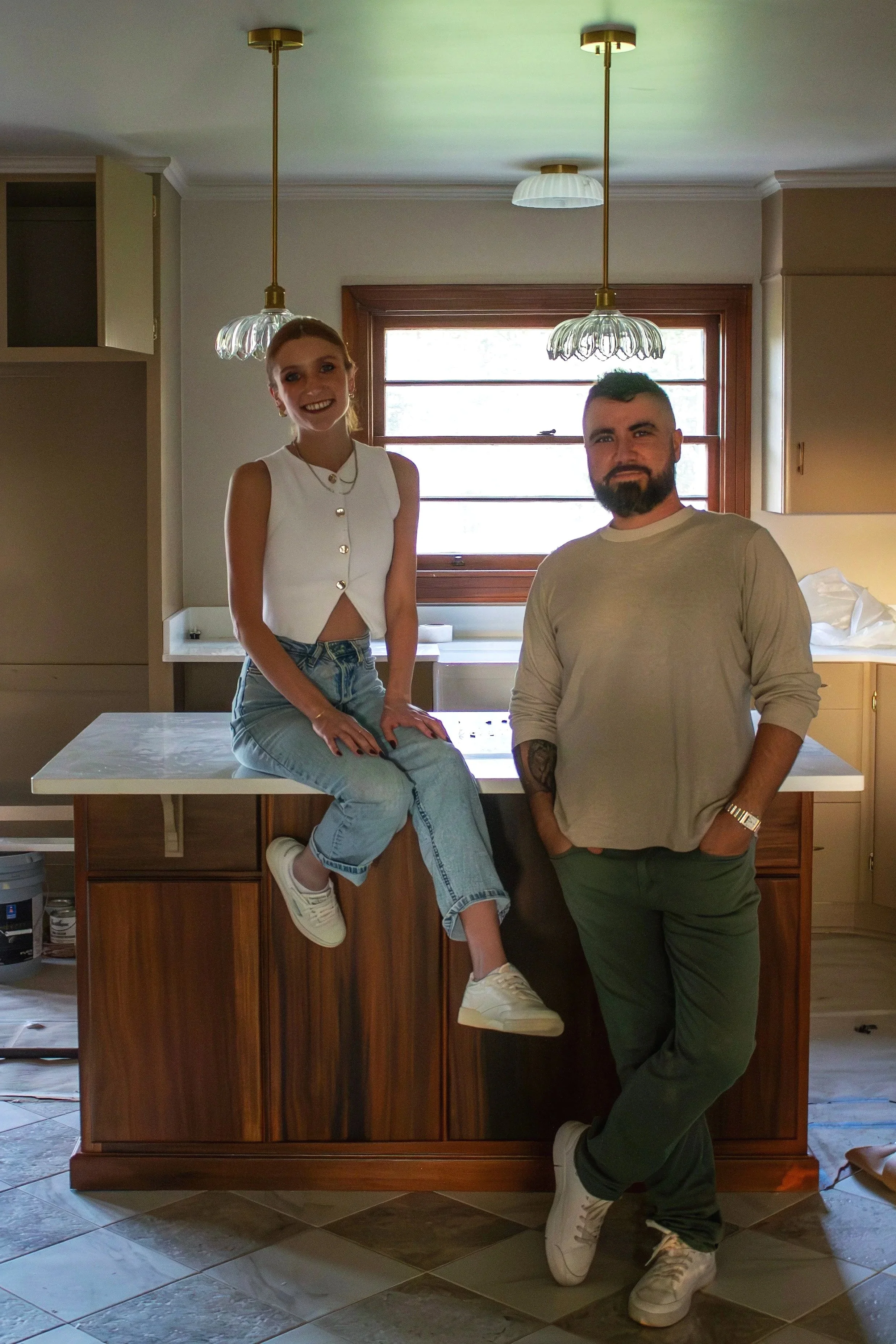
The dust has settled, the last coat of paint is dry, and 105 Teche is no longer a before—she’s the after they warned you about. But make no mistake, this isn’t just a run of the mill flip. What began as a sagging structure with promising bones has been fully transformed into something soulful, intentional, and design‑forward. Every corner holds a detail, every surface a story.
As someone who eats, sleeps, lives, and breathes the world of real estate and interior design, I knew this house was about more than square footage and comps—it was a chance to blend architecture, artistry and authenticity. We’ve already touched on the major shifts—layout changes, structural reinforcements, the improved flow that now defines the space—but today I want to take you deeper. I want to walk you through the intention behind the selections, the moments of craftsmanship that flew under the radar, and the bold design calls that gave Teche her new identity. She’s almost market-ready, but we’re showing our cards early.

A Shower Moment, But Make It Cinematic
First stop: the bathroom that sets the tone, then takes it one giant step further. Dark, dramatic marble tile now flows up the walls, enveloping the space in moody sophistication. The intention was clear: we wanted contrast, texture and a hint of luxury that didn’t feel ostentatious.


The star in this space is the brass shower system. It doesn’t scream for attention, it wears like jewelry: precise, textural, and exactly right.
The shower niche is proof that a detail can be both functional and quietly show-stopping. The scalloped tile layout plays with repetition and restraint, alternating between bold, large-aggregate terrazzo and a finer, more grounded mix. It’s texture without visual noise. Framed in coordinating brass trim, the niche breaks through the dark marble surround with just enough warmth to catch light, not steal it. Every finish here is speaking the same language: edited, layered, modern. It’s the kind of designer bathroom detail that makes a space feel intentional, not overworked—proof that functional elements don’t have to disappear.
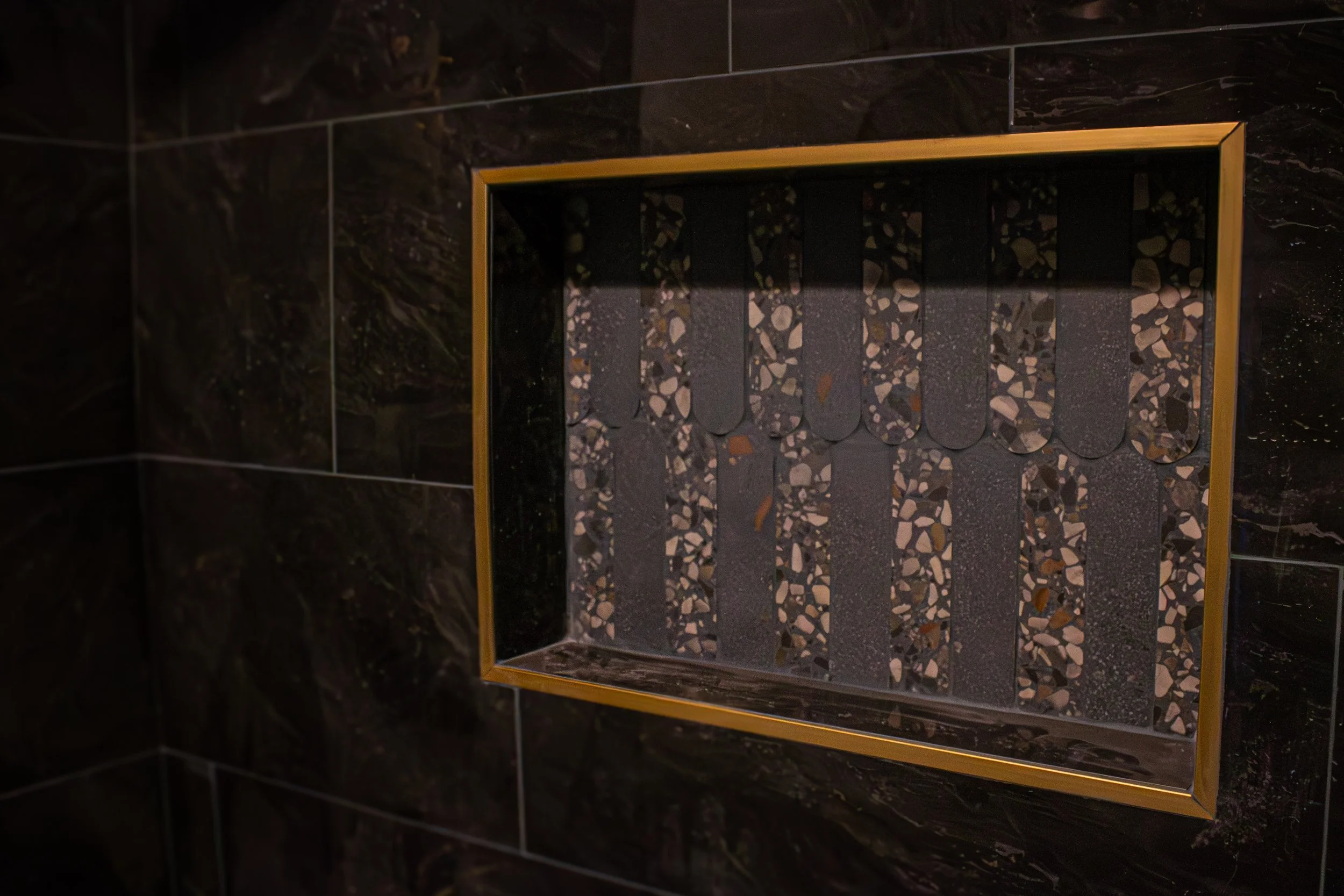
Why this works
Navy marble does the heavy lifting, creating a rich, dramatic backdrop that anchors the entire bathroom without begging for attention.
Brass finishes punctuate the room’s darker palette, adding warmth, reflectivity, and a sense of patina that connects the space to the rest of the home’s vintage-modern language. In a room of saturated tone, brass offers just enough light play.
The terrazzo niche adds a layered texture, a surprise detail that shifts the space from “luxury bathroom” to “bespoke design moment.”
The juxtaposition of dark, reflective stone with warm metal and articulated terrazzo demonstrates a controlled risk: bold, but rooted in restraint.
The added beaded moulding, painted to match the wall, bridges the gap between the brass trim and the rest of the space—keeping things cohesive, with just enough cottagecore to soften the modern edge.
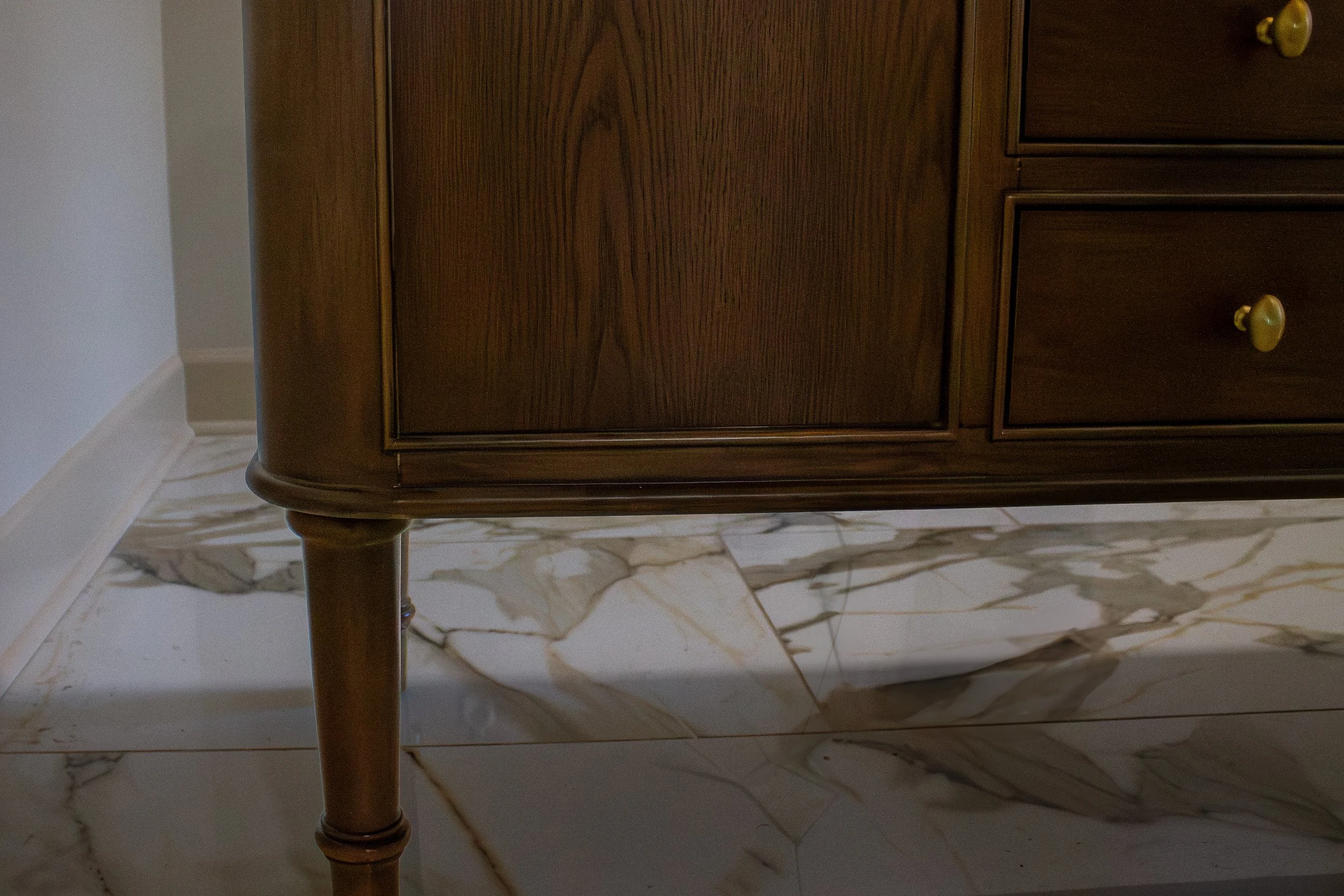
Soft Neutrals, Strong Lines: A Modern Take on the Primary Bath
From the moody intensity of the navy marble bath, we transition into something quieter—but no less considered. The primary suite bath trades saturation for softness. It’s calm. It’s architectural. A quieter kind of bold.
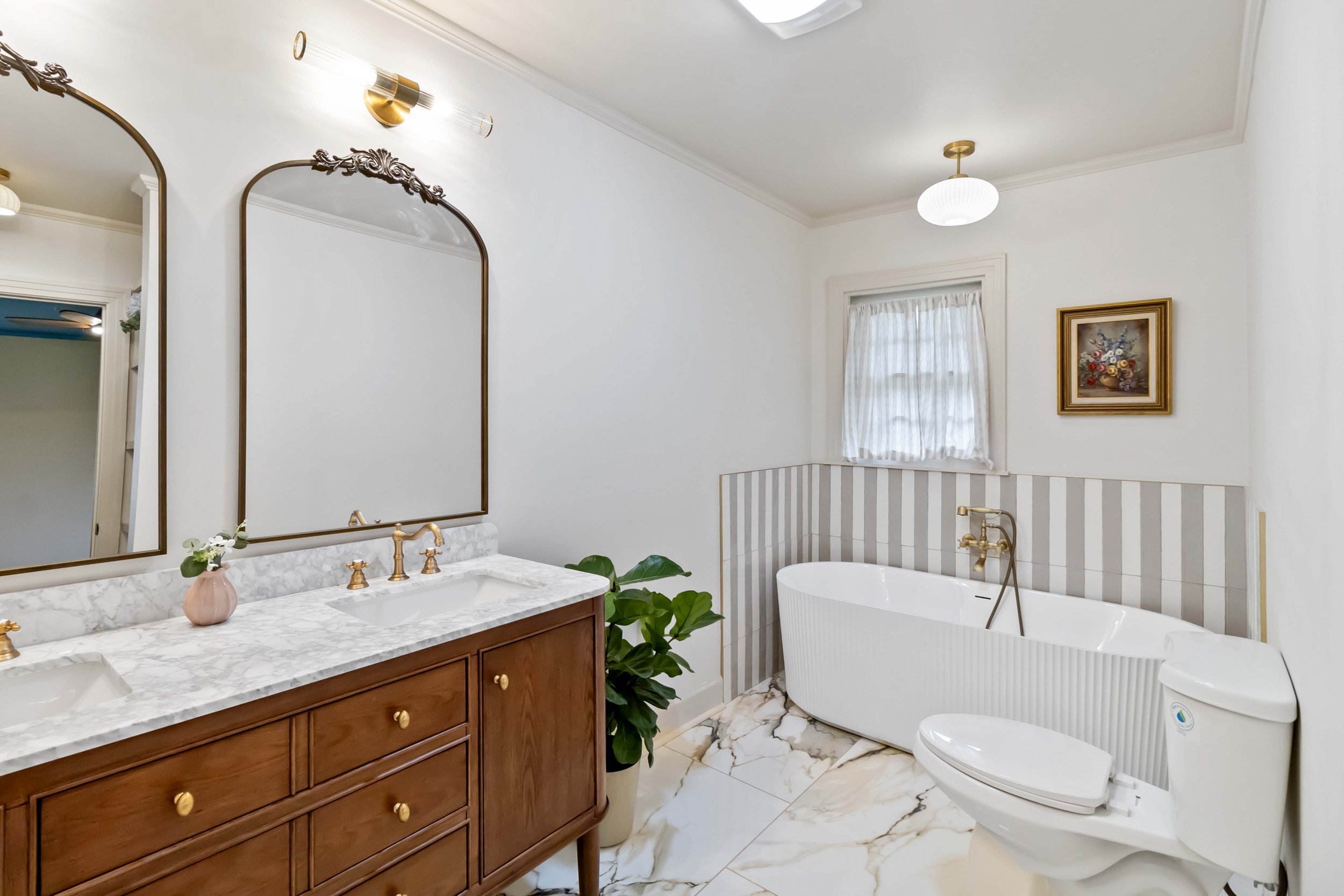
Hand-cut vertical stripe tile draws the eye upward, adding subtle movement and emphasizing height. On the floor, golden marble veining softens the geometry, grounding the room with a more organic pattern. The fluted freestanding tub sits at the center—sculptural but not showy, anchoring the space without feeling heavy.
And the wall-mounted brass faucet? Vintage-inspired, beautifully tactile, and quietly confident. It balances form and function the way great fixtures should—elegant, purposeful, and built to last.

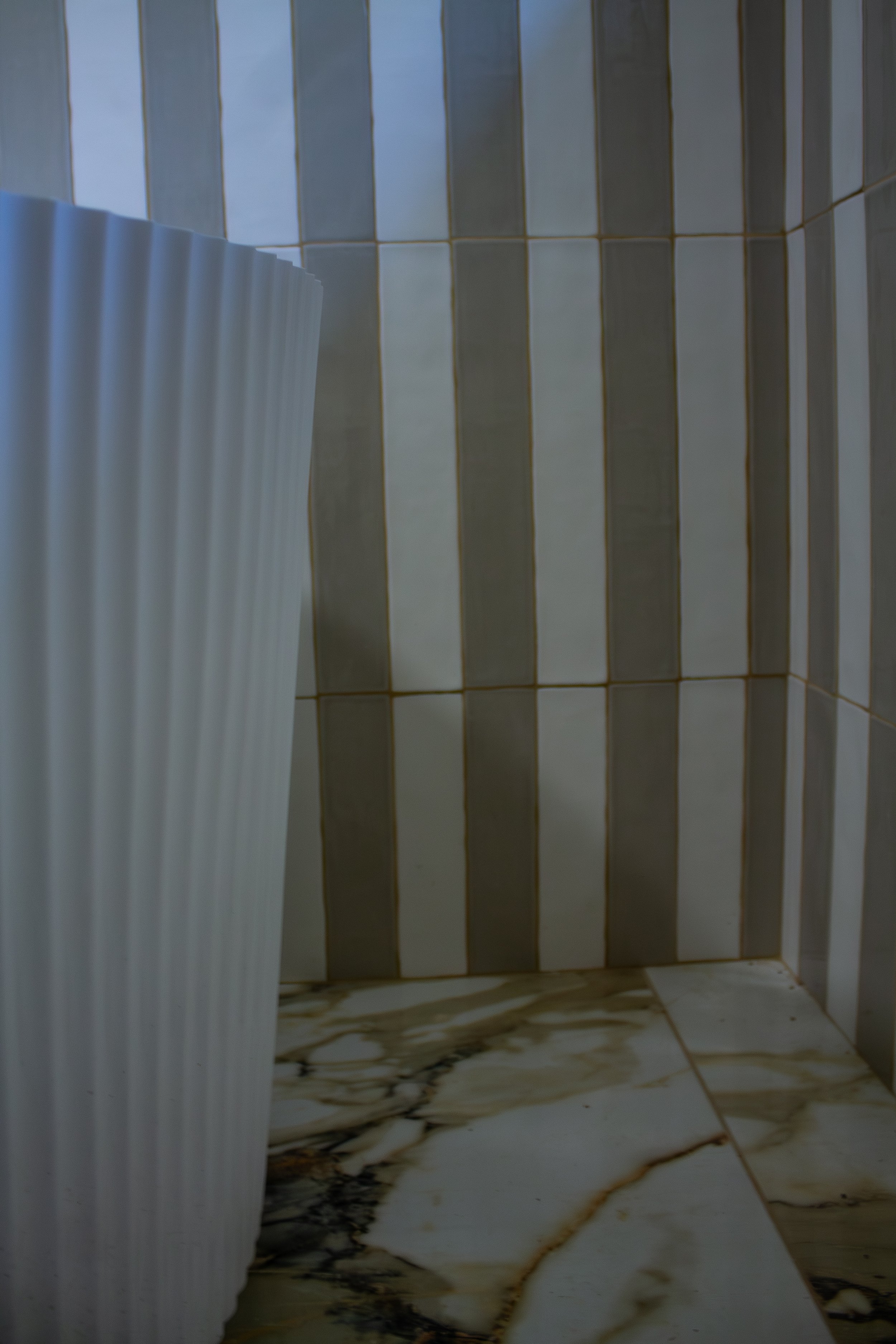
Design intentions:
The vertical tile does more than stretch the walls—it gives the room rhythm. Quiet but deliberate, it keeps the space from feeling static.
Honey veined marble underfoot softens the structure. It adds just enough movement to ground the geometry without stealing the show.
The fluted tub is more sculpture than statement. It anchors the space, but doesn’t dominate it—form doing exactly what it should.
Antique brass fixtures bring warmth in all the right places. Wall-mounted, vintage-referenced, and chosen for the way they’ll age, not shine.
Nothing matches—but everything speaks the same language. The space isn’t coordinated. It’s composed.
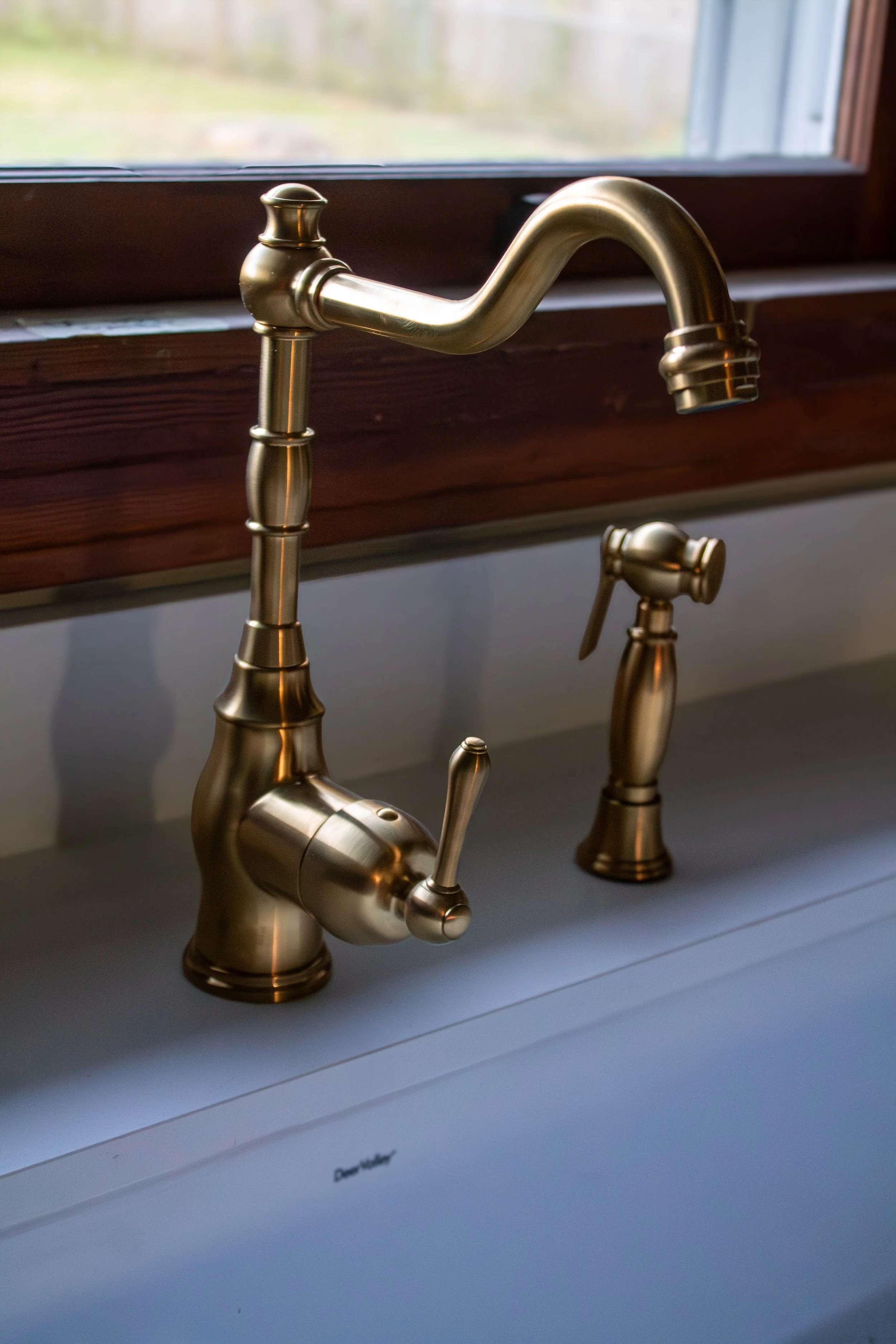
Soft Utility: Where Design Meets Daily Use
The original kitchen layout had the sink awkwardly shoved to the left of the window—a placement that made no sense functionally or visually. So we moved it. Centered it. Gave it a view.
Now, the faucet sits exactly where it should: anchored beneath the window, framed by light, aligned with the outdoors. It's no longer an afterthought—it’s part of the composition. Everyday tasks feel just a little less routine when they happen in a space that was actually designed to be lived in. The unlacquered, vintage-inspired brass fixture ties back to everything Teche got right: cohesive, era-appropriate, and fully functional for real life.
And because this house was always meant to hold life, not just stage it, we made sure to test that theory. This house was never meant to be precious. It was never about creating a space too perfect to touch—it was about designing a home that could take a breath, hold a moment, and look even better after it’s been lived in. We didn’t just design the kitchen to look good in photos. We let it live. Really live. We broke in the floor by dancing on it. We pressure-checked the layout by spinning in circles. We gave the countertops a real audit by letting a four-year-old climb on them and cackle at full volume.
And in those moments, something clicked. The design didn’t fall apart. It embraced us. The light landed in the right places. The foundation proved rock solid. The space worked—because it was made to. It’s easy to forget, in the world of curated stills and showroom-perfect walkthroughs, that homes are meant to be a little loud. A little messy. Full of little fingerprints and inside jokes.
What we built here isn’t just resale-ready—it’s life-ready, the good, the bad, and everything in between. And that’s the part you can’t fake. You can feel when a house was designed with heart. When someone thought about real life unfolding inside it. This kitchen isn’t just where you’ll plate dinner. It’s where someone will practice spelling at the counter, where you’ll take a breath between emails, where you might one day hold a tiny human mid-laugh and realize—you built something great.



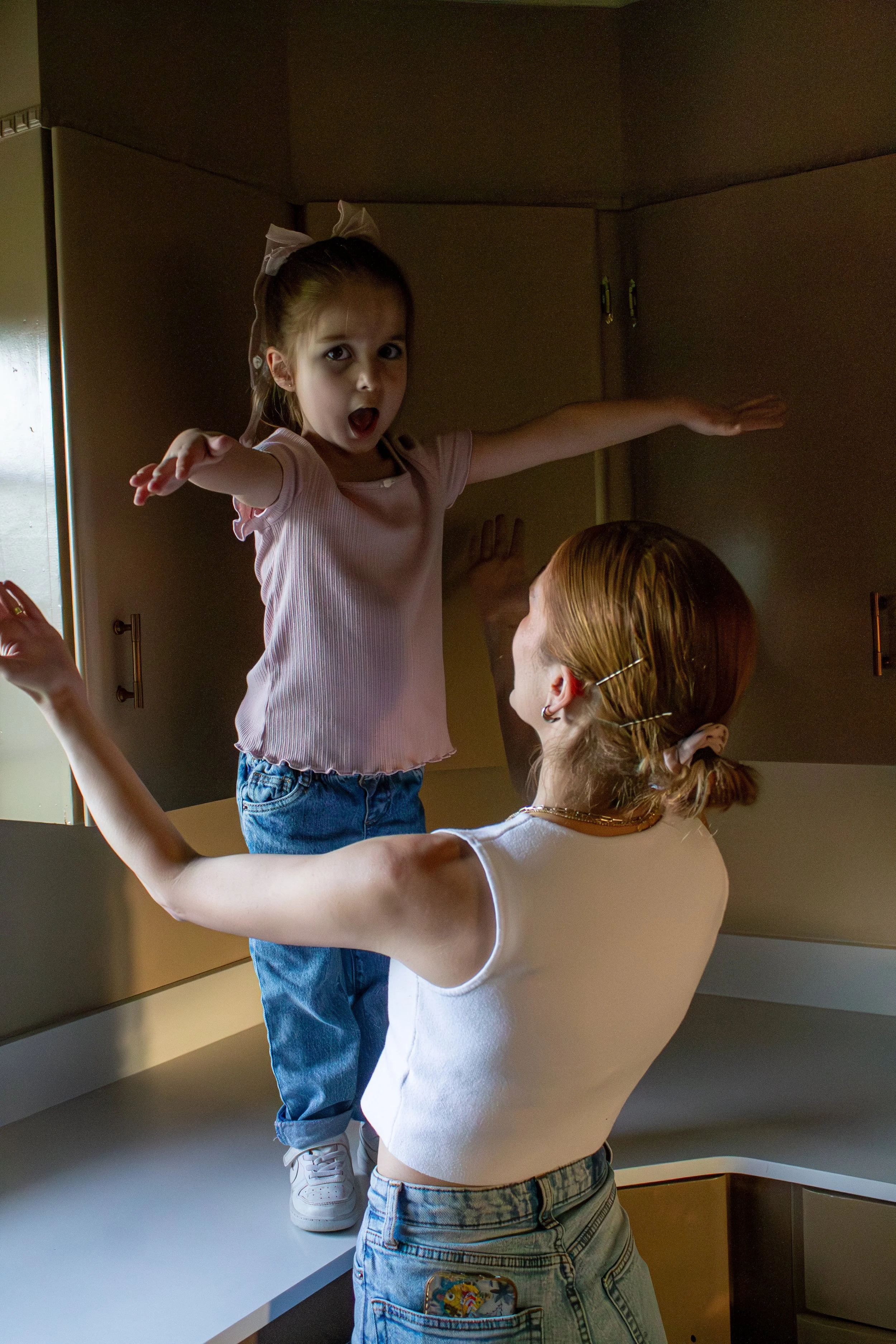
A sink with a view is nice. A kitchen that holds a moment like this? Priceless.
The kitchen was never just about trendy cabinet colors—it had to work for actual life. Preferably loud, barefoot, and standing on countertops.
Not Just for the Photos
You don’t always notice good design in the moment. It’s not loud. It doesn’t announce itself. But it changes how you move—how you pause, how you breathe, how you connect. It shows up in the way a room supports your rhythm without interrupting it.
This kitchen wasn’t built for show, but to hold the weight of real life—quiet mornings, quick meals, late-night pacing, a glass of water at the end of a long day. If you feel more grounded in it without knowing why, that’s by design.
Design isn’t just visual—it's spatial memory. The kind that sneaks up later, when you walk into a different kitchen and realize something feels off.
Good design doesn’t insist. It just works—quietly, daily, and often without credit. But if it makes someone feel more at ease in their own space? That’s the point. Always was.
Built for the Life Inside It
While we arranged textures and details to impress, at the heart of Teche is the invitation to live. This home is not a showroom—it’s a backdrop for real life.
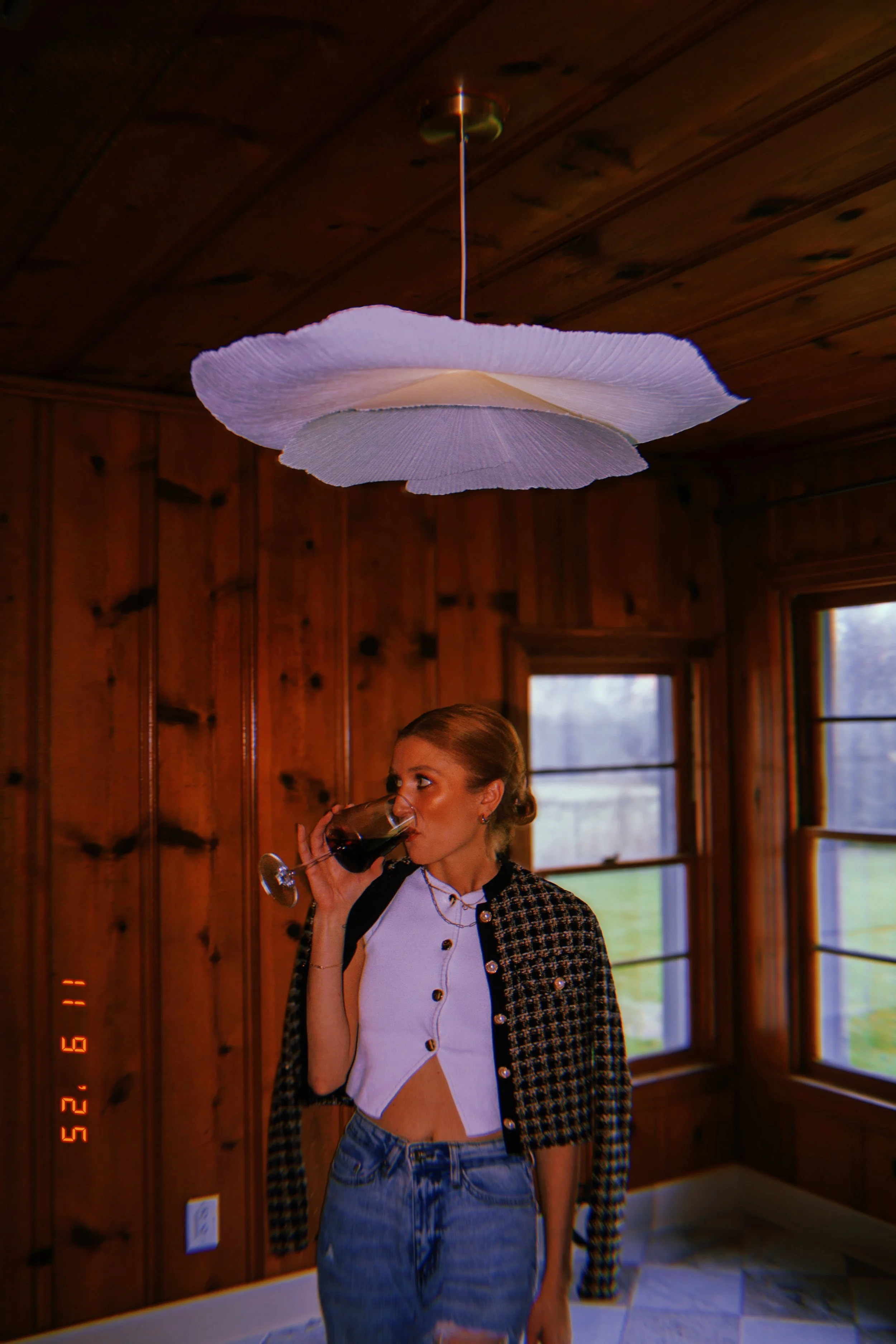
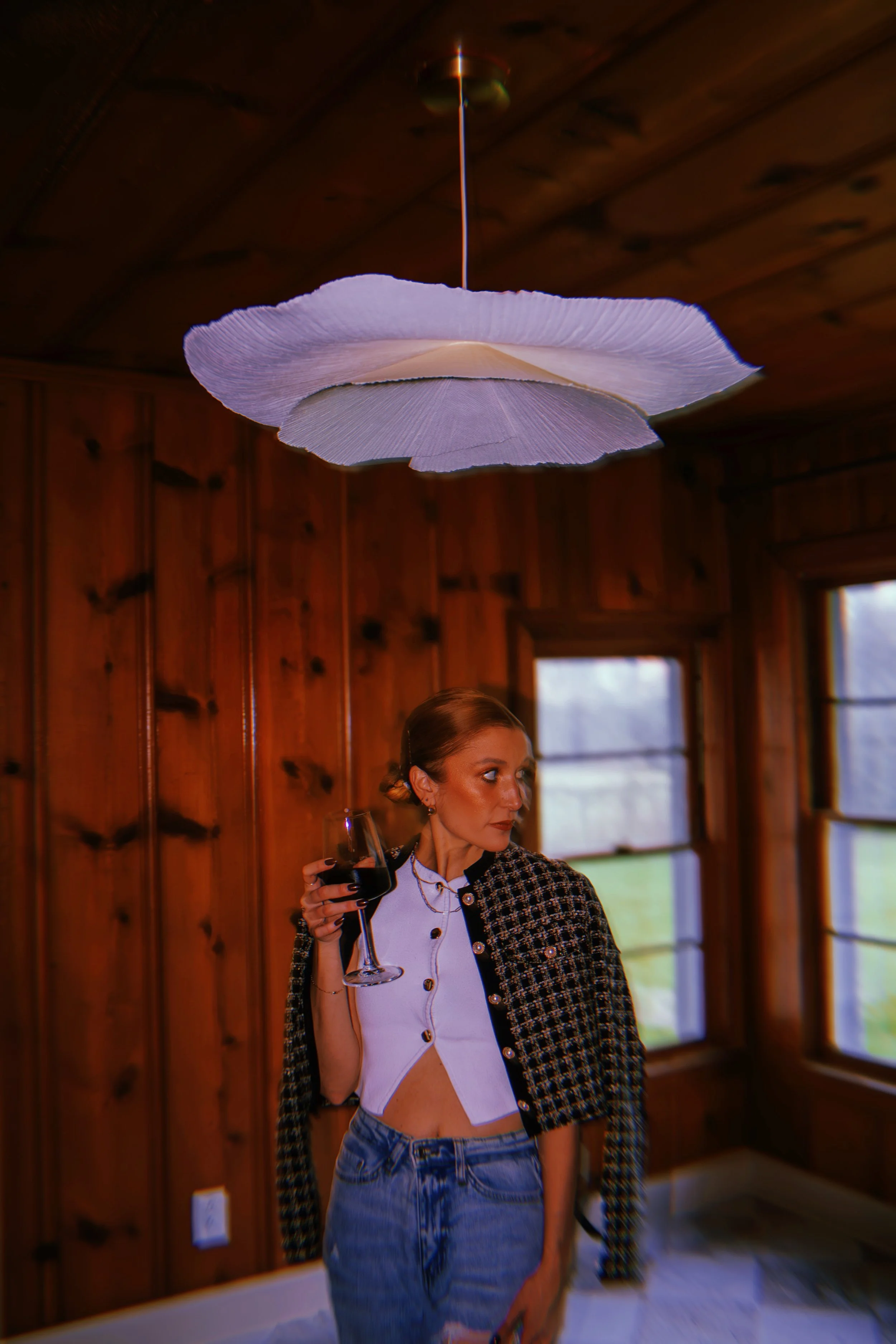
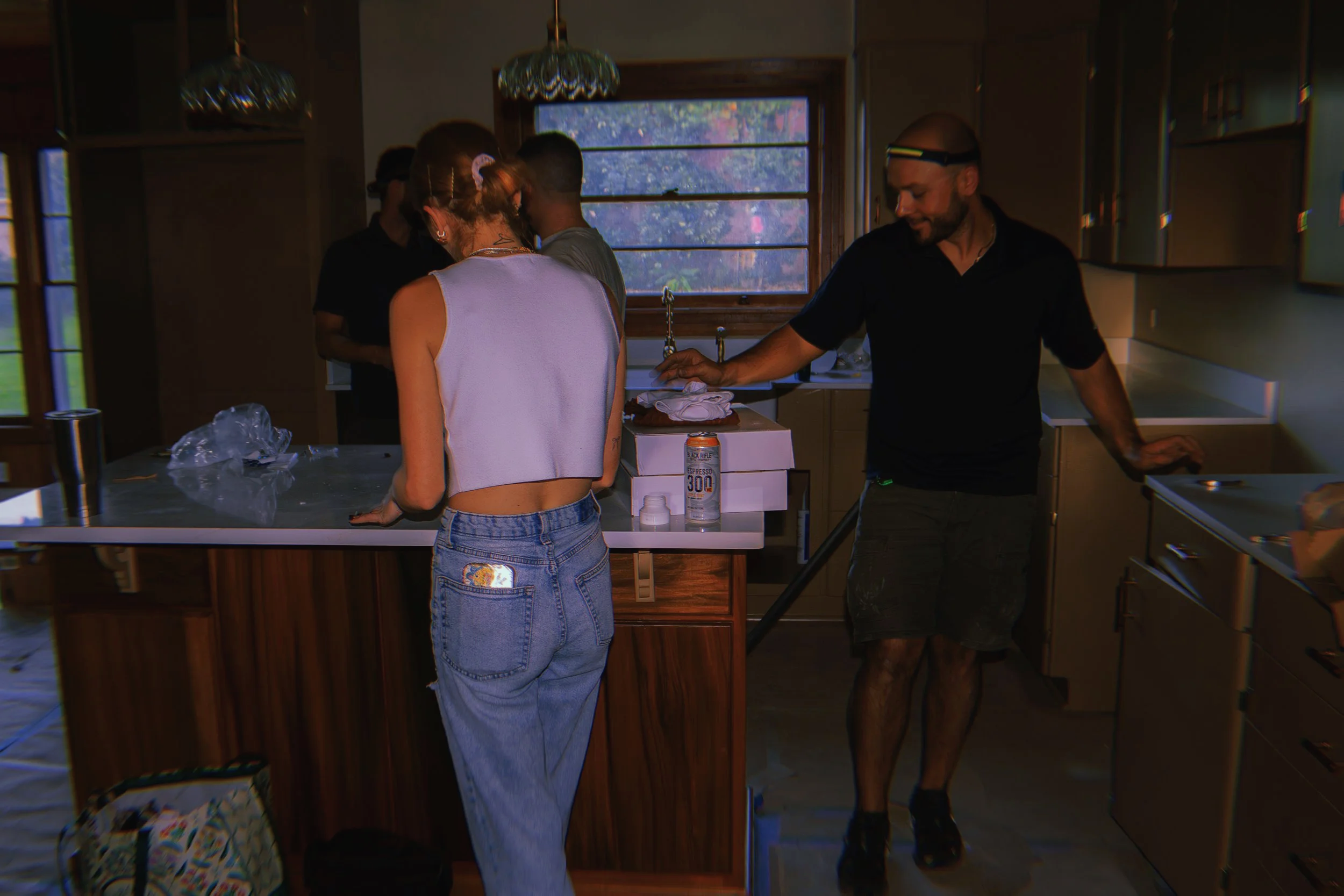
The final photo shoot, for example, wasn’t about perfection. It was about capturing laughter in the kitchen, glasses clinking under that sculptural light fixture, moments of arrival. Because houses don’t just become homes—they become scenes, core memories, integral parts of each and every one of us.
The Mindset
When we design a space, we’re not setting a scene—we’re creating space for real life to step in. The laughter, the mess, the late-night pacing, the slow mornings. We don’t cover that up. We make room for it.
The design choices matter (in fact I obsess over them). But what brings a house to life is always the people. The energy it holds. The stories that haven’t happened yet but feel close.
This one came together with the kind of team you want in your corner. The kind that knows when to push, when to pause, and when to crack open a bottle on the floor before the light bulbs are even in. It felt less like a project, more like a shared vision that actually landed.
Teche isn’t just nearing the finish line. She’s getting ready for whatever—and whoever— comes through the door next.


Joy, unstaged.
Next up: The finishing layers, the list-day plan, and a new standard for Lafayette flips.
The renovation’s nearly over—but the story’s just warming up.
This isn’t just a run of the mill flip rushed for the sake of a “for sale” sign, this is a chapter we still live in, breathe in, and show up for together. Our team, more like a scrappy collective than a crew, leaned into the chaos: hanging cabinet hardware in heels (guess who), collective panic over gas company delays, all hands on deck to decode my paint instructions and light fixture placements, drywall dust in shoes, and that moment when the door moldings finally aligned. We didn’t slip away silently—we stayed to peel back the final layer, untuck the details, and test how it all felt in real life. 105 Teche wasn’t built to be perfect.
It was built to meet you where you are.

And all the moments you see here? Captured beautifully by Wrigley Smith, who somehow managed to capture the mess, the magic, and all the quiet in between. You can follow her work here.
FAQs
-
A design-forward flip isn’t about packing a house with trendy upgrades—it’s about designing with intention, from structure to finish. It means asking better questions at every stage: How does this space function day-to-day? What should it feel like at 7 a.m. with sunlight pouring in—or after dinner when the house gets quiet? Instead of defaulting to resale-safe choices, we focused on proportion, flow, and timeless materiality. A flip doesn’t have to feel temporary or generic. It can feel collected, livable, and quietly bold.
Teche is that philosophy in practice. We moved the kitchen sink to align with the window—not just for symmetry, but to bring the outdoors into a daily ritual. We chose unlacquered brass because we wanted materials that age with the house. We added bead moulding and warm wood tones to soften harder lines, keeping one foot in her cottage roots while updating her for modern life. Every edit—from the terrazzo niche to the window casings—was made to support the space, not steal from it. It’s a house that was rethought, not just redone.
-
Because buyers feel the difference before they know what they’re looking at. You can walk into a house and instantly tell whether it was thoughtfully renovated or rushed to market. Details like unlacquered brass fixtures, bespoke cabinetry, or custom tile work don’t just look elevated—they signal care, longevity, and a point of view. And that’s what makes buyers fall for a home, not just buy it.
These aren’t upgrades for the sake of flash—they’re decisions that create emotional connection and perceived value. In a crowded market, the flips that linger are usually the ones that feel flat or forgettable. But when a home has been edited with intention—where the materials, palette, and layout all work in quiet harmony—buyers take notice.
But a design-forward flip doesn’t mean blowing the budget on luxury everything. We hunt for pieces that look high-end, feel durable, and still let the margins breathe. It’s about having a vision and refusing to settle—even if that means scouring every corner of the internet or every aisle at the big box stores. (Just ask Patrick—he watched me scroll through every faucet on Amazon and every vanity at Home Depot. Twice.) -
Start with an audit of your explore page. If everything looks the same, you’re missing the point.
Timeless design doesn’t come from copying, it comes from creating. It’s less about what’s popular and more about what holds up. Look for materials that wear in, not out. Real stone with natural quirks. Metals that patinate. Fixtures that feel like they belong to the house, not the Pinterest board.
You don’t need to blow the budget, you need to know what reads as considered. I’ve sourced Amazon faucets that pass for vintage and mixed them with polished stone and custom vanities without blinking. It’s about the composition, not the cost.
And yes, it takes time. Think: 74 open tabs, comparing the curve of spouts, filter settings set to “brass only,” endless photoshop renderings, and one poor contractor watching me spiral as I unpack the wrong fixture shipped from Amazon… again. But when the palette hits, the scale’s right, and nothing feels like it’s trying too hard? That’s when it works.
-
Start by letting the house speak—and actually listening. On that first walkthrough, before demo, before Pinterest boards, you can usually feel what the house wants to be. The lines, the light, the layout (even if it's broken)—they all leave clues. You’re not forcing a look onto a space. You’re pulling the right version of it out.
From there, staying on brand doesn’t mean stamping the same style onto every project. It’s about working within a consistent design language: warm metals, tactile materials, tonal restraint, layered contrast. Things that feel edited, not overworked. Even when the architecture shifts, your point of view doesn’t have to. You just calibrate the mix.
For me, that means brass shows up often, but it lands differently depending on the room. A fluted detail might move from sink to tile. A certain type of veining shows up again—not because it's a formula, but because it belongs.
It’s never about matching past projects, but about making the next one’s final product feel inevitable. Like it was always meant to look this way—even if it took some demo (and maybe even tears) to get there.
-
The work doesn’t stop at the final photo edit or when the staging pillows are fluffed. Once the listing hits, it turns into a sprint—but a curated one. It starts with how the story is told: social content that actually reflects the design process, captions that go beyond “just listed,” and visuals that show more than angles—they show intent.
The showings matter, but so does the experience within them. Lighting adjusted. Tools Gone. Kitchen island styled. Let the finishes speak. Let the layout guide. It’s about giving buyers space to feel something.
Then there’s the follow-through. The email responses that don’t sound templated. The detail sheets that highlight why that wall was opened up, why that faucet was chosen, why this flip doesn’t feel like a flip.
Because a buyer isn’t just walking into a house—they’re stepping into a decision. Maybe the biggest one of their lives to date. Our job is to make sure it all feels intentional. Every touchpoint, every room, every material—designed to not just show well, but live well.
-
We’re down to the final layer—the kind of details that most people overlook, but that actually make the space feel finished. A few light fixtures still need to be installed (yes, even more are coming). Laundry room cabinetry is next. Gas connection is scheduled so the new range can do its job.
We’re also swapping out a few pieces of door hardware—touchpoints again—and making sure every outlet and switch plate cover is matched and intentional. Paint touch-ups are happening, grout is getting sealed, and we’re walking the house with fresh eyes before the final tidy-up.
It’s not quite the big reveal yet. But almost.

From a Flip to a Feeling: How 105 Teche Became Lafayette’s Design Darling
Renovation progress looks good in theory — until your bathroom mirrors turn out to be auto parts. Between countertop wins, lighting surprises, and a few shipping misfires, the Teche Flip is still pulling off her modern cottagecore moment with suspiciously good humor.

There’s a shift that happens in every renovation—the day you walk in and realize the construction zone has quietly turned into a home. That’s where we’re at with 105 Teche Drive. The paint’s on, the floors are in, and the lighting is… somewhere between “en route” and “back-ordered.” The bathrooms? Drama. The kitchen? Straight from a Nancy Meyers fever dream, but, like…cooler.
It’s giving modern-luxe cottagecore with just enough edge to keep it interesting. And while Blaise ran off to elope (while I sobbed at home about how stunning and happy he and Teagan looked), our head contractor Ian and I kept the show running. Light fixtures in one hand, incorrect Amazon shipments in the other. Because the glow-up doesn’t wait for anyone, even the groom.
Here’s the latest update on the Teche Flip — AKA our favorite 70503 girlie in her renovation era.
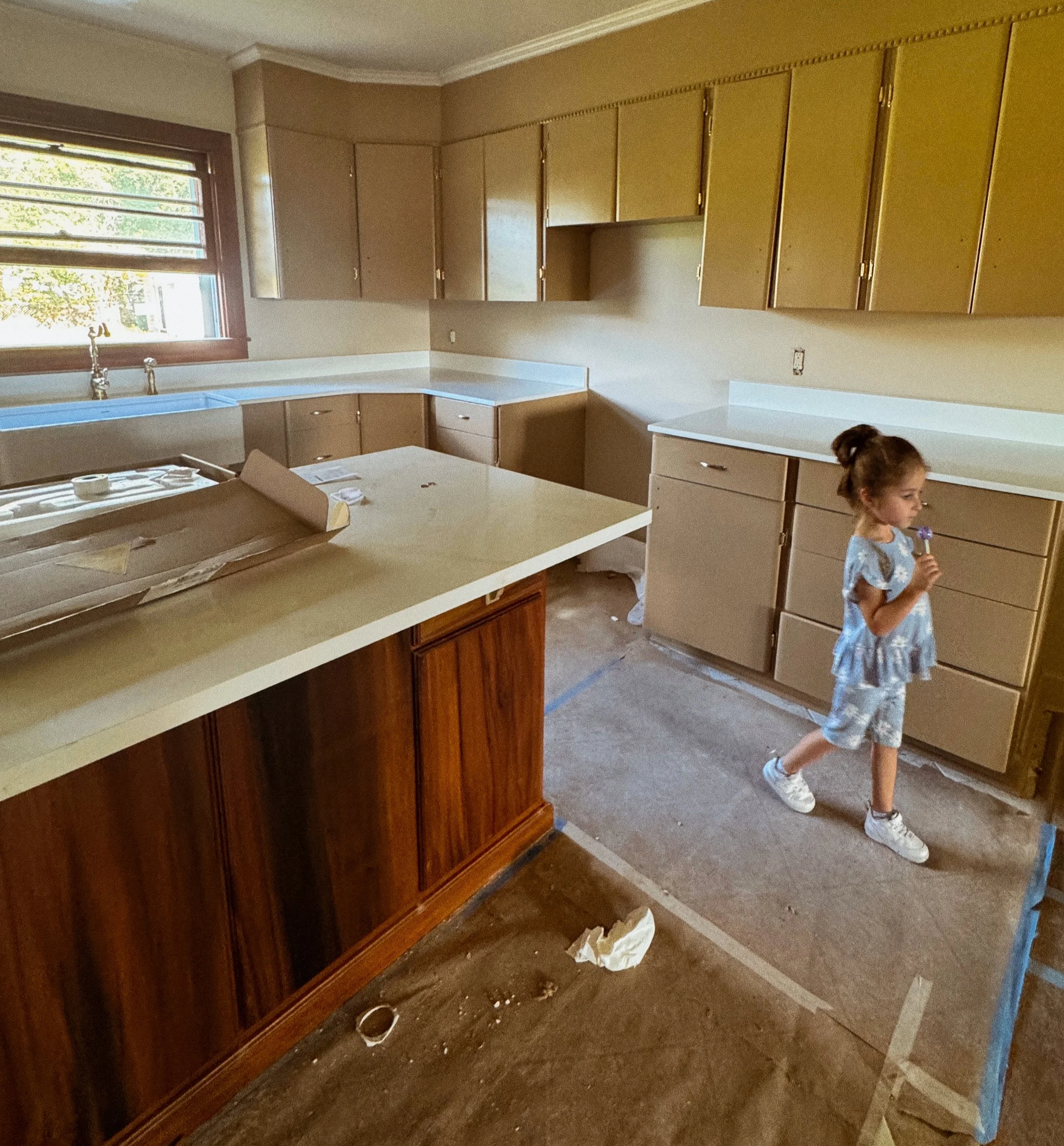
The Kitchen’s Power Couple: Veined Countertops + Vintage Pendants
The island has landed, and she’s the moment.
We went for rich stain with a warm, grounded midtone, somewhere between a walnut and acacia finish, with those deep espresso striations that catch the light just enough to show off the grain. It’s not too polished or too rustic. It has that intentional, lived-in sheen that feels like it’s been there long enough to earn its confidence.
It’s doing exactly what it should: marrying the tone of the new floors with the original wood paneling in the dining room. The stain bridges those elements without competing: the cooler undertones of the flooring meet the honeyed warmth of the paneling halfway, and the island becomes the translator. Above it, a pair of vintage-inspired glass pendants will tie the look together. Their scalloped shades and subtle brass hardware feel familiar but refined — a soft nod to the home’s midcentury roots without dipping into nostalgia.
That continuity is what makes the Teche renovation feel considered instead of contrived. We didn’t erase the home’s original soul — we enhanced it. The untouched wood ceiling and walls in the dining now read as a deliberate design choice, not an afterthought, because the island carries that same organic depth forward. Something moody but still grounded. Topped with a thick Calacatta gold-veined quartz slab, it just quietly commands attention. As for the countertops along the wall cabinets? Simpler white quartz, so the island can actually be the anchor instead of fighting for attention.
This is where wine gets poured. Where gossip, business deals, pivotal life moments, and minor existential crises will happen. If you’re not leaning on this island mid-rant like it’s your scene partner, you’re missing the point.
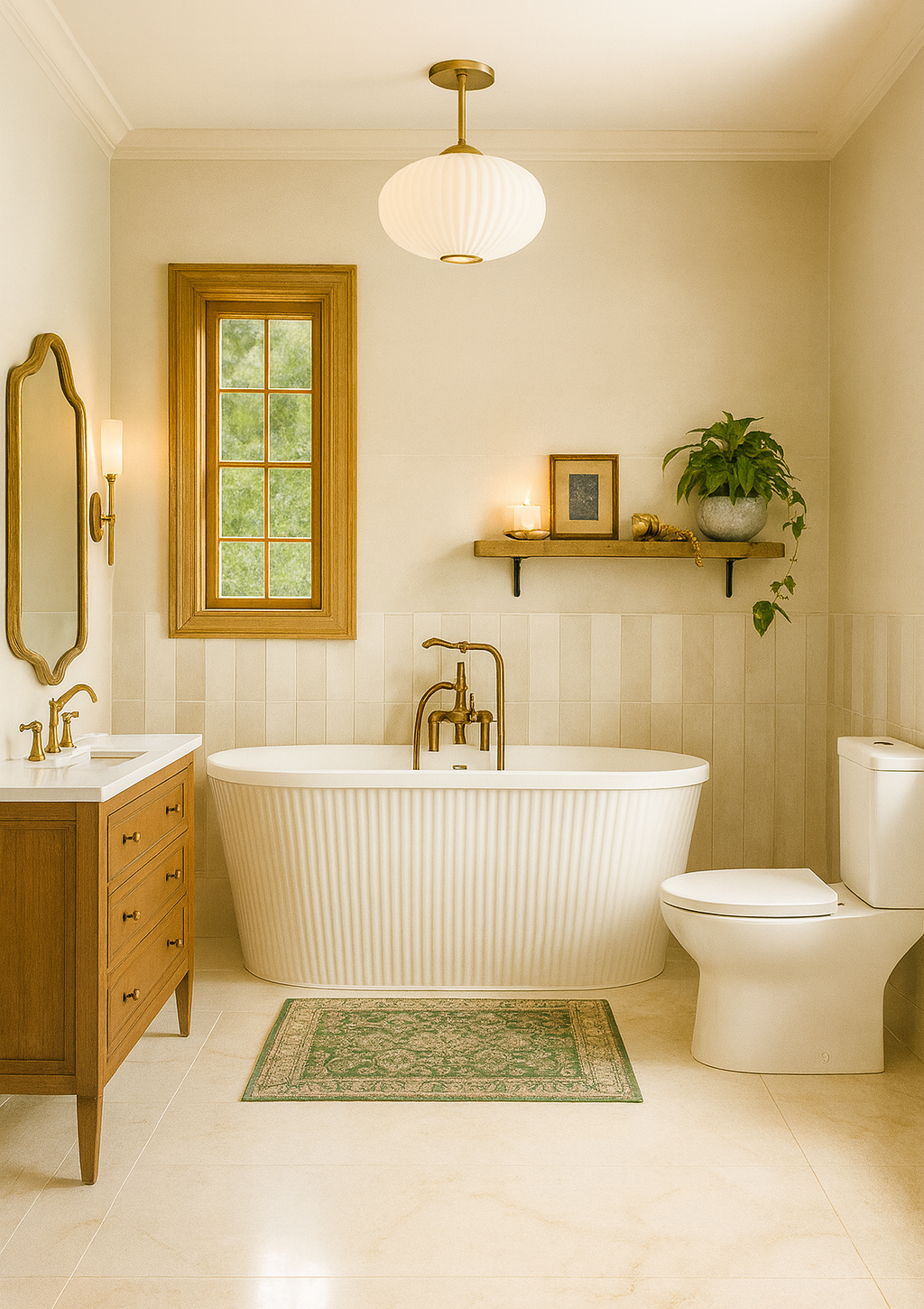
Primary Bath: Vintage Brass Fixtures, Vertical Stripes, and a Hint of Main Character
Let’s start with the primary bath, because I don’t believe in saving the best for last.
We took a risk with hand-cut vertical tile arranged in a striped pattern, and it paid off big time. Paired with soft creamy walls and antiqued brass plumbing that looks expensive (but wasn’t), the whole room feels like a boutique hotel in Paris had a baby with a southern cottage.
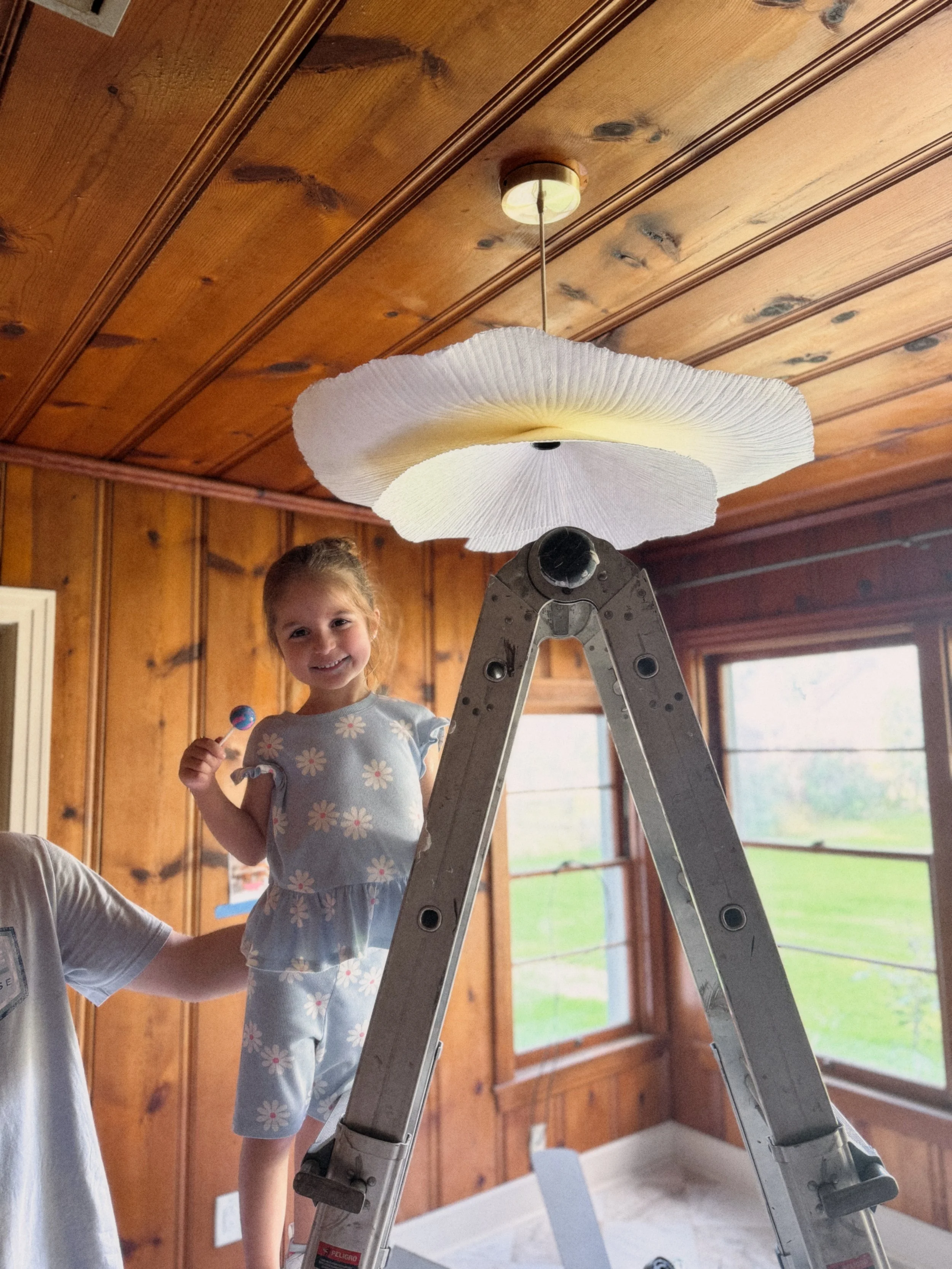
The chandelier saga continues. The dining one was too big for the space. The bathroom one? ALSO too big for the space. So we pivoted—shifted the bath fixture to the dining room (taking the wood paneled dining room from “maw maw’s duck camp” to “modern cottage with a touch of romantic whimsy” ) and found a better-scaled one for the bath (fluted details win again). It’s all about the ability to pivot, keeping a (tired but keen) eye on proportions, and refusing to settle for “fine.”
Now the primary bath is all vintage brass fixtures, sculptural sconces, and just enough glow to make the paint color flex. Suddenly it’s not just a bathroom, it’s a vibe. Less Pinterest-core, more lived-in luxury. Personality-core with a capital P.

Guest Bath: The Moody One with the Niche (Literally)
In a word? She’s moody. We went full navy and onyx marbled tile in the shower, which makes the tub pop and adds just enough drama without going full batcave.
The real MVP here is the custom inset shampoo niche, finished in the same terrazzo tile as the floor — just cut into scallops in alternating scale, because you know I love a difficult detail. Brass trim finishes it off, and the deep navy ceiling ties it all together.
Still under construction, but the vision? Fully loaded.

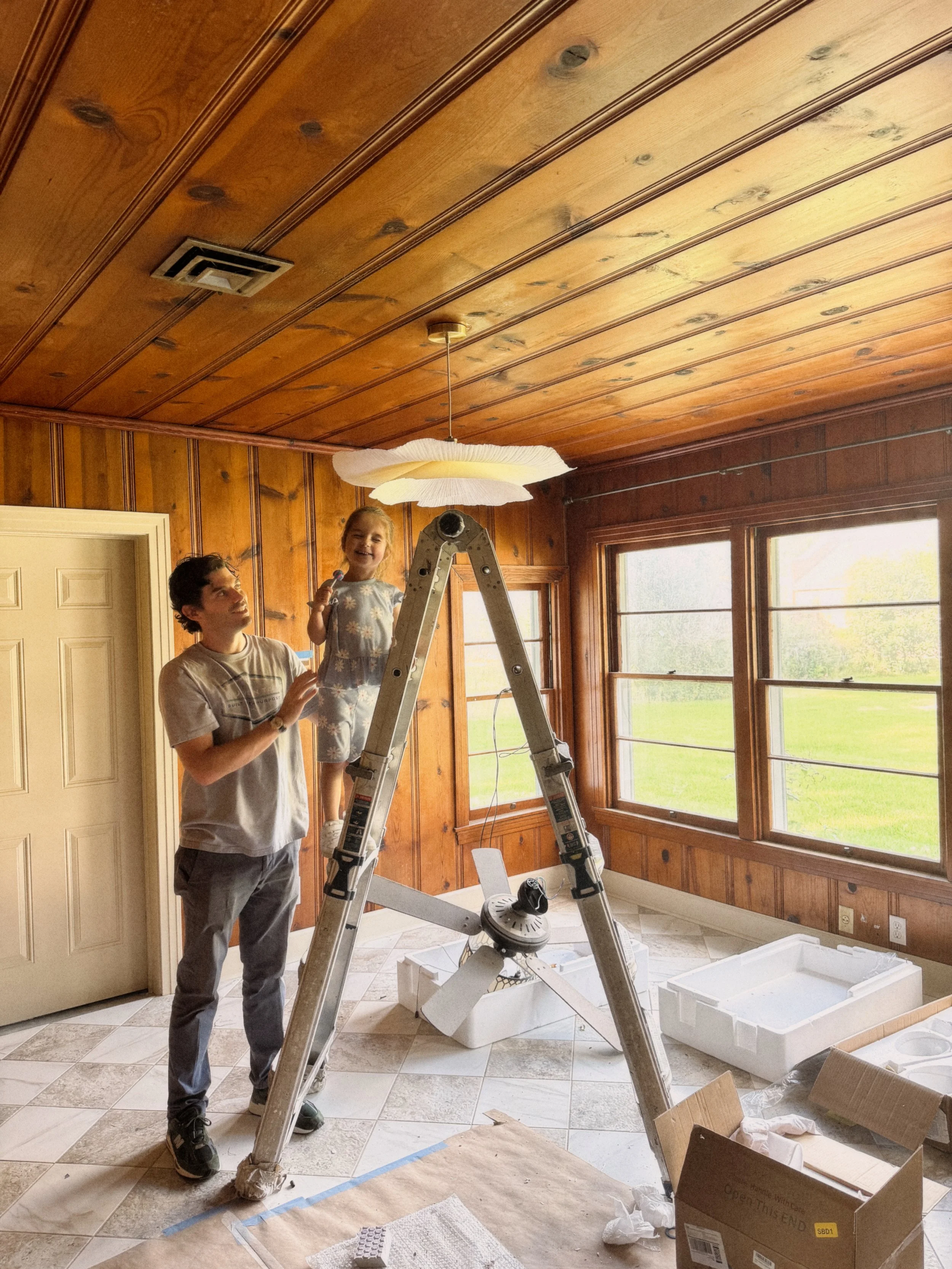
Behind the Scenes: Still Messy, Still Magic
By this stage in any renovation, the universe starts to get a little bold with her sense of humor. Fixtures arrive cracked. Boxes show up missing the one part you actually need. And in our case, a certain supplier — looking at you, Bezos! — managed to send us a 2008 Honda Odyssey radiator instead of the pair of primary bathroom mirrors we ordered. (Close, but not quite.) It’s the part of the process where you stop asking why and just start asking how fast can I return this? But even with the shipping mishaps and dented egos, the house keeps moving forward — stubbornly, beautifully, almost in spite of us. We’re in the best part. The click moment. When design, function, and results finally agree on something.
I brought Evie through during demo months ago. Dust everywhere, a house held up by framing and vision alone. She stood on the porch and yelled, “Mama! Make this house beautiful!”
I’m happy to report: we did.
105 Teche Drive is becoming that balance of modern and nostalgic—a home with personality, presence, and no interest in playing by flip-book rules. What’s next: The last of the light fixtures, paint touch ups, final punch list, exterior cleanup, and prep for styling.
We’re almost at the part where I stop sweating about grout color and start posting listing links.
Stay tuned.
FAQs
-
We’re not doing beige boxes. Every decision has intention, texture, and a little rebellion baked in.
-
Lafayette light—rich hues, moody, and way too pretty to waste on gray paint.
-
By treating every project as a design story—not an inventory item.
-
We design for living, not for listing photos.
-
It’s a city that loves comfort and story. We design to reflect that.
-
We focus on long-lasting materials and timeless finishes over fast-trend choices.
-
Appliances, 1000 punch list items, final styling, and a photoshoot that’ll make all the dust worth it.
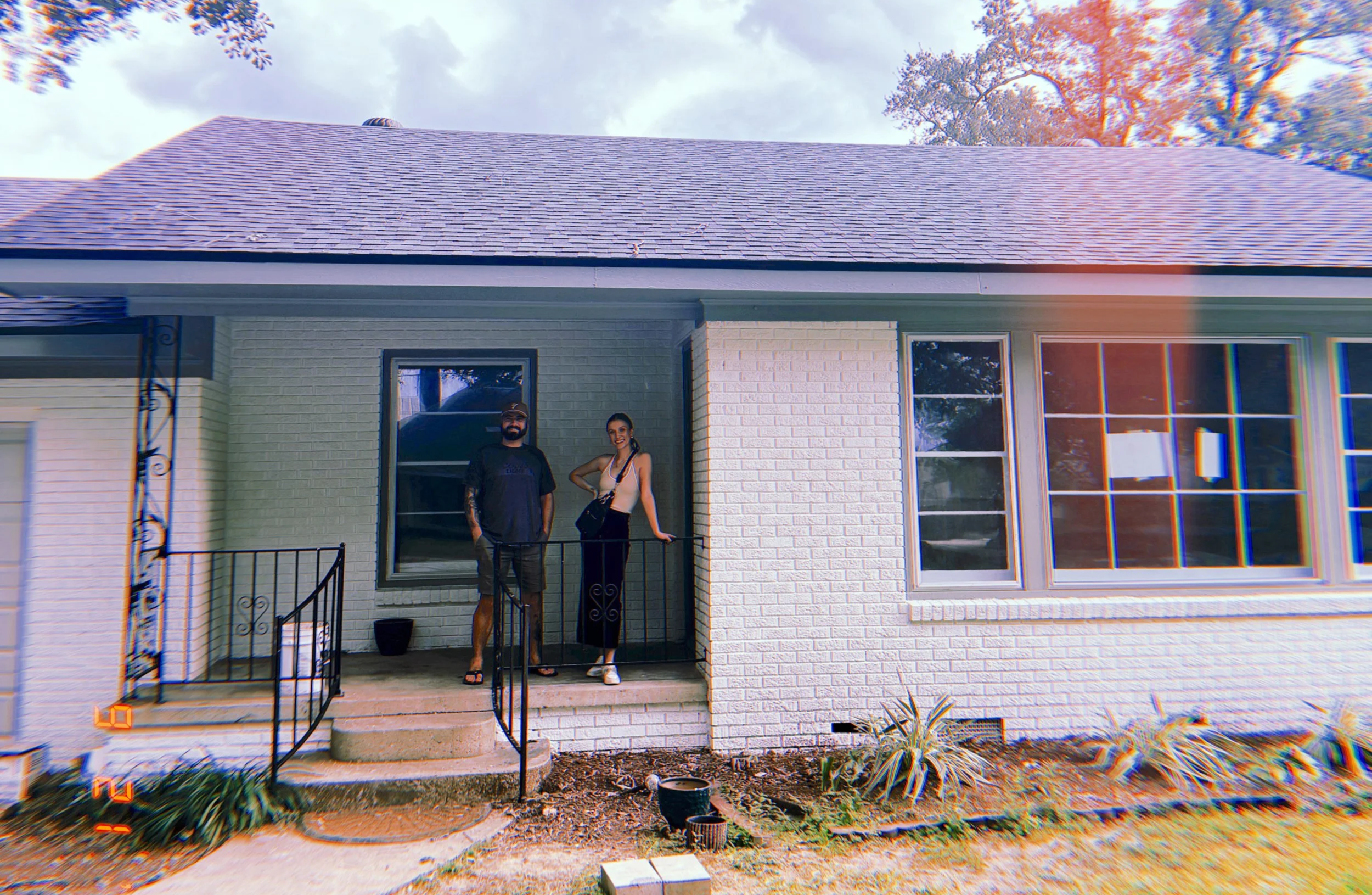
Teche’s Hot Girl Era: Paint Done, Floors Down, Fixtures Loading
We’ve officially entered the best phase of the Teche Flip—the glow-up. With moody cabinets, custom hardware, vintage tile, and the kind of kitchen island that demands a glass of wine, this house is finding its identity. Think warm tones, quiet luxury, and just the right amount of drama. Come behind the scenes as we break down the finishes, the flair, and the still-very-real countertop chaos.
That “Wait… It’s a Real House Now?” Moment
You know that feeling when a renovation crosses the threshold from “project” to “place you actually want to hang out in”? We’re there. 105 Teche Drive isn’t just a construction zone anymore—it’s giving modern-luxe moodboard meets actual livable space. Paint? Done. Cabinets? Finished. Floors? Laid. Fixtures? In transit. And let’s not forget the moody-stained kitchen island that’s been stealing focus like it’s auditioning for an Architectural Digest cover.

The Wall & Cabinet Saga: A Color Commitment Crisis Worth Having
I lost sleep over these paint colors. We chose ten. I tortured Blaise. But every drop of drama was worth it. The walls aren’t just painted—they’re dressed. Wrapped in creamy warmth, soft neutrals, and just enough contrast to keep it interesting. The cabinets complement without competing. It's giving restraint with a wink. Even my sometimes-grumpy-always-practical flip partner had to admit “I had my doubts, but somehow all of this works even better than you promised it would.” (Thanks for admitting I was right, Blaise!)
Design tip? Sometimes indecision is just dedication in disguise. And yes, I’ll die on that hill.
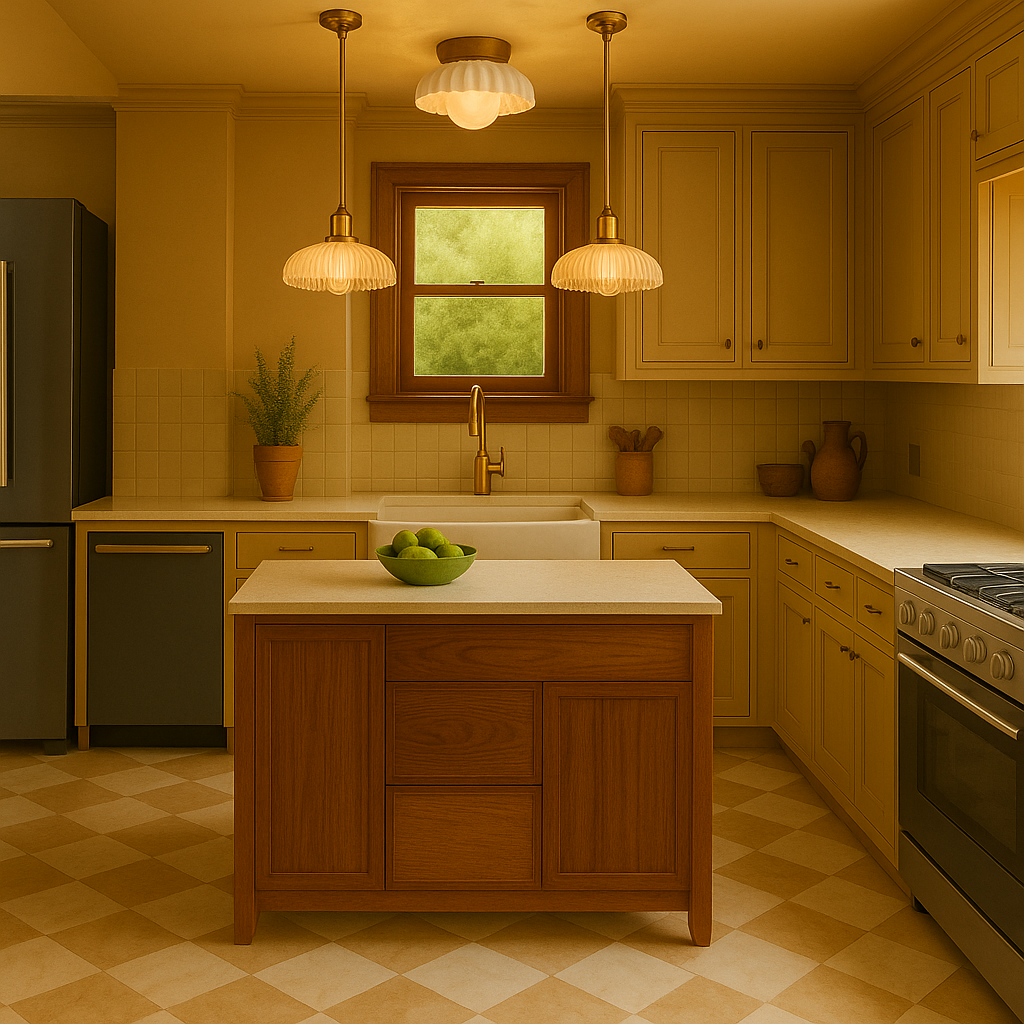
Let’s Talk About the Kitchen Island—Because It Deserves Its Own Section
This island isn’t just a surface; it’s a vibe. We went dark and moody, but kept the woodgrain visible—rich, grounded, a little mysterious. It says: “I host wine nights but also get sh*t done.” It anchors the space visually and emotionally. It’s not just the heart of the kitchen—it’s the soul of the flip.
I’ve already mentally styled it three ways. And yes, there will be a ceramic fruit bowl with one aggressively aesthetic pomegranate in at least one listing photo. Fight me.
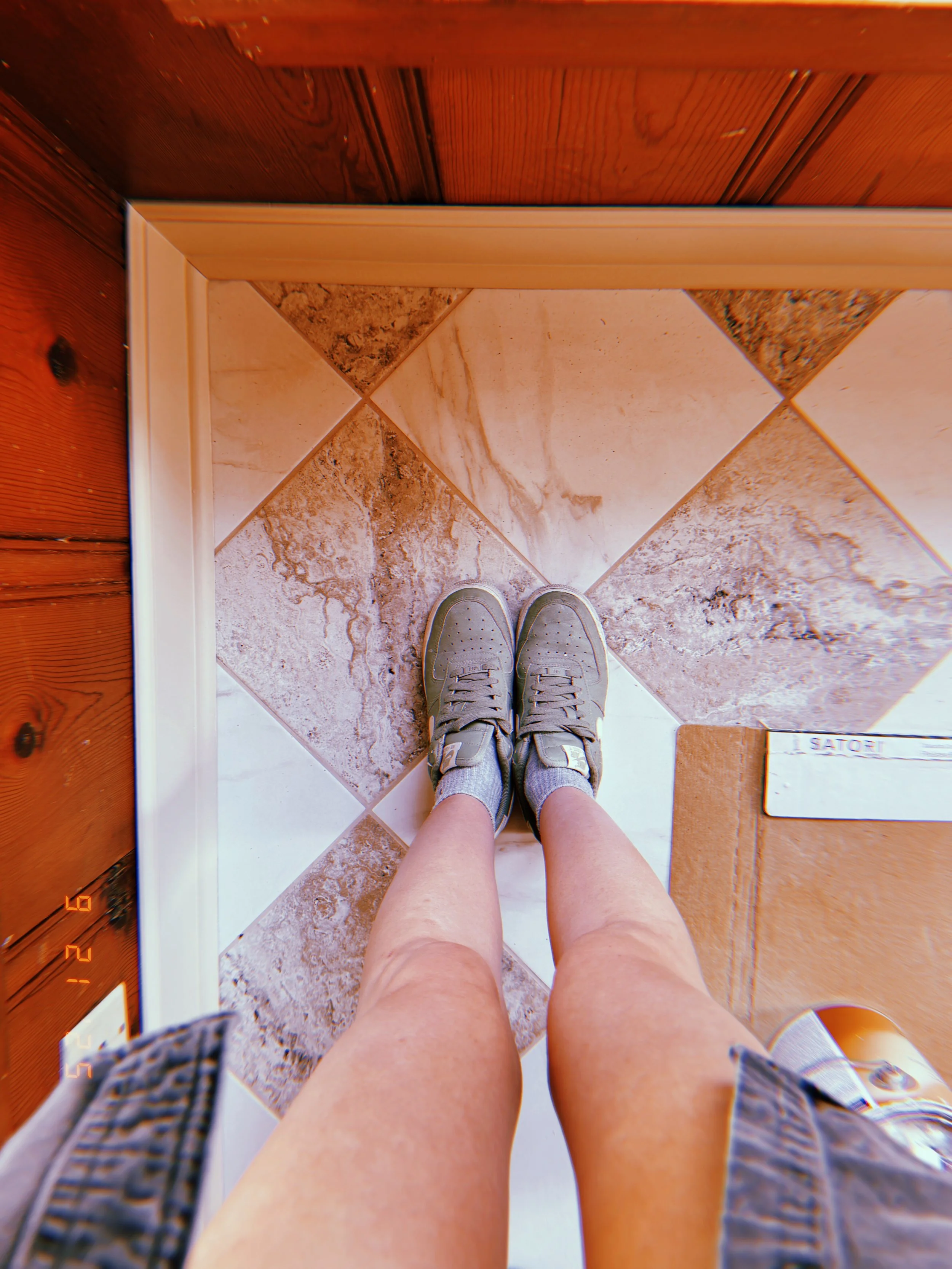
Floors: She’s Grounded Now
Subfloor echoes? Gone. Now it’s solid, checkerboard tile and warm wood tones underfoot. The kind of flooring that makes you want to ditch your shoes and slow-walk through the house with a glass of wine like you’re in a Nancy Meyers movie.
We went for wide plank, matte finish—chic but not trying too hard. The last few corners are getting touched up, but the foundation of the home’s vibe is down, literally and stylistically.
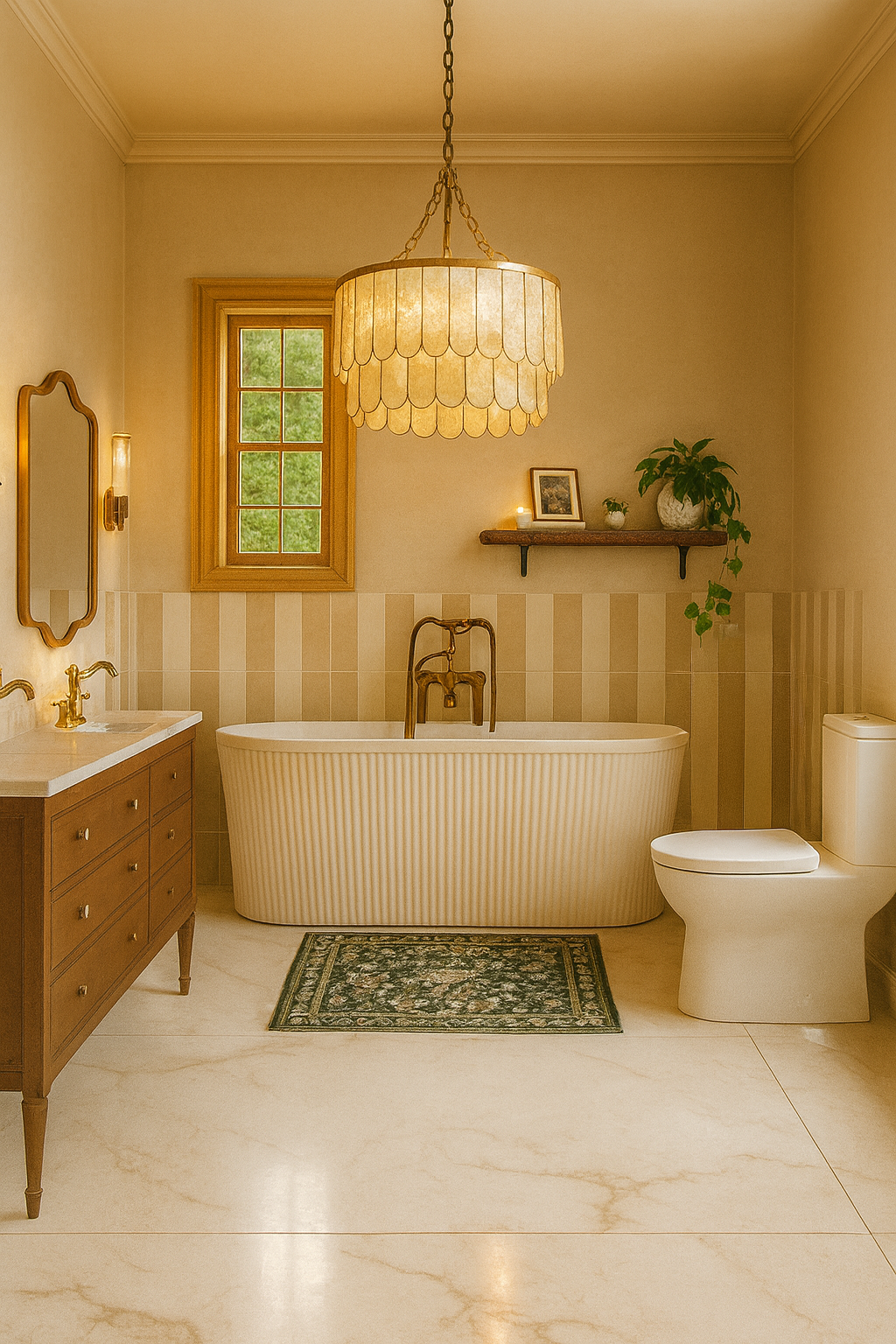
Fixtures, Vanities & That Tub Surround: All the YES Moments
Let’s get into the real stars of this phase:
Vanities: Not just storage—statements. Think antique wood, soft-close everything, and a finish that whispers "spa" but still holds your dry shampoo stash.
Tub Surround: Custom, clean, but full of personality. It’s got that “you could definitely take a dramatic Sunday soak here” energy.
Lighting: All ordered. All on theme. Brass. Globes. Sconces. Drama. I’m lighting this house like it’s about to walk a red carpet.
There’s nothing quite like watching your Pinterest boards materialize into actual shipments arriving on site. If serotonin came in box form, it would look like pendant lights.

Touch Me Textures: The Hardware Edit
Let’s talk hardware—because she’s not just decorative, she’s the unsung hero of a well-dressed space. What may feel like trivial details to some are actually the most important part of bringing a space together— it’s ALL about the touch points. I went deep into the design rabbit hole and came out holding vintage-inspired brass beauties that are the literal definition of quiet luxury.
Antique Brass Cabinet Pulls
We’re talking warm aged brass with fluted grip detailing—bold without shouting, luxe without trying too hard. The texture gives just enough grip to feel intentional (read: not builder basic), and the profile hits that sweet spot between traditional and tailored. They’re the kind of pulls you notice after the fact—when you catch yourself running your hand over them because they just feel that good.
Fluted Bedroom Knobs
Don’t even get me started on these chunky circular knobs with beaded backplates. They’re giving vintage vault chic. A little industrial, a little Roman revival, and just enough edge to keep things modern without sacrificing the cottagecore aesthetic. I love how they ground the room—literally. There’s something quietly commanding about them. And yes, I did test them in every lighting condition like a psycho.
Glass + Brass Bathroom Doorknobs
As for the bathroom doors? We’re doing glass knobs set in aged brass rosettes with a slight Art Deco flair. It’s serving restored antique but make it curated. They sparkle in the best way—like a design Easter egg when the sun hits just right. You could be wearing a ratty robe and still feel like Old Hollywood just brushing past one of these.
These hardware choices don’t just finish the space—they elevate it. Like couture for your cabinets. Functional, yes. But mostly? Just straight-up FAB.
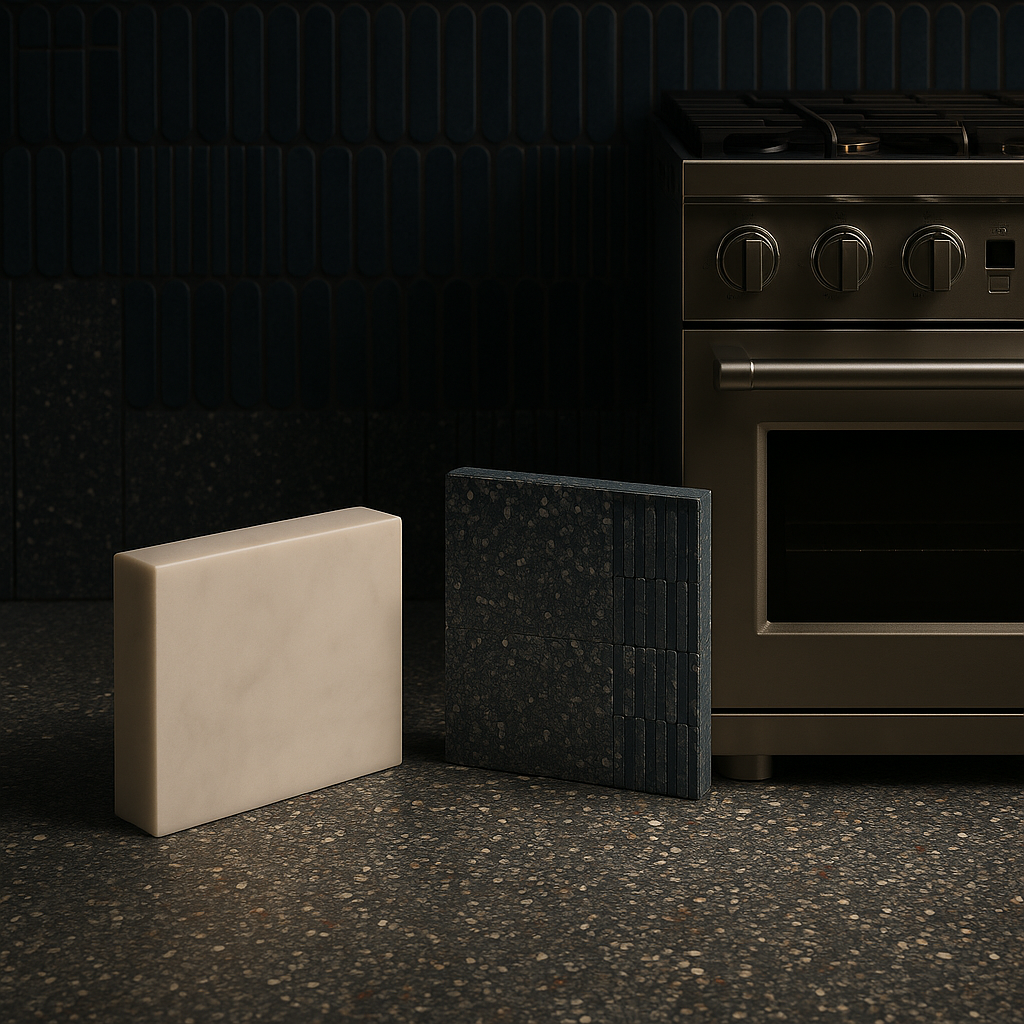
On Deck: Stone Slabs, Dreamy Tile, and Appliance Angst
Every good glow-up has a few cliffhangers. Here’s ours:
Countertops: I’m spiraling between quartz, soapstone, and one statement color that’s so unexpected I kind of love it.
Terrazzo Tile: The hall bath is getting it. Non-negotiable. It’s retro, modern, and quietly expensive-looking all at once. Literal design dream unlocked.
Appliances: Time to make decisions that are both aesthetic and functional. The big players. The stainless steel soldiers. The things that make a kitchen not just pretty, but powerful.
These aren’t just finishing touches—they’re identity-defining choices. The things that move the Teche Flip from "cute Instagram girl" to “she’s got a mortgage and a skincare fridge.”

The Vibe Check: Teche Flip, but Make It Personal
We’re living in the sweet spot of any renovation—the click moment. When everything begins to align. Walls have warmth. Floors feel finished. Light is coming. It’s not just a house anymore—it’s a whole mood.
Modern with a nostalgic wink. Elevated but not unapproachable. A little dramatic, a little romantic, and a whole lot of her.
And while countertops, terrazzo tile, and appliance decisions loom on the horizon, I’m allowing myself this moment of pause to say:
105 Teche is coming together—and she’s everything.

How 10 Paint Colors and a Perfect Sink Defined This Flip
At 105 Teche Drive, we painted the cabinets, stained the island, swapped in a 36″ gas range, and (yes) used ten paint colors. Add in the farmhouse sink I’m head over heels for, plus brass lighting magic, and this flip’s kitchen finally found its rhythm.

The Flip That Keeps Teaching Me Lessons
If the first phases of this flip were all about structural drama and the second was budget-breakthrough chaos, then this chapter is officially the paint-fueled emotional rollercoaster. We’re deep into the kitchen now — where every design choice either cements the cottagecore-modern dream or spirals into Blaise muttering about aneurysms. Spoiler: both happened.
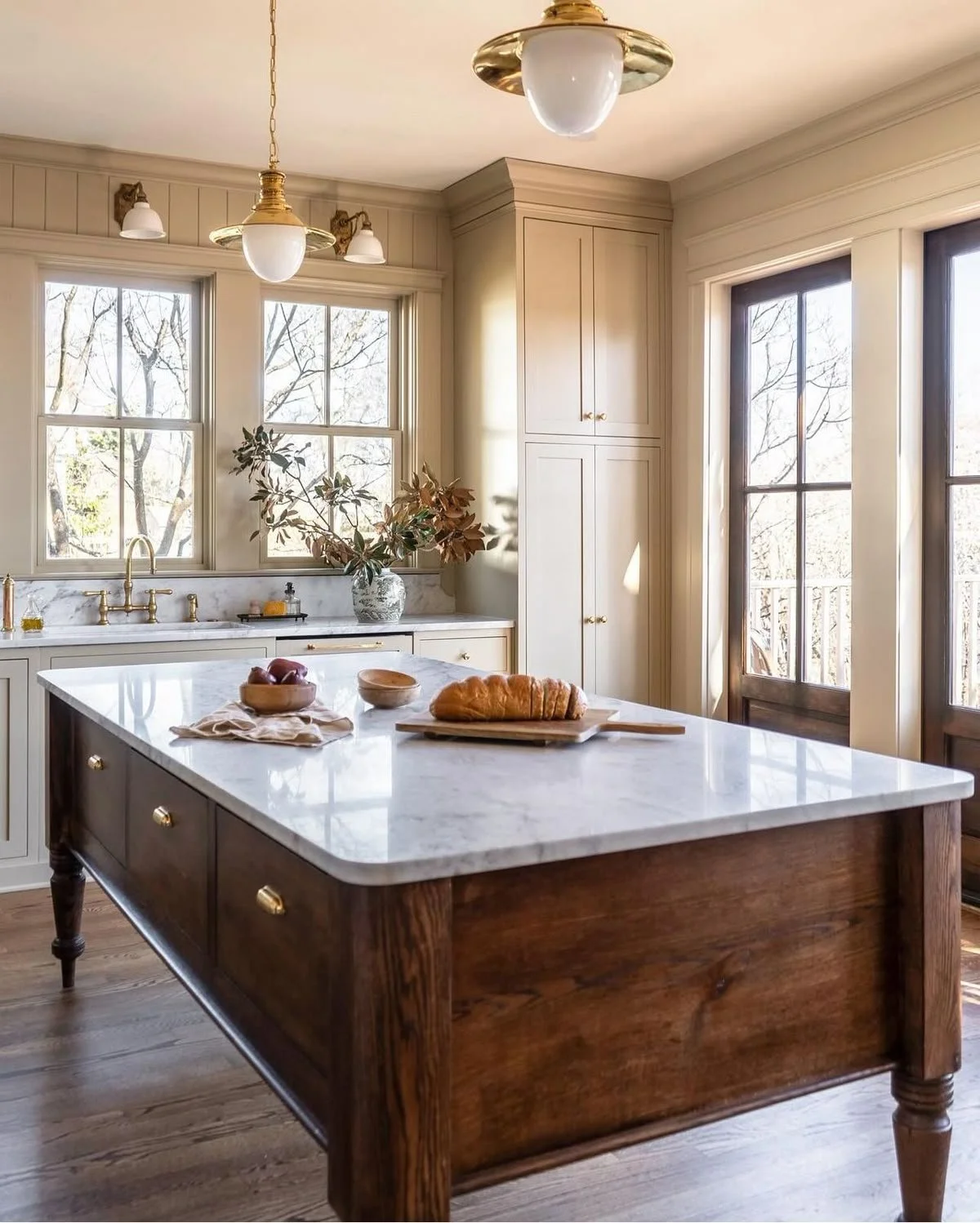
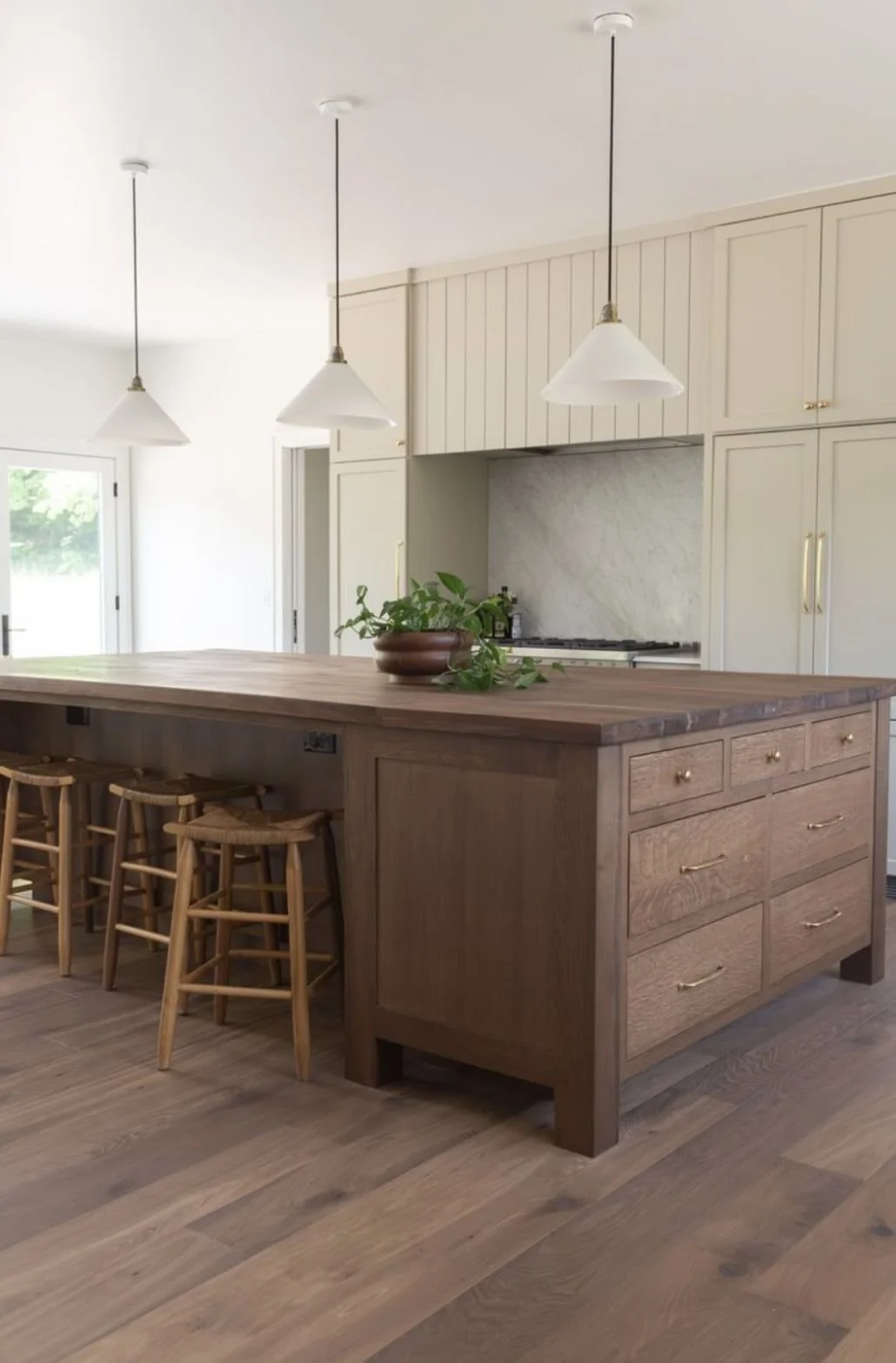
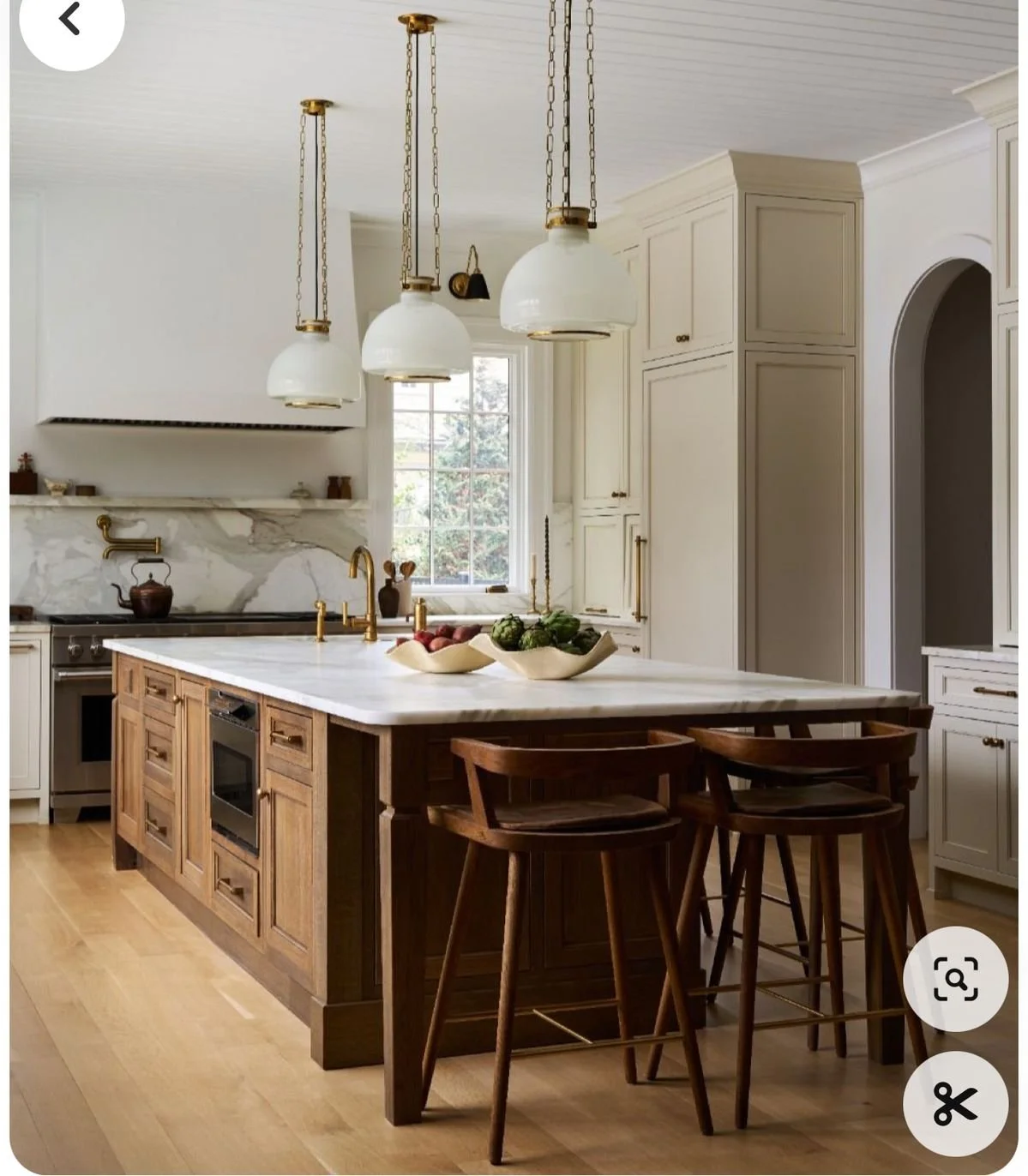
Cabinets That Got the Glow-Up
We finally committed: painted wall cabinets + stained island.
It’s the kitchen equivalent of a power couple — one side crisp and classic, the other warm and grounded. The painted wall cabinets keep the space grounded while the wood island delivers that moody, cozy hit I can’t live without. It’s modern cottagecore in one fell swoop.

The Great Range Relocation
Remember how we planned a 30″ in-island gas range? Yeah, that’s gone. Instead, we’re opting for a 36″ wall range. Moving it freed up the island for prep, storage, and seating while giving the range its own moment on the wall with more space to actually cook— a win-win if you ask me. Functionally, it’s a dream. Aesthetically? Total win.
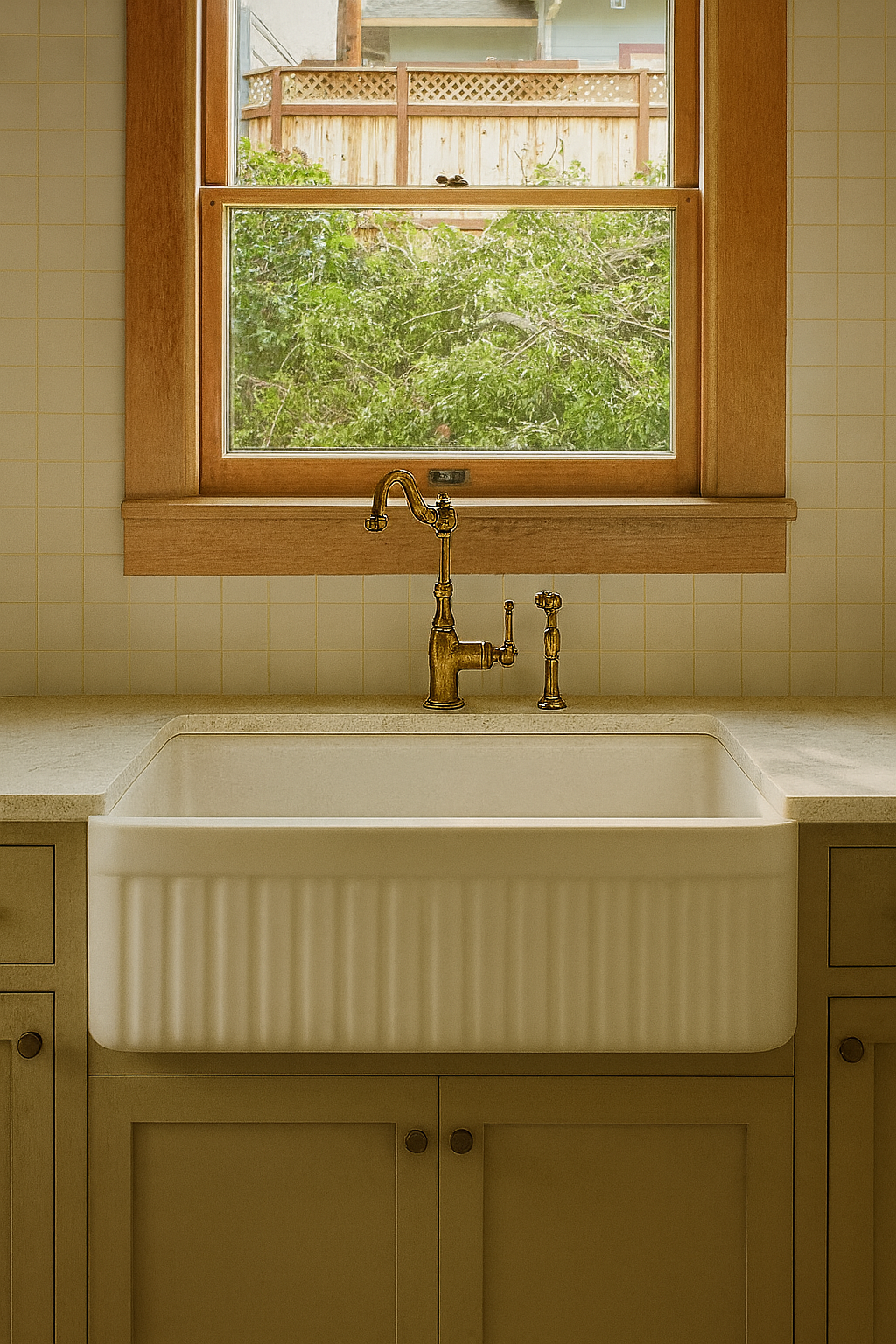
The Sink That Stole My Heart
You know when you see the one? That’s how I feel about our sink. An apron-front fluted beauty with just enough heft to anchor the whole wall. Paired with a brass faucet, it’s equal parts romantic and practical. This was one of those decisions that Blaise and I were both gung-ho for the second I sent the link.

Top Row (Left to Right): Double Latte, Malabar, Garden Gate, Hot Cocoa, Maison Blanche
Bottom Row (Left to Right): Best Bronze, Samovar Silver, Delft, Shoji White, Waterloo
Ten Paint Colors. TEN.
Here’s where Blaise nearly lost it. We (aka me) landed on ten different paint colors for this house (and that’s not counting sheens). Walls, ceilings, trim, cabinetry — each got its own treatment. I insisted it was non-negotiable.
To avoid painter mutiny, we taped every single can with the code + sheen and matched that to the walls, trims, and ceilings. We even taped huge “DO NOT PAINT” signs on the wood paneling and window trim that we opted to leave as is. It looked like a paint-coded war room. But it worked, and the depth it’s giving each space? Worth every eye-roll from our paint crew.

Lighting Lock-in
After rounds of indecision, we’ve locked (almost) everything: brass pendants, sculptural sconces, and globe lights. They’ll tie together the (I’ll admit) excessive paint palette, carefully curated tile choices, and dreamy rich wood tones into one cohesive, cottage-modern glow.

When Chaos Finds Its Rhythm
This flip keeps teaching me that design is as much about the big-picture vision as it is about the tiny details that nearly break you (or your partner). Painting cabinets, relocating a range, obsessing over a sink, juggling ten paint colors, and finalizing lighting—it’s all adding up to a kitchen that feels like 105 Teche’s heart, and a house that feels like a home.
Next up? Tile installs, finalizing plumbing fixtures, picking out appliances, and a whole slew of fun things! Stay tuned.
FAQs
-
We wanted the best of both design worlds. Painted wall cabinets keep things light, clean, and airy — like a fresh exhale in the morning. But the island? That’s where we grounded the room. The stained wood brings in that rich, moody depth, adding contrast and cottagecore warmth without overwhelming the space.
But more than just aesthetics, this choice was rooted in respect: the original solid wood cabinets were high-quality, beautifully built, and worth keeping. Rather than ripping them out, we gave them a refresh — painting the uppers to modernize and brighten, while still making them functional, easy to clean, and durable for everyday use. It's a revival, not a replacement. Balance with personality and practicality.
-
Think of it as going from a well-fitting tee to a tailored blazer — same idea, way more impact. The 36" gas range gives us more burners, better functionality for serious cooking, and serious wow-factor for resale. Plus, once we moved it to the wall, we freed up the island to be all about prep, storage, and entertaining.
-
Oh, where do I start? It’s deep enough to handle real-life messes and pretty enough to anchor the kitchen wall while staying cohesive to the rest of the design (looking at you, fluted master bathtub!) With its apron-front silhouette and classic curves, it hits that perfect note between romantic nostalgia and modern utility. Add a brass faucet? I’m swooning.
But it’s not just a pretty face, it’s also intentional for the lucky buyers of this home. The undermount design means you can sweep crumbs and spills straight off the counter — no grout lines, no raised edges, no fuss. And the single-bowl format? Absolutely perfect for those giant Louisiana gumbo pots. It’s beautiful, yes, but also built to handle the kind of cooking that makes a kitchen feel like home.
-
Yes. And also, absolutely not. Sure most traditional flips don’t go this “hard in the paint” (I’m cringing at myself).
Every room tells its own story, and ten curated colors let us layer mood, tone, and intention throughout the home. It’s not chaotic — it’s deliberate depth. Some may think it’s unnecessary, but guests? They’ll feel it without even knowing why.
-
We ran that job site like a war room. Every paint can was labeled with its code and sheen. Then we matched each surface — walls, trims, ceilings — with taped labels in every room. Zero confusion, fewer mistakes, and just enough micromanaging to make Blaise deeply question his choice in flip partner.
-
We did. Staying within the same brand gave us better control over color consistency and paint quality— especially when dealing with multiple sheens and finishes. No surprises, just smooth transitions from wall to trim to ceiling. All the paint in this house came from Sherwin Williams, both Blaise and I are partial to their products.
-
Like a playlist with no skips. We curated shades that speak the same design language — subtle shifts in undertone and warmth — so each room has its own personality while still feeling like part of a whole. No jarring jumps, just beautiful flow. It was quite a feat, but after about 80 total hours of mock ups and crossed eyes, I sent one of my famous spreadsheets to Blaise and dealt with the raised eyebrows after the fact.
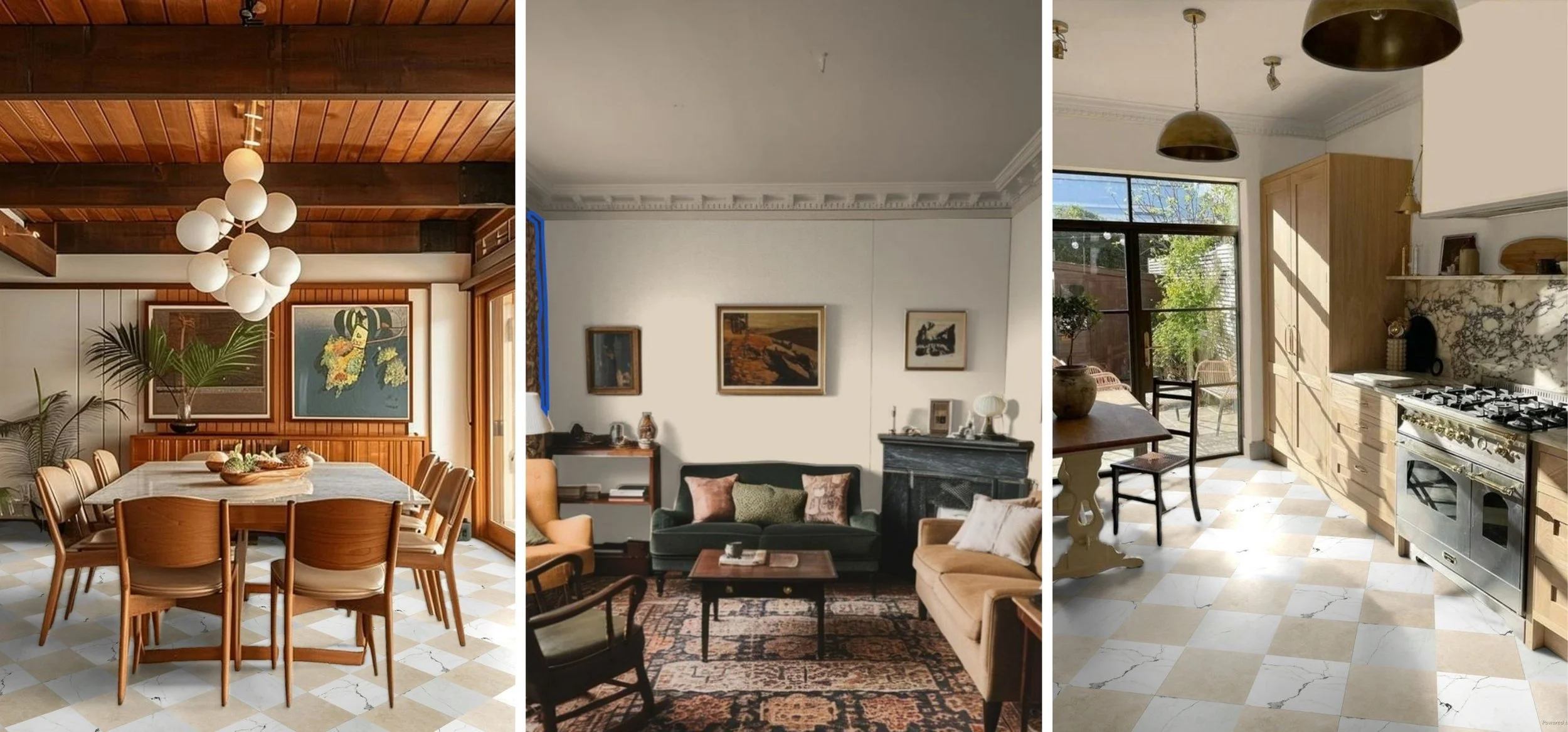
From Chaos to Cottagecore: Teche’s Design Risks, Budget Breakthroughs & Cozy Aesthetic
Flips can feel like spreadsheets in disguise, but at 105 Teche, every risk seems to turn into reward. This Lafayette flip house is shaping up into a modern cottagecore dream—checkerboard floors DIY’d on a budget, moody wallpaper murals in the laundry room, vintage-toned brass fixtures, and paint colors chosen like a playlist. The result? A renovation that feels intentional, warm, and anything but cookie-cutter.

Real Talk Before the Pretty Pictures
Flipping a house is basically like signing up for a group project where you’re the leader, the note-taker, and the one buying snacks—except the snacks are $7,200 worth of tile you absolutely cannot justify.
That’s been the journey at 105 Teche. We started with a house that felt more “structurally haunted” than “dream home”. But after months of foundation fixes, roof replacements, and late-night design debates, it’s turning into something that’s both functional and… dare I say, pretty charming.
If you’ve been following along, you know the vibe has shifted from “what did I get myself into?” to “wait, is this about to be my best flip yet?” Let’s break it down—design risks, budget wizardry, and a heavy dose of modern cottagecore.

Modern Cottagecore Without the Cliché
When you hear cottagecore, you might picture mushroom mugs and gingham everything. Cute, but not sustainable when you’re designing for real buyers (and not just Instagram). What I’m aiming for here is modern cottagecore—which means blending cozy nostalgia with clean, livable updates. This renovation is about enhancing and staying true to the spirit of the home while still giving it the thoughtful updates that still make it not just livable, but a dream living space.
Think:
Textures that feel layered, not chaotic. Plaster walls, warm wood tones, textiles that look collected over time.
Colors with personality. Nothing sterile, nothing too “builder beige.” Just rich hues that feel alive without screaming.
Patterns in moderation. Checkerboard floors, wallpaper in unexpected spots, terrazzo-inspired tile. Small doses that make you pause, not panic.
The point is to create a house that feels warm and welcoming—but still fresh, functional, and move-in ready. A space with soul, not a Pinterest board cosplay.
Budget Tricks That Saved This Flip
I’m all for bold design choices—my budget, not so much. That’s where a little creativity (and a good dose of stubbornness) really saved the day.
Checkerboard Tile: Dream vs. Reality
In my head: a dramatic, magazine-worthy checkerboard floor running through the kitchen, dining, and laundry.
In reality: $7,200 quotes that made me laugh-cry into my calculator.
Solution? DIY. We got in the car, drove the Great American Race: Lafayette Flip Edition, and finally sourced affordable tile at Lowe’s, laid the pattern ourselves to make sure the thickness/exact LxW measurements were compatible for our pattern, and cut the cost down to a whopping $650. It was a little chaotic, a little back-breaking, but totally worth it. I stood firm on my design non-negotiable that shaped the project from day one, and the budget stayed intact.
Strategic Material Swaps
Sometimes it’s less about compromising and more about pivoting. Instead of overspending on “must-have” finishes, I found affordable dupes: terrazzo-inspired porcelain instead of true terrazzo, plaster-textured paint instead of imported limewash. Luxury materials for accents/small spaces, and tried and true budget friendly tile for larger footprints (while still being on trend and vibe obvi). Each choice keeps the aesthetic intact without tanking the bottom line.
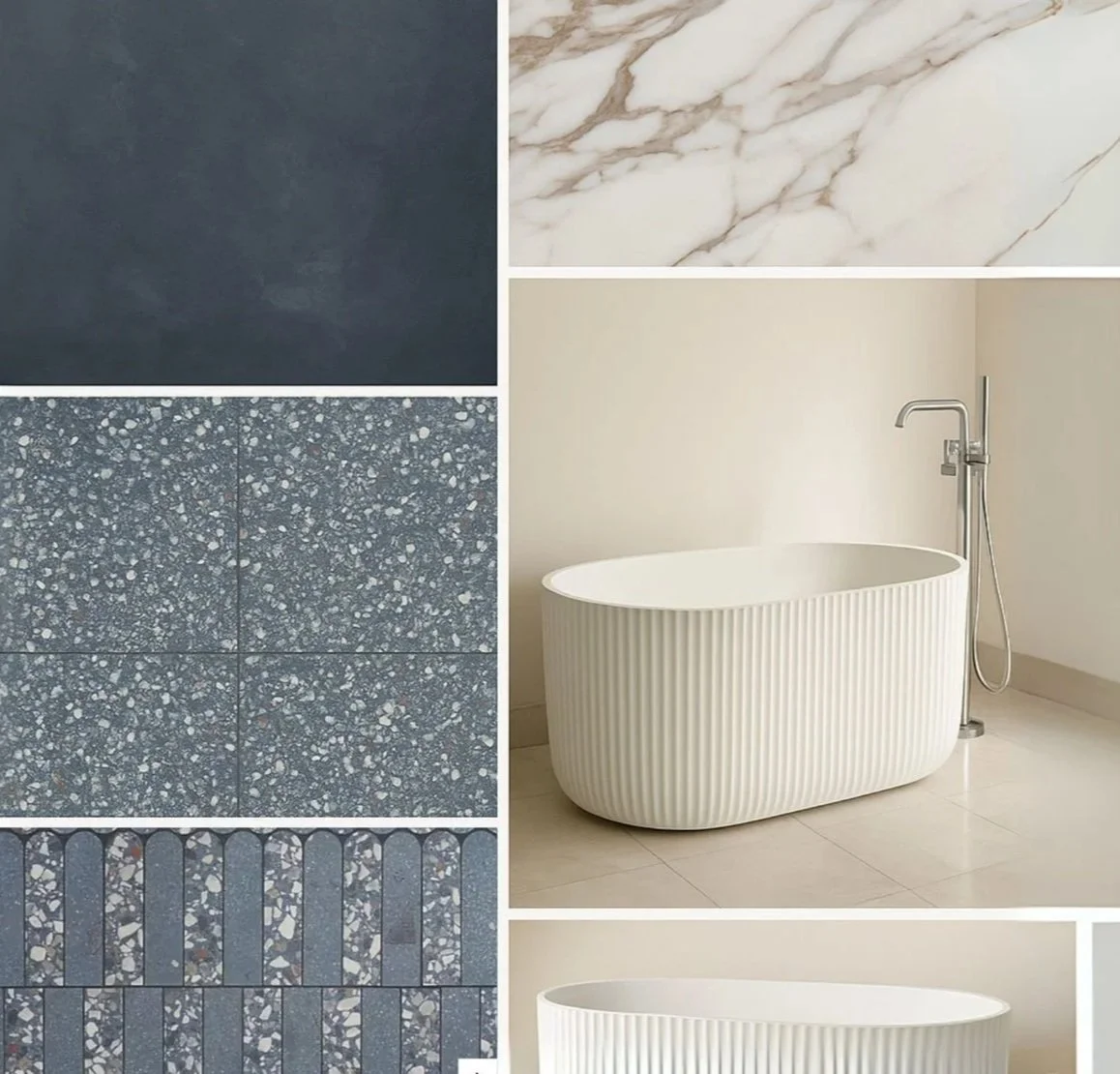
Bathrooms That Refused to Be Basic
Bathrooms are always where flips can tip into either “safe and boring” or “sterile modern style departure” territory. Not at Teche.
Primary Bath
This space got the quiet confidence treatment:
Calacatta Marble inspired floor tile for subtle pattern and texture.
Fluted standalone soaking tub for the vibiest escape of all time.
A layout that feels functional and calm, not fussy.
It’s earthy and understated—but in a way that feels intentional.
Secondary Bath — The Dark Horse
This is the one that surprised me. It’s small, sure, but that just gave me permission to go bold:
Ocean-blue terrazzo floor tile (TileBar’s “Kobe Flakes Ocean Blue”)—playful and moody all at once.
Matte microcement navy shower walls—they absorb light, creating a cocoon-like vibe that makes the tub pop, while still introducing a more natural texture that ties the room into the design flow of the rest of the house.
Shower niche with arched alternating luxury tiles—the kind of unexpected detail that elevates the whole room.
When I shared the mockup with friends, the group chat exploded with heart eyes and “okay but what tile is that??” That’s when you know you’re onto something.

Tiny Details, Big Payoff
Cottagecore doesn’t really live in the oversized gestures—it’s in the details you almost miss at first glance, but can’t stop noticing later.
Like the wallpaper mural in the laundry room, turning what’s usually a “close the door and forget it” space into a spot that actually feels intentional (yes, even folding socks deserves a view). Or the addition of dentil trim accents, those subtle architectural touches that give otherwise plain edges a sense of craftsmanship.
Then there’s the vintage-toned brass plumbing fixtures—warm, lived-in, and just enough patina to avoid the too-shiny “new build” look. Pair that with paint colors chosen like a playlist—every shade in conversation with the next, cohesive without being predictable.
And of course, the lighting. Nothing random, nothing filler. Each fixture placed to shape the mood, not just illuminate it. The result? A house that doesn’t feel “flipped,” it feels considered. Designed. Like someone cared about the small stuff.

Conclusion — Still in Motion
Teche isn’t done yet, but the progress feels exciting. Risks are paying off, the budget hasn’t collapsed, and the house is finally shedding its “before” energy.
We’re heading toward the fun part—staging, finishing touches, and eventually listing—but for now, I’m just enjoying this in-between moment where vision and reality are finally syncing.
And yes, I’m still open to mirror and sconce suggestions. Or laundry wallpaper votes. Or any unsolicited design hot takes. You know where to find me.

Quick FAQs (Because People Always Ask)
-
A: Balance. Too much floral wallpaper and it screams costume, too many niche/trendy light fixtures and it feels cheap. But pair vintage-inspired touches (like brass fixtures and botanical artwork) with modern functionality (like updated layouts and smart lighting), and you get cozy luxury without kitsch.
-
A: Absolutely, when done right. Buyers love character, and the cottagecore aesthetic layers warmth into a renovation. The trick is being intentional: wallpaper in a laundry room instead of every wall, brass plumbing fixtures instead of builder-basic chrome. Those details sell (and I have the eager potential buyer DMs to prove it).
-
A: Paint. Always paint. At Teche, carefully chosen palettes gave each room personality without adding unnecessary budget spend. Lighting comes in second—swap one boring overhead for a statement fixture, and suddenly the whole vibe changes. These are also the most DIY friendly upgrades, and labor costs are always the first to get out of hand in a home renovation. Say it with me: Sweat Equity.
-
A: Like curating a playlist—you want every track to feel different, but still cohesive. Each color was chosen in conversation with the next. Neutrals with depth, moody accents for contrast, and no sterile whites in sight. Unlike most flips that have 2 colors: trim and wall, we really went for maximalism here in color and sheen variation.
-
A: Loaded question, but at the risk of oversimplifying I can attest to this: Buyers are leaning toward cozy, character-driven spaces. Think: textured walls, mixed metals, vintage-inspired furniture, and warm neutrals. The farmhouse-gray trend is fading, and personality is back in.
-
A: Because they make buyers stop and feel something. Anyone can recognize a mass-market flip. But a dentil trim detail or tiled shower niche tells people the house was designed, not just renovated. That’s the emotional hook. This also isn’t your typical “quick flip turned investment property,” at our price point and level of detail, this isn’t so much a “flip” as it is an upscale restoration destined to be a lucky buyer’s forever (or for a long time) home.
-
A: Spend where it matters—tile, fixtures, lighting—and save where you can DIY. At Teche, the checkerboard floor went from an almost 7 figure estimate to a little over $500 total with a scrappy Lowe’s hack. Buyers notice the design, not the receipt.
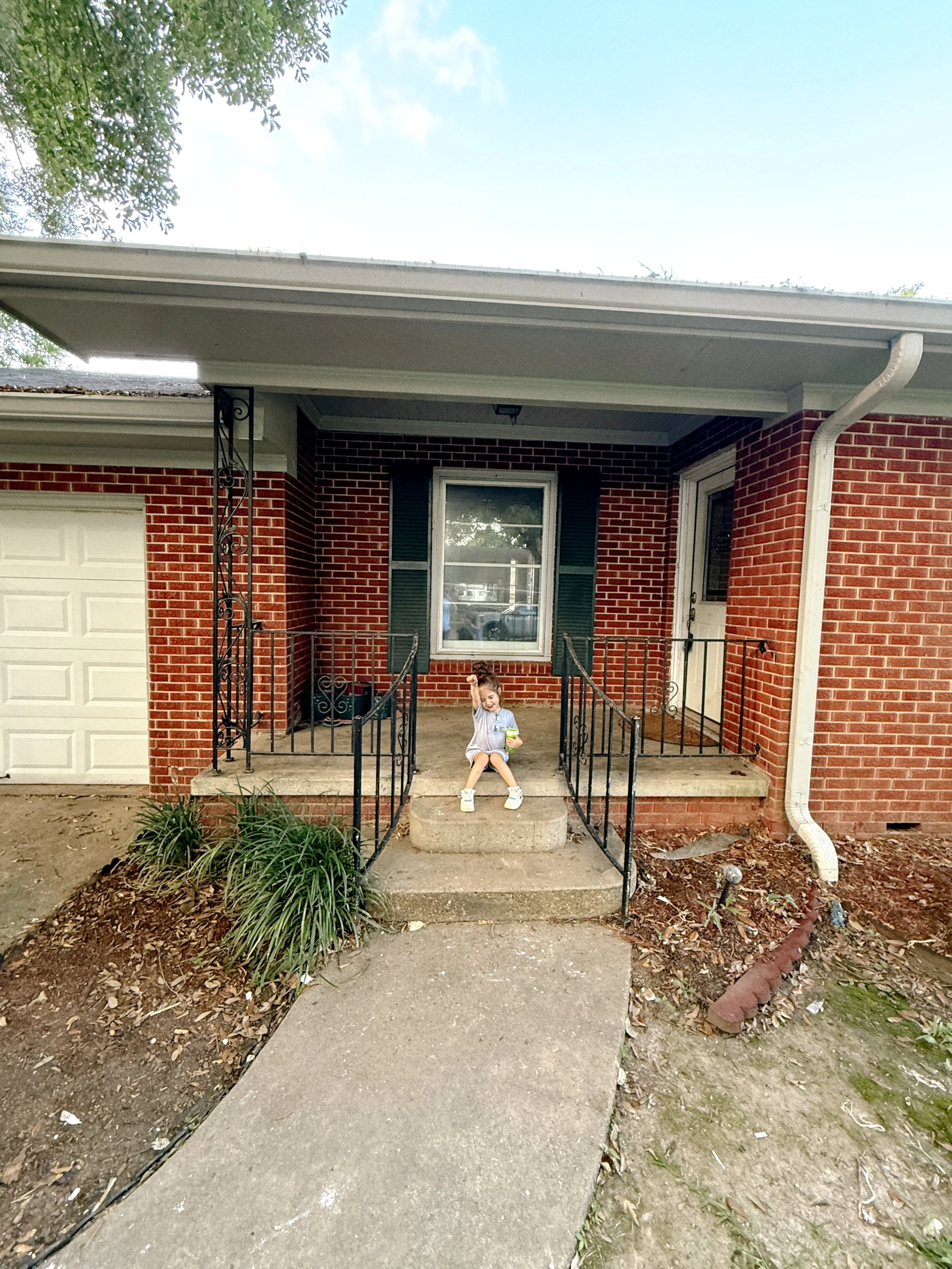
From Structural Fixes to Style Moves: The Teche Flip Gets Serious
What started as a modest midcentury brick home is quickly turning into something layered, livable, and full of surprises—like the window we uncovered mid-bathroom demo. From a brand new roof to a freshly framed third bedroom and a just-picked exterior palette, this flip is growing up fast. Catch the latest progress, design direction, and where we’re headed next.
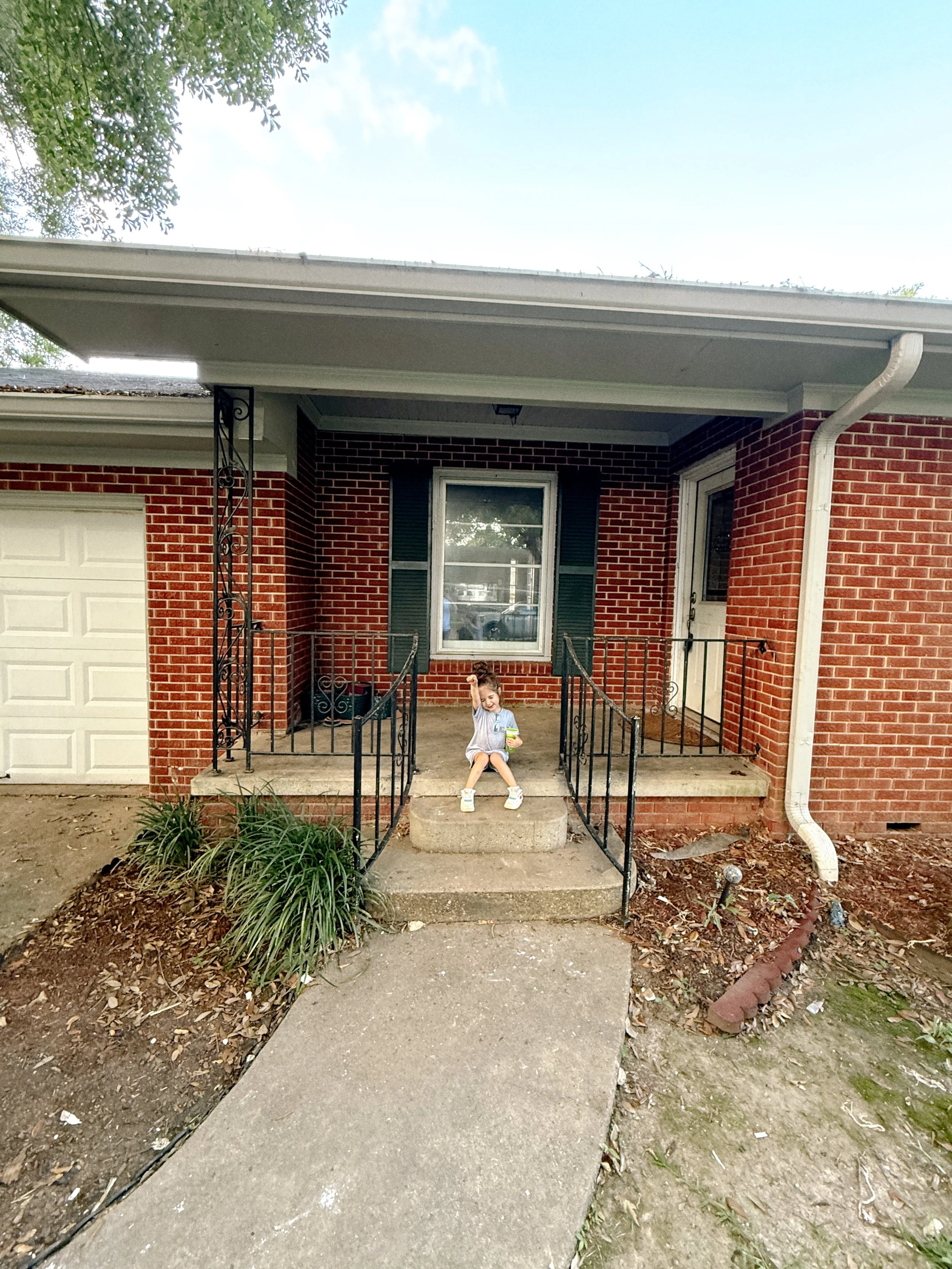
Future project manager vibes. Teche’s tiniest fan staking her claim on the porch before we even picked paint colors.
The Parts You Can't Undo—Now Done
We’re officially past “demo looks worse than it started,” and well into strategic chaos. The bones are stronger, the flow’s clearer—and we might have stumbled into literal bathroom daylight. Here’s your deep dive into the latest chapter at 105 Teche.
This phase is where most flips either start sinking or start making sense. For us? It’s the latter. We're laying the groundwork for something that looks effortless but is anything but. Every beam, every floorboard, every color swatch—it’s all part of the plan.
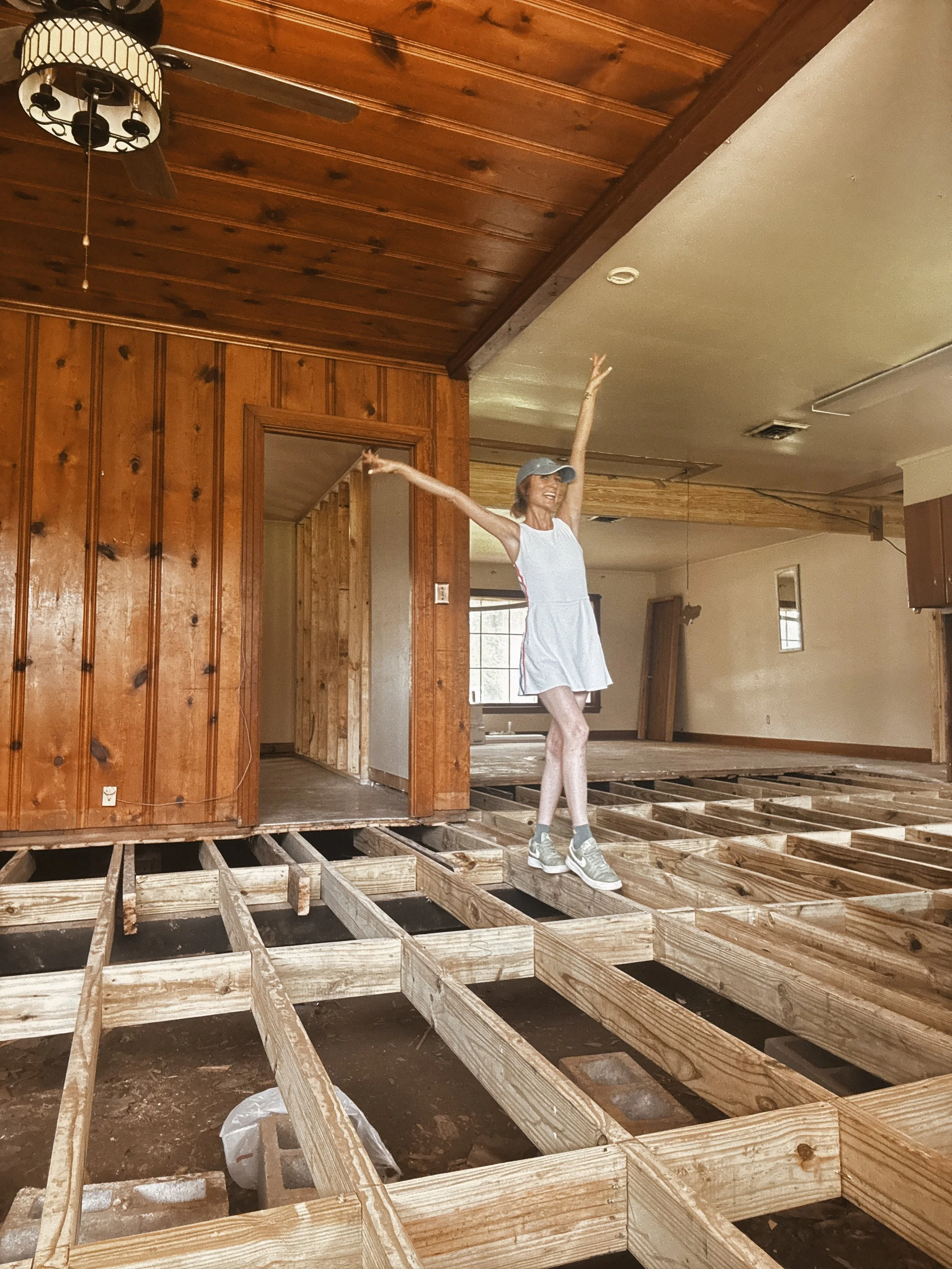
Built Different (Literally): The Foundation Overhaul
First thing we tackled? The literal foundation. We went full overhaul—ripped out every questionable board and rebuilt from the dirt up. It’s now level, sound, and ready for the next 50 years (or just a very chic resale). Not the sexiest part of a flip, but definitely the smartest. No more soft spots or “should this floor bounce?” moments.
A solid foundation doesn’t just mean safety. It means you can design without fear. Add tile without cracking. Move walls without guessing. Hang art where it should go, not just where studs happen to be. Trust—it’s worth it.
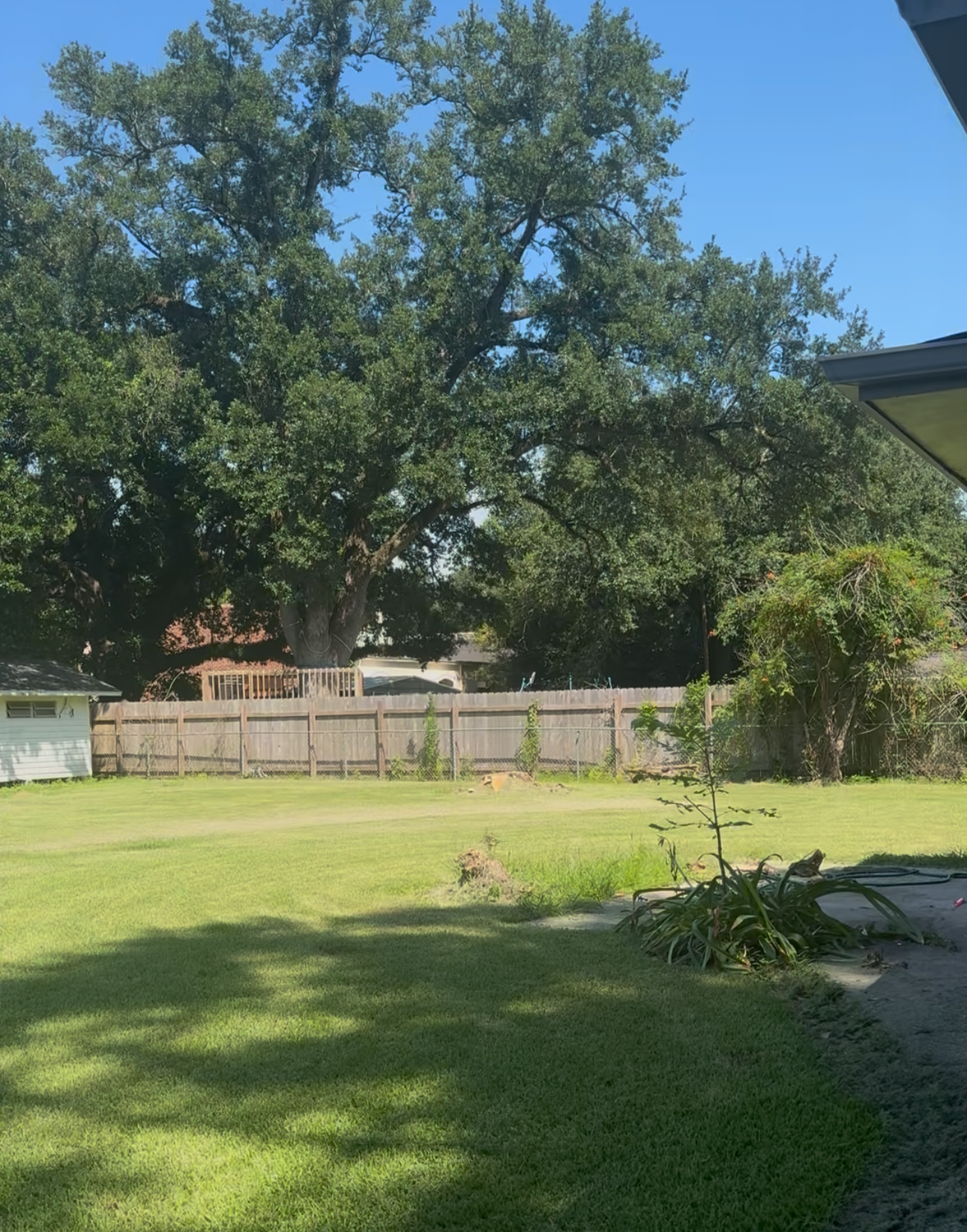
Yard Cleared. Vision Loading.
We finally said goodbye to the rogue tree stumps that were threatening to trip everyone who dared to enter. The yard has been fully cleared, leveled, and prepped for future landscaping—aka actual usability. It’s now giving “afternoon garden party” instead of “survival training course.”
Clearing the yard also made it easier to visualize the exterior’s future. Think garden beds, string lights, a gravel dining area, maybe even a vintage metal bistro set. We’re not overdoing it, but we’re definitely not letting this space be basic.

First draft of new floor plan for 105 Teche
Layout, Leveled Up: We Built a Real Third Bedroom (and a Non-Cursed Bath)
The old layout was doing the bare minimum. We’ve reframed the third bedroom and carved out a completely new space for the second bathroom—moving it from its former awkward situation inside the laundry room to a much more logical and functional location. Think thoughtful flow, modern layout, and way better vibes.
The third bedroom instantly ups the resale appeal, especially for second-home buyers or small families. It’s compact but intentional—no wasted square footage. The new bathroom location also brings symmetry to the home, making it more livable without tacking on unnecessary additions.

AI rendering of the space, not actual design plan.
Kitchen + Living Room Now Speaking Fluently
The major wall between the kitchen and living area? Gone. We installed a sleek support beam that holds everything up without cramping the open-concept style. The space now breathes. It’s brighter, more social, and finally feels like a space someone would actually want to live in.
Removing that wall changed everything. The natural light travels farther. The furniture layout options just multiplied. It no longer feels like three separate boxes—it feels like a home. The support beam gave us function and form, and it’s kind of the unsung hero of the flip so far.
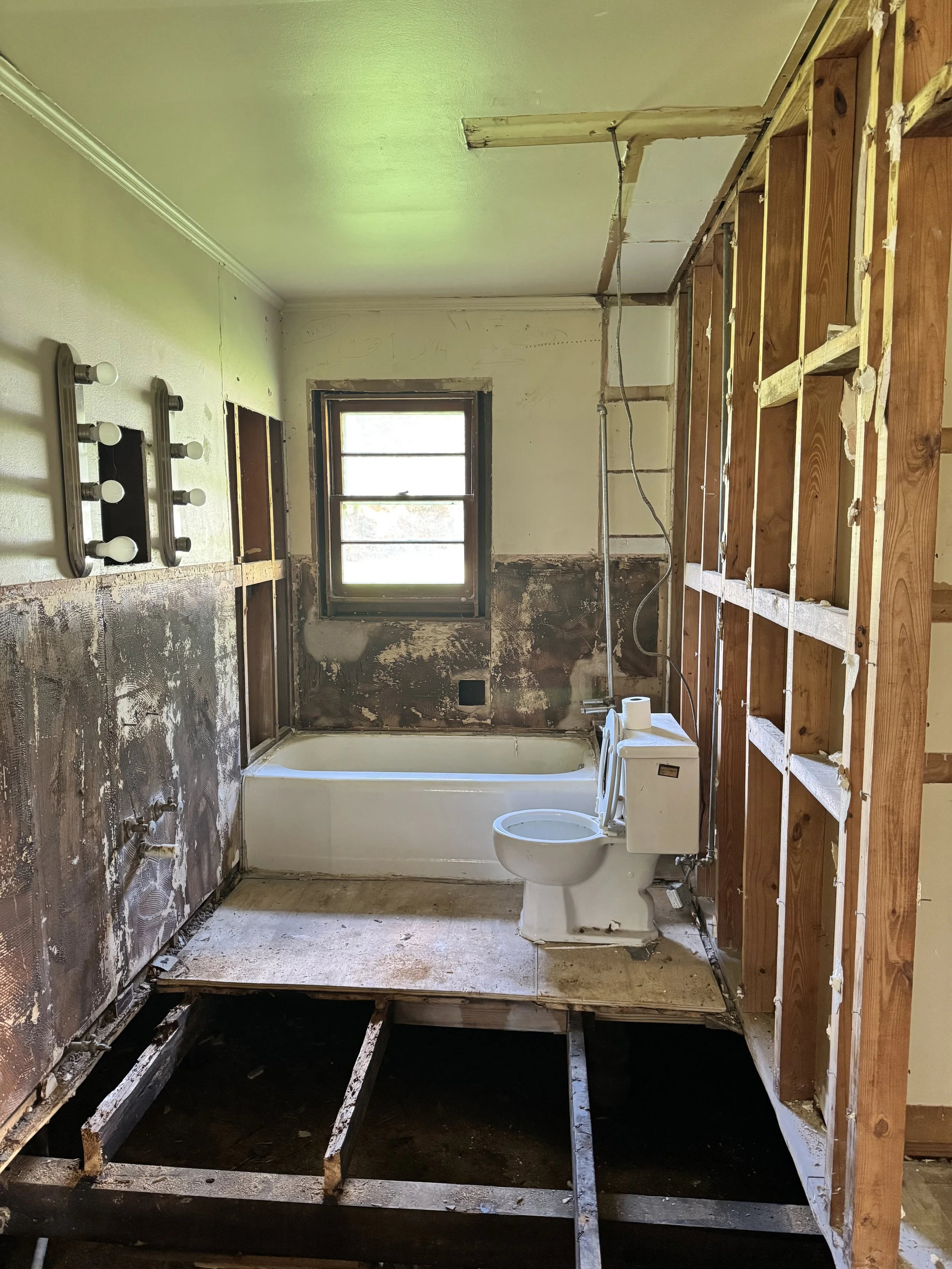
Surprise! Natural light in the primary bath is now in the cards.
Demo Surprise: A Window We Didn’t Know We Needed
During bathroom demo, we uncovered what can only be described as a hidden gem: a completely covered-up window behind the old shower wall. It’s now a highlight in the future master bathroom plan—bringing in soft, natural light and instantly elevating the space. Sometimes demo gives back.
Finding that window shifted our entire bathroom design strategy. It gave us permission to lean into light tones and textures instead of compensating for a dark, moody space. Expect a spa-like layout with modern cottagecore undertones—brass fixtures, leafy textures, clean tile lines, and maybe a framed print that says something cheeky.
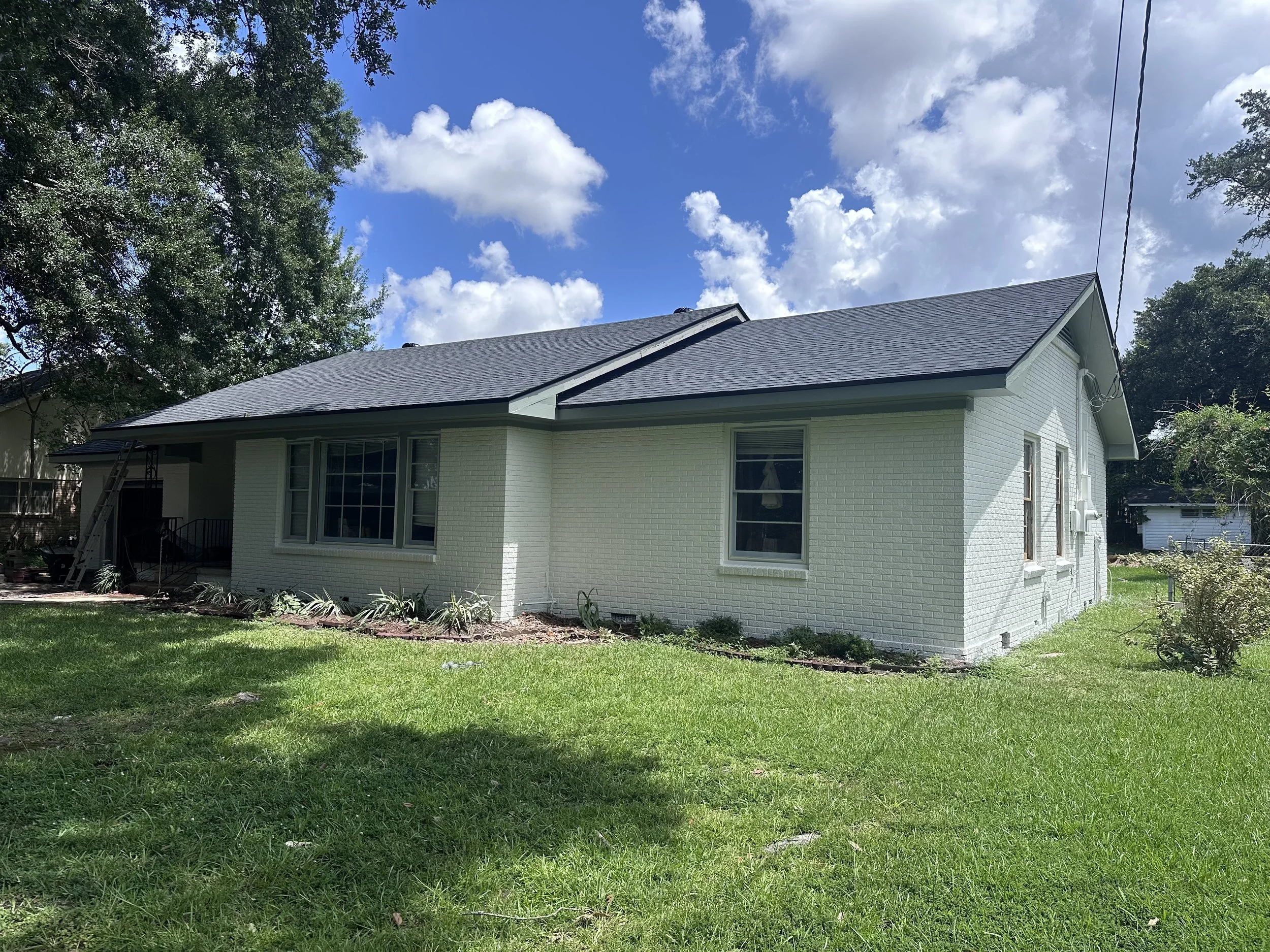
Fresh paint, a brand new roof, and major curb appeal—105 Teche’s glow-up is officially in motion. Greek Villa + Evergreen Fog never looked so good.
Teche Gets Dressed: Greek Villa Meets Evergreen Fog
We’ve officially chosen exterior paint colors and yes—they’re perfect:
Brick: Sherwin-Williams Greek Villa (SW 7551) – a warm, creamy white that reads timeless
Trim/Shutters/Ceiling: Sherwin-Williams Evergreen Fog (SW 9130) – a calming, muddy sage that feels earthy and modern all at once
It’s soft, inviting, and just the right amount of elevated. Very much “Lafayette traditional meets design-forward curb appeal.”
Painting the exterior is one of those moments where the house finally starts looking the way it feels. The palette is subtle but intentional—neutral enough to sell, distinct enough to stand out. Once it’s painted, it’s going to turn heads in the best way.
We’ve also installed a brand new roof. It’s not a flashy update, but a fresh roof equals clean lines, better insulation, zero leaks, and solid resale value. Sometimes boring is beautiful.
The current roof was holding—but barely. The new one ties the exterior together, quiets the house down, and just feels better. You don’t think about a roof when it’s done right. And that’s the goal.
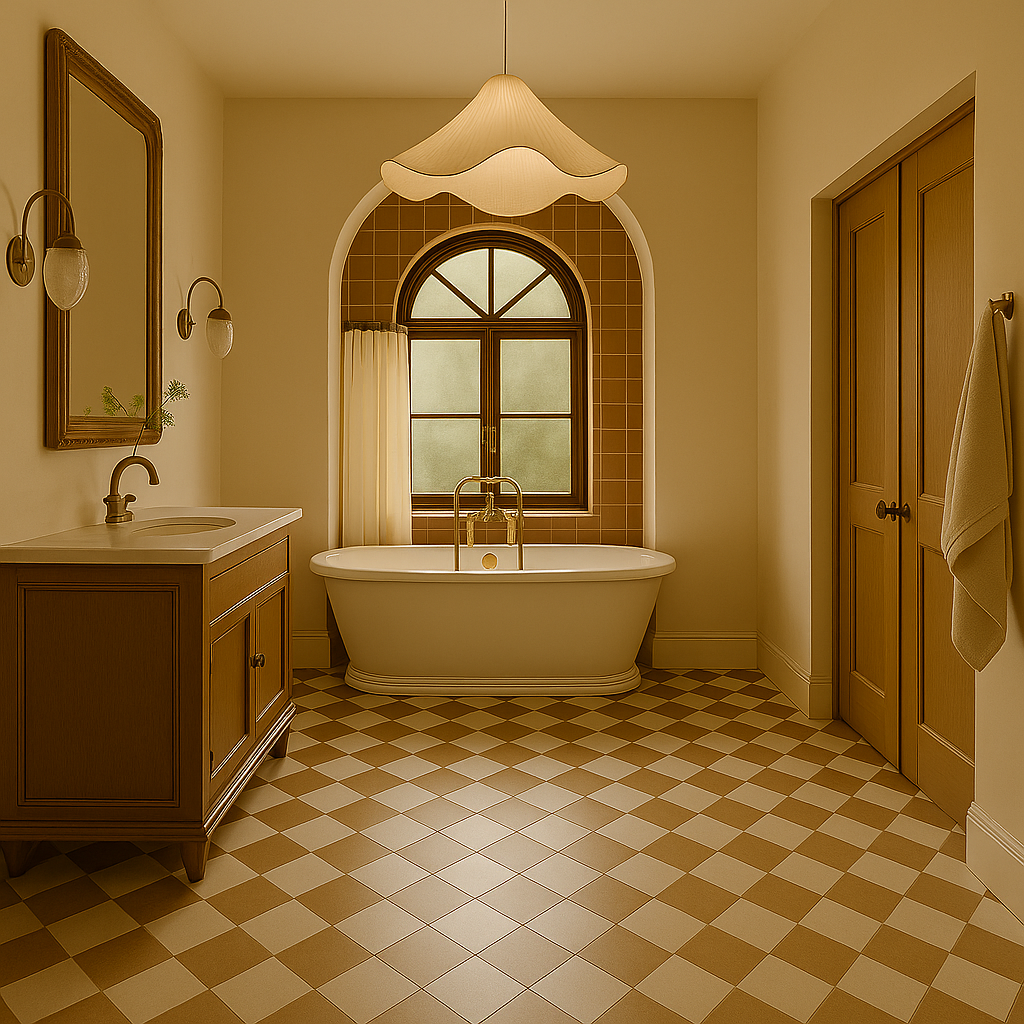
A little photoshop imagination of the primary bath—mood, not blueprint. Expect warmth, curves, and cottagecore energy.
Plotting the Primary Suite: Smart Storage, Better Flow & No Weird Plumbing
With the bathroom now completely demoed, we’re officially in the planning phase for the new primary suite. The goal? A layout that actually works—zoned spaces, hidden storage, and brassy fixtures that feel vintage without the weird plumbing. We’re mapping everything out to maximize light (shoutout to the surprise window), optimize flow, and build in comfort without unnecessary square footage bloat.
We’re sketching out vanity placement, debating tile finishes, and figuring out if we can sneak in a linen closet without sacrificing breathing room. This is where the flip starts to feel personal—even if it’s for a future buyer.
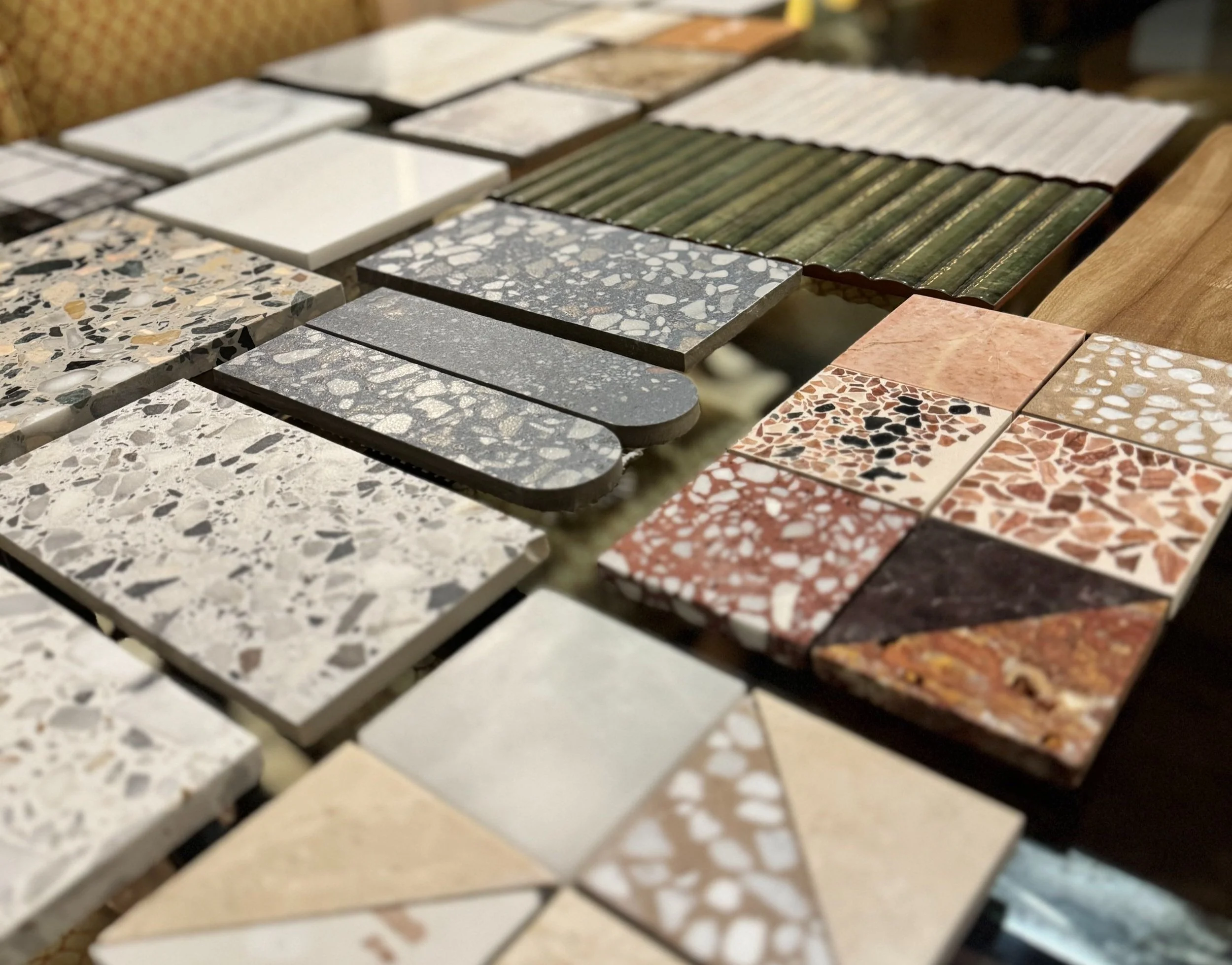
The Flip’s Coming into Focus
This stage is less about Pinterest and more about priorities. It’s dusty, it’s structural, and it’s setting the stage for the finishes to shine. The big moves are done. The framework is in. Now we get to start layering in the charm.
Every choice now builds toward the reveal—the vibe, the livability, the resale moment. We’ve done the heavy lifting. Now it’s about doing the right pretty.
Q+A
-
We’re blending modern function with cottagecore charm—think natural textures, vintage-inspired finishes, brass details, and a floor plan that actually makes sense. It's Lafayette-traditional meets Pinterest-saved-with-intent.
-
We chose Sherwin-Williams Greek Villa (SW 7551) for the brick—creamy, timeless, and soft—and Evergreen Fog (SW 9130) for the trim, shutters, and porch ceiling. It’s organic, neutral, and very Lafayette-front-porch-chic.
-
We opened up the wall between the kitchen and living room, added a structural support beam, reframed the third bedroom, and relocated the second bathroom to a better spot within the main footprint. It flows now—without adding extra square footage.
-
While demoing the old master bathroom, we found a fully covered window behind the shower wall. It’s now a major design feature, bringing in natural light and completely changing the feel of the future primary suite. A literal bright spot.
-
We’re designing a functional, stylish suite with great flow, smart storage, and vintage-inspired finishes. Expect brassy fixtures, earthy textures, and a layout that feels custom without the custom-home price tag.
-
Every decision is a mix of what looks good and sells well in Lafayette. We’re preserving original charm (like wood cabinets), using timeless materials, and skipping low-ROI upgrades (like luxury appliances or major structural additions).
-
Because laundry room bathrooms are NOT it. The new layout puts the bathroom in a proper location, improves flow, and makes it actually usable for guests or future homeowners.
-
New roofs aren’t glamorous, but they’re essential. The updated roof will improve energy efficiency, resale appeal, and peace of mind—plus, it ties the entire exterior upgrade together.
-
Anyone who wants a space that feels intentional, looks good, and doesn’t require a full-on renovation just to function. It’s stylish, practical, and move-in ready—with enough charm to stand out and enough comfort to settle in. It’s ideal for anyone who appreciates good design without the pressure of doing it themselves. It’s cozy, practical, and pretty—in that order.

Design Plans, Delusions, and My First Lafayette Flip
Just closed on my first Lafayette flip at 105 Teche Drive—and let’s just say, it’s about to go from “wait, what?” to wow. I’m keeping the good bones (hello, original cabinets) and reworking the rest with a vibe that’s somewhere between earthy cottagecore and cool, clean modern. If you’re into smart space planning, bold-but-budget-aware design, and behind-the-scenes renovation chaos—you’ll want to follow this one.

Big news from 105 Teche Drive!
Blaise Verret, a fellow Lafayette Realtor, and I have officially teamed up to embark on a house flip that’s part grit and part artistry, designed to marry modern living with timeless charm. This is the first of its kind for us, and as the project unfolds, we’re excited to share every intentional choice, creative curveball, and practical upgrade planned for the space. If you’ve been following along on my social media, you’ve already seen the video and those shining before shots—it’s real. Today, I’m sharing the grounded design plans, the fun delusions creeping in, and why every choice matters to Lafayette buyers like you.

The Real Talk: What I’m Actually Doing
Preserving Character and Timeless Details
When you walk into a home, it speaks to you. For 105 Teche Drive, it was whispering, "Keep me grounded, I’ve got a history you can’t manufacture." That’s exactly what we plan to do.

Original Wood Kitchen Cabinets
These solid, mid-century beauties just needed a little love. Modern kitchens are often dominated by cookie-cutter cabinet sets, but these wood cabinets bring warmth, individuality, and a nod to Lafayette’s personality. A fresh stain or a soft matte finish will give them a new lease on life while keeping their vintage appeal intact.

Ceiling + Wall Wood-Paneling
Far from the dark paneling of decades past, these walls are textured, elegant, and steeped in nostalgia. Paired with updated lighting and lighter accents, it promises to exude intentional design rather than basement rec-room vibes.
Preservation like this isn’t about budget shortcuts; it’s about celebrating the bones of the home.

Maximizing Space with Smarter Planning
With 1,650 sq. ft. to play with, the challenge was ensuring the existing layout worked for today’s lifestyle. This flip is a study in floorplan optimization. Every room serves its purpose, and every adjustment adds functionality without unnecessary square footage.
Reconfiguring the Primary Suite
We’re converting the current layout into a more substantial primary suite. Think walk-in closet and a bathroom designed to pamper. It’s a space that says, “Welcome home; you earned this.”
Relocating the Second Bathroom
Right now, the second bathroom awkwardly lives in the laundry room, and to call it a bathroom in its current condition is a stretch. The fix? Relocating it into the living area footprint. Every square inch will now add value for both daily living and resale.
By optimizing the use of space, we’re proving that it’s not about how much square footage you have, but how well you use it.

The Design Direction
Every decision bubbles up to a central design ethos. At 105 Teche Drive, we’re merging modern freshness with cottagecore home style, creating a finished product that is both aspirational and accessible.
Here’s how we’re doing it:
Color Palette: Warm whites and muted taupes provide a clean canvas, while sage greens and soft blues keep it serene. An occasional moody contrast (charcoal or navy) will add depth.
Brass Fixtures: Hardware and light fixtures channel vintage sophistication. Imagine the kind of brassy glow you’d find in an old Paris café, updated for today.
Timeless Elements: Tile shapes and patterns that never feel dated, combined with textures that invite you to touch every surface.

The Mulligan List
If the Budget Stretches, Here's the Wish List
Checkerboard Floors: What’s more Instagram-worthy than modern checkerboard floors in the kitchen and laundry? They’re timeless yet trendy, making both spaces feel vibrant and inviting.
Statement Granite Kitchen Island: The kitchen island will act as the star of the show. With a bold granite slab, it’s the place where morning coffee, weekend baking, and family dinners all come together.
Wallpaper Accents: Picture an ornate vintage-inspired print behind the bed in the primary suite or on a statement wall in the dining area. It’s the kind of detail that people won’t forget.
Timeless Tile Trends: We’re bringing in both function and flair with elegant, clean lines for the shower tile and backsplash. These are touches that age gracefully yet feel utterly fresh.
If we can pull these off within the budget, they’ll add serious personality while delivering a high return on investment.
None of these are dealbreakers, but if we land under budget or feel the ROI is there, these are ready to be greenlit.

The Nope File
What’s Not Worth It (for This Flip)
Every great flip requires hard decisions about what NOT to pursue. For this project, a few ideas are landing firmly in the "nope" category, and here’s why.
A 2-car garage expansion: While nice-to-have, expanding the garage ultimately isn’t worth it. Permitting is painful, the roofline shift is $$$, and costs would strain the budget without offering much in resale ROI.
Refinishing original wood floors: I wanted to love them, but they’re too far gone. The labor and cost outweigh the aesthetic reward. It’s better to replace them with new flooring that honors the home’s charm in a way that yields a higher quality result for the future buyers.
Viking appliances: Stunning? Yes. Necessary? Not even close. Most buyers want reliability and decent brand names, not ultra-luxury labels. Instead, we’ll focus on stylish yet accessible options that appeal to a wider pool of buyers.

105 Teche Drive, Lafayette, LA 70503
Why 105 Teche Drive Matters for Lafayette Buyers
What makes 105 Teche Drive special isn’t just in the details we’re putting into it; it’s in the people we’re designing for. From young professionals to first-time homeowners and seasoned buyers seeking a charming second home, this flip is built for those who want balance.
Dream Features + Practical Design: Thoughtfully planned upgrades ensure the home feels indulgent and functional all at once.
A Space for Everyone: Whether you’re relaxing in your upgraded primary suite or hosting a garden barbecue in the massive backyard, every space serves its best purpose.
This isn’t just another flip; it’s an opportunity to enhance how people in Lafayette live and connect with their space.

Have Your Say (And Follow Along!)
Here’s the rundown for 105 Teche Drive so far:
Preserving the authenticity and charm of its bones (hello, original wood cabinets)
Optimizing every square inch for smarter living (floorplan optimization is key)
Dreaming big with features like checkerboard floors and statement granite
Infusing the perfect balance of modern and cottagecore aesthetics
Have thoughts about our approach? Questions about the process? Or maybe you just want a sneak peek at the next step? Drop your comments below or sign up for our newsletter below. I’m sharing insider details, behind-the-scenes progress, and plenty of design debate moments throughout. Come along for the ride, and who knows? Your input might just inspire the final look.
FAQs
-
Our goal is to be market ready by fall. August 1 is the ideal completion date, but September 1 wouldn’t have us pulling our hair (or each other’s) out.
-
These cabinets are full of character and craftsmanship. Refurbishing them not only stays true to the home’s original character, but also frees up valuable materials dollars that are better utilized for the luxury finishes that you’re bound to fall in love with. :)
-
Cottagecore is about soft palettes, natural materials, and cozy, nostalgic vibes that make spaces feel warm and lived-in.
-
Absolutely. A smarter and more functional layout makes the home feel larger, more practical, and more desirable to future buyers.
-
Yes! Track progress on Instagram, Facebook, or subscribe to our Flip newsletter!