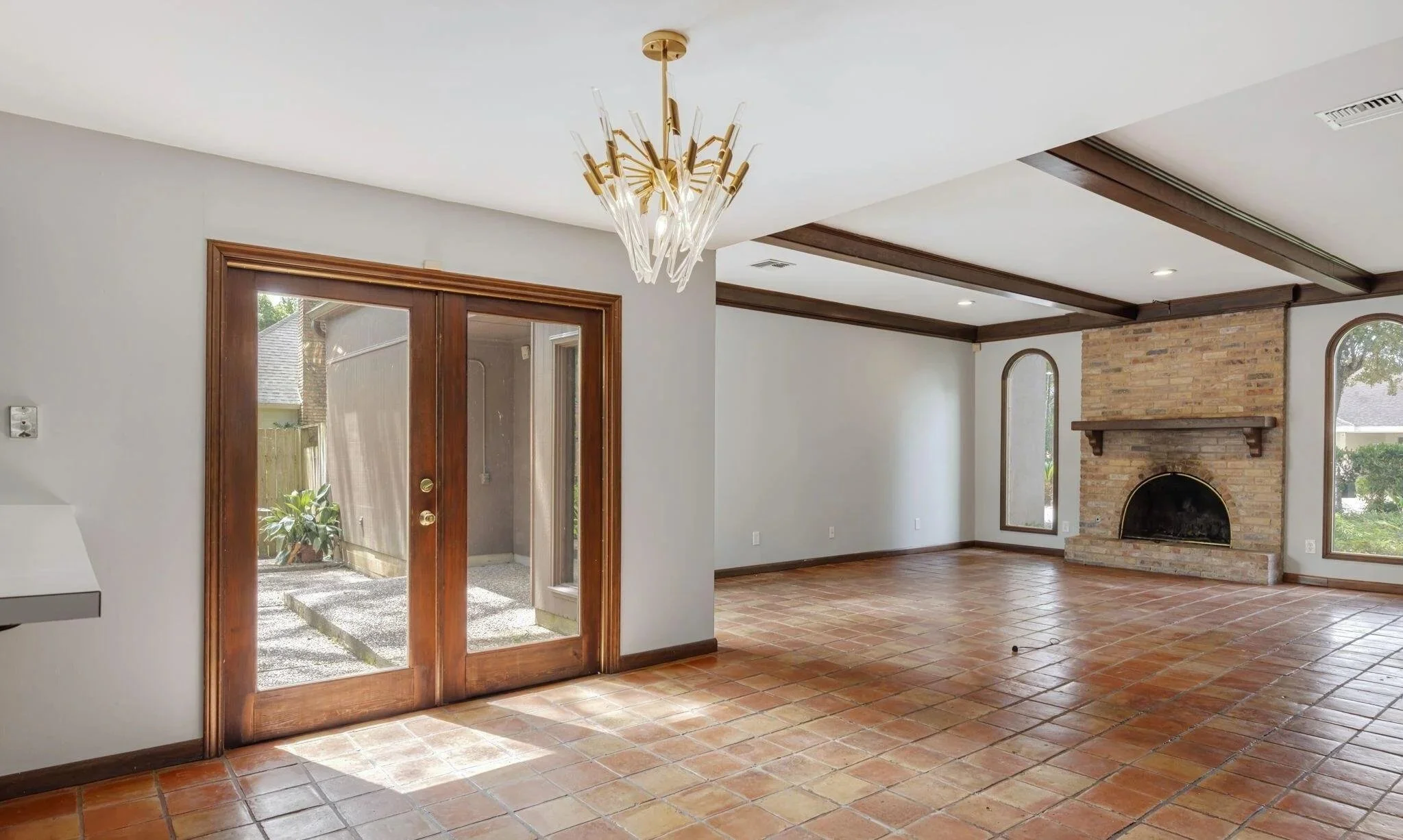
Selling or renting out 110 Cedar Mound Ln (worth $205,000, paid off) while buying 315 N Demanade Blvd for $295,000 — every option, in plain English.
🔑 Important update: he has already left his job. That means borrowing from the 401(k) is no longer possible — plans only lend to current employees. The money is still there (~$135,000), but taking it out now means a withdrawal. At withdrawal, ~35% is skimmed off (22% federal + 3% Louisiana + 10% penalty) — but be fair about what's actually "lost": the ~25% income tax is owed whenever this pre-tax money comes out, now or at retirement. The only truly extra cost of taking it early is the 10% penalty — plus the years of tax-deferred growth the money gives up.
Path 1 — Sell the old house
Selling costs eat 7%, but you walk away with a big pile of cash to put toward the new house.
$190,650
cash in hand after selling ($205,000 − 7% costs)
Path 2 — Keep it & rent it out
No cash from a sale, but a tenant pays you every month — which offsets most of your new mortgage.
+$1,167/mo
rent minus taxes, insurance & HOA (before repairs/vacancy)
1 · How much cash do you need on closing day?
Down payment + 3% buying costs. The black line marks your $190,650 of sale proceeds (Path 1 only).
1A SELLFHA · 3.5% down
$19,175
1B SELLConv · 5% down
$23,600
1C SELLConv · 20% down
$67,850
1D/1E/1F SELLConv · 65% down
$200,600
2A–2C RENTsame loans, no sale money
$19k–68k
⚠ 65% down falls $9,950 short of the sale proceeds. Three ways to plug it: 1D plain savings ($9,950) · 1E 401(k) withdrawal (must pull out $15,308 — $5,358 evaporates in tax & penalty) · 1F a HELOC bridge (~$75/mo interest, but it's repaid from the sale at closing — it buys timing, not money).
Path 2 has no sale proceeds, so closing cash comes from savings — or from the two tools in section 6.
2 · What's the monthly payment on the new house?
Every bar is the full bill: loan payment + property tax + insurance + mortgage insurance (the penalty for small down payments).
Principal & interestPMI / FHA MIPProperty taxInsurance
FHA 3.5% down6.00% · scenarios 1A/2A
$2,341
Conv 5% down6.25% · scenarios 1B/2B
$2,328
Conv 20% down6.25% · 1C/2C/3A/3B
$1,927
Conv 65% down6.25% · 1D/1E/1F
$1,110
The red slice = mortgage insurance, an extra fee only charged when you put down less than 20%. FHA's version (~$130/mo) lasts the life of the loan. Conventional PMI (~$128/mo) automatically drops off around year 9. Put 20% down and it disappears entirely.
3 · If you keep the old house, what does the rent actually earn?
$1,600 of rent doesn't all reach your pocket — the house still has its own bills.
$1,600rent collected
−
$167property tax*
−
$242landlord insurance
−
$25Wells Landing HOA
=
$1,167net per month
*Tax goes up when it becomes a rental (~$1,270 → ~$2,002/yr) because Louisiana's homestead exemption moves with you to the new house. Plan on ~$927/mo after setting aside 15% for vacancies and repairs — tenants leave and water heaters break.
4 · The bottom line: your true monthly housing cost
New-house payment, minus rent received, plus any HELOC payment. Red text = one-time 401(k) tax-and-penalty hit, paid once at withdrawal.
1A SELLFHA 3.5%
$2,341
1B SELLConv 5%
$2,328
1C SELLConv 20%
$1,927
1D SELL65% · gap from savings
$1,110
1E SELL65% · gap from 401(k)
$1,110−$1,531 true penalty*
1F SELL65% · HELOC bridge
$1,184until sale closes
2A RENTFHA 3.5%
$1,175
2B RENTConv 5%
$1,162
2C RENTConv 20% · $67,850 savings
$761
3A 401kRent · 20% from withdrawal
$761−$10,438 true penalty*
3B HELOCRent · 20% from HELOC
$1,270
Purple = HELOC payment ($509/mo interest-only in 3B; ~$75/mo in 1F while the bridge is open). Lighter tips = the ~$240/mo vacancy-and-repairs cushion you should budget. *"True penalty" = the 10% early-withdrawal charge only. The withdrawal also pays ~25% income tax up front ($26,096 in 3A / $3,827 in 1E), but that tax is owed whenever the pre-tax money comes out — early withdrawal just pays it sooner. The real extra costs of early: the 10% penalty + decades of lost tax-deferred growth.
💡 Cheapest month-to-month: 2C and 3A tie at $761/mo. 3A's honest price tag: a $10,438 pure penalty (the ~$26k of income tax was coming out of that money eventually regardless) — plus pulling ~$104k out of tax-deferred compounding decades early. If the $67,850 isn't sitting in savings, weigh 3A's one-time $10.4k penalty + lost growth against 3B's $509/mo HELOC interest with retirement untouched — 3B breaks even on the penalty alone in ~20 months, but keeps the compounding, which is the bigger prize over 30 years.
5 · What's left in your pocket after closing?
Path 1 only — the trade-off for a lower payment is handing more of your sale money to the bank.
1AFHA 3.5%
$171,475
1BConv 5%
$167,050
1CConv 20%
$122,800
1D65% · savings
−$9,950
1E65% · 401(k)
−$15,308 from 401(k), incl. $5,358 burned
1A keeps the most cash but has the highest payment (and permanent FHA mortgage insurance). 1C is the classic middle ground: no PMI, six figures still in the bank. The 65% options only make sense if minimizing the monthly payment matters more than everything else.
6 · The two "unlock the cash" tools — after leaving the job
Both can reach the 20% down payment ($67,850 with costs) without selling the old house. They are no longer close cousins.
3A · 401(k) withdrawal PRICEY — BUT LESS THAN IT LOOKS
Loans are only for current employees — he left, so the only access to the ~$134,000 balance is withdrawal. To net $67,850 he pulls out $104,385. Of the $36,535 skimmed off:
$26,096 = deferred tax he owes eventually anyway
$10,438 = the true early-withdrawal penalty (10%)
Pre-tax 401(k) money is always taxed on the way out — at 59½ or now. The 10% penalty is the only charge unique to taking it early. (20% federal withholding applies up front; square up at tax time.)
No monthly payment — withdrawals aren't repaid
~25% of the tax bill was never really "his" money — it was always the IRS's deferred slice
The 10% penalty ($10,438) is pure loss — nothing is received for it
Timing risk: taxed at today's 22–24% bracket vs. likely lower brackets in retirement, and a $104k lump likely spills into 24%
~$104k stops compounding tax-deferred — at 7%, that's roughly $800k of forgone value by a retirement 30 years away
No home-purchase exception exists — and the IRA $10k homebuyer exception doesn't apply (he owns a home)
3B · HELOC on the paid-off house BETTER TOOL
110 Cedar Mound is debt-free; a credit line at 75% of value offers up to:
$153,750
Draw $67,850 → interest-only payment of $509/mo (9%, variable). Covers 100% of closing cash and the 401(k) stays whole.
Rental income (~$1,167/mo) more than covers the payment
Retirement keeps compounding untouched
Open it before moving out — rental-property HELOCs are capped lower and priced worse
Requires documented income to qualify — if he's between jobs (not just switching), this is the first hurdle
And the small $9,950 gap in the 65%-down sale plan?
Ranked cheapest to priciest: 1D savings ($9,950, costs nothing extra) → 1F HELOC bridge (~$75/mo until the sale closes; remember it's repaid from the sale proceeds, so it solves timing, not the shortfall itself) → 1E 401(k) (withdraw $15,308 to net $9,950 — the true extra cost is the $1,531 penalty; the other $3,827 is income tax that was due on that money whenever it came out). Still: if $9,950 of savings isn't available, consider whether 65% down is the right target at all — 1C at 20% down keeps $122,800 liquid.